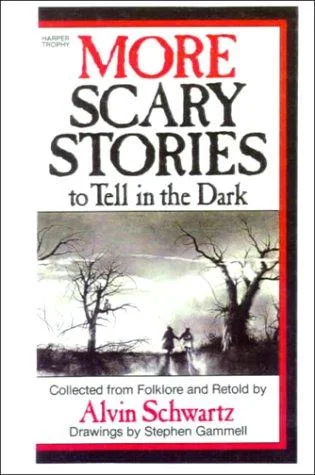
More Scary Stories to Tell in the Dark
- Publication Date:
- October 1st, 1999
- Publisher:
- Tandem Library
- ISBN-13:
- 9780808579953
- ISBN-10:
- 0808579959
Why More Scary Stories to Tell in the Dark Has Been Challenged
Critics have pushed back against handing children a book whose explicit purpose is to frighten them, arguing that the stories' content is simply too intense for the age group that picks it up. See more ↓
Challenged or banned in 1 state across 1 school district.
Overview
More Scary Stories to Tell in the Dark continues Alvin Schwartz's project of gathering frightening tales from American folklore and oral storytelling traditions into a single collection aimed at young readers. The book mixes old campfire staples with newer, more contemporary horror, pulling together ghosts, witches, and vampires alongside the kind of "jump" stories built around a sudden scare at the very end.
Rounding out the collection are a handful of scary songs, a reminder that Schwartz treats fright as something passed down and performed, not just read silently on the page. The variety of forms, spoken tale, song, and short sharp shock story, reflects his interest in horror as a living folk tradition rather than a fixed literary genre.
As a follow-up to his first scary stories collection, the book extends the same approach: short, stripped-down narratives meant to be told aloud, heavy with atmosphere and built for maximum unease in minimal space.
Horror as Inherited Tradition
What distinguishes Schwartz's work from much children's horror is its grounding in folklore scholarship. He was a folklorist by training, and his scary stories collections function as much as cultural preservation as entertainment, drawing on regional legends, campfire tales, and urban myths that had circulated informally for generations before he set them down in print. The book's blend of ghost lore, witch tales, and vampire stories situates American childhood fear within a much older lineage of oral storytelling found across cultures.
The inclusion of "jump" stories and songs also points to something structural: these are texts designed for performance, not quiet reading. A story meant to end in a shout, or a song meant to be sung with mounting dread, only fully works between a teller and a listener. That performative quality helped make the collection a staple of sleepovers, classrooms, and libraries, where its stories were as often recited as read. It also helps explain the book's broader place in Schwartz's career: he was already an established writer of folklore and wordplay for children before turning to horror, and this volume cemented that reputation, becoming inseparable from the illustrated editions that gave the stories their visual intensity.
Why More Scary Stories to Tell in the Dark Has Been Challenged
A recurring complaint from parents and school officials is that the book's stories are simply too frightening for the children who are most likely to encounter it on a library shelf, with specific tales singled out as capable of causing nightmares or lasting anxiety in young readers. Some objections center on the collection's treatment of death and violence, arguing that scenes involving ghosts, witches, and vampires dwell on macabre or grotesque imagery without the softening context that might make the material appropriate for a children's or middle-grade audience.
Other challenges have framed the book as poorly suited to its shelving location, contending that material this intense belongs, if anywhere, in a section aimed at older readers rather than general children's or elementary collections. Across the single state and single district where a formal challenge has been recorded in this catalog, the underlying concern has been consistent: that the book's commitment to genuine fright, rather than mild spookiness, crosses a line for its intended audience.
Where to Buy


Affiliate links may generate a small commission at no extra cost to you, which helps support this site.
Banned in Schools
Banned or challenged in 1 state across 1 school district.
Florida 1 district
- Clay County School District Banned pending investigation