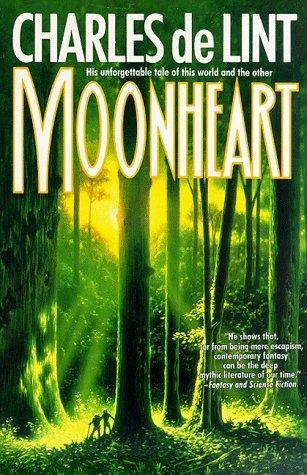
Moonheart
- Publication Date:
- May 1st, 1992
- Publisher:
- Tor Books
- ISBN-13:
- 9780812516227
- ISBN-10:
- 0812516222
Why Moonheart Has Been Challenged
Some readers have pushed back against the novel's treatment of magic and folk-spiritual practice as active forces within an otherwise ordinary modern setting, rather than as clearly fictional embellishment. See more ↓
Challenged or banned in 1 state across 1 school district.
Overview
Moonheart is Charles de Lint's early and enduringly influential entry into what would come to be called urban fantasy — fiction that folds myth, magic, and the otherworldly into a recognizable modern city rather than a invented secondary realm. Set largely in and around Ottawa, the novel treats the contemporary world as a thin membrane stretched over something older and stranger, an approach that became a hallmark of de Lint's career and of the genre he helped popularize.
Rather than building its fantasy from scratch, the book draws on existing folk traditions — Celtic lore chief among them — and lets them surface within ordinary settings: apartments, back rooms, city streets. That collision of the mundane and the mythic gives the story its particular texture, one that resists easy separation into "real world" and "fantasy world" chapters.
The result is a novel frequently cited as a touchstone for readers and writers of contemporary fantasy, valued less for plot mechanics than for the atmosphere it conjures: a sense that magic has never really left the modern city, only gone quiet.
A Genre Finding Its Voice
Moonheart arrived at a moment when fantasy was still largely defined by pastoral, medieval-inflected secondary worlds, and its insistence on grounding magic in a specific, mapped, present-day city was something of a departure. That choice — myth as neighbor rather than as distant kingdom — is part of why the novel is still discussed as a foundational text of urban fantasy, a genre that would go on to include a wide swath of later fiction, film, and television.
De Lint's broader body of work returns again and again to this same premise, and Moonheart is often treated as the book where that sensibility first fully cohered: the conviction that folklore is not a relic to be studied but a living presence that modern life has merely obscured. Read in the context of the author's career, it functions as an origin point, the novel against which his later, more polished urban fantasies are frequently measured.
Why Moonheart Has Been Challenged
Critically, Moonheart has been treated as a landmark of imaginative fiction, praised for the confidence with which it blends folklore and contemporary setting into something that reads as neither pastiche nor pure invention. The objections raised against it come from a different vantage point entirely, one less concerned with craft than with content. Fantasy novels that depict magic as an active, practiced force — rather than as clearly demarcated make-believe — have long drawn scrutiny from readers who view such depictions as normalizing occult or pagan belief systems, and Moonheart's premise, in which old magical traditions operate openly within a modern city, places it squarely in that category of concern. The book has been challenged or restricted in 1 state and 1 district tracked in this catalog, objections rooted in its supernatural and mystical subject matter rather than in any single passage or scene, reflecting a broader unease some readers hold toward fantasy fiction that treats magic as substantive rather than symbolic.
Where to Buy




Affiliate links may generate a small commission at no extra cost to you, which helps support this site.
Banned in Schools
Banned or challenged in 1 state across 1 school district.
Florida 1 district
- Escambia County Public Schools Banned pending investigation