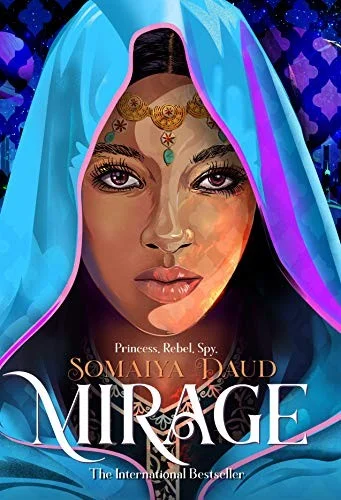
Mirage
by Somaiya Daud
- Publication Date:
- January 1st, 2018
- Publisher:
- Hodder & Stoughton
- ISBN-13:
- 9781473672635
- ISBN-10:
- 1473672635
- Pages:
- 320
Why Mirage Has Been Challenged
Set against a backdrop of imperial occupation and forced political impersonation, the novel has drawn scrutiny less for any single scene than for its sustained focus on coercion, captivity, and rebellion as a young protagonist's daily reality. See more ↓
Challenged or banned in 1 state across 1 school district.
Overview
Mirage introduces Amani, a teenage girl from a moon on the edges of an interstellar empire, whose life is upended when she is seized and forced to become the body double for a princess she resembles almost exactly. The princess she must impersonate is despised by her own people for the brutality of the empire she represents, and Amani is thrust into a palace where every gesture and word could cost her life.
Somaiya Daud builds the story around the tension between Amani's inner world — her memories, her language, her sense of self — and the mask she is compelled to wear in public. The novel follows her as she learns the rhythms of court life, forms uneasy alliances, and discovers that her resemblance to the princess makes her useful not only to the empire but potentially to the very resistance movement working against it.
Drawing on North African and Amazigh cultural traditions, the book roots its far-future setting in specific, lived textures — poetry, tattooing traditions, oral storytelling — rather than treating its world as generic space-opera backdrop. That specificity gives the story much of its emotional and political weight.
A Story of Empire, Identity, and Doubling
Mirage belongs to a tradition of speculative fiction that uses distant settings to examine very present histories: colonization, cultural suppression, and the psychological cost of survival under occupation. The device of the body double is doing double duty here — it is a plot engine, but it is also a metaphor for what colonized people are often asked to do: perform an identity not their own in order to be safe, useful, or simply alive.
The book has been discussed as part of a wave of YA science fiction that centers non-Western cultural inheritance as the emotional core of its world-building rather than as decoration. Amani's connection to her family's poetry and her people's traditions functions as a form of resistance in itself, since the empire she serves has worked to erase exactly those things. Within Daud's broader body of work, the novel set the stage for a duology that continues to follow Amani's shifting loyalties and the costs of the role she is forced to play.
Why Mirage Has Been Challenged
Reviewers and readers have generally praised Mirage for the care of its world-building and for grounding a science-fiction premise in real cultural specificity rather than treating identity as an afterthought, yet in the small number of institutions where it has been formally challenged — one state and one school district in the records tracked by this catalog — reviewers have focused less on craft than on content they judged unsuited to younger readers.
The objections that have surfaced center on the novel's depiction of political violence: forced servitude, the threat and use of torture by an occupying power, and scenes of armed rebellion against that power. Because the story is told from the perspective of a girl coerced into complicity with an oppressive regime, some challengers have also raised concerns about its handling of coercion and the loss of personal autonomy, arguing that the material is emotionally intense for the middle-grade and early-YA audience the book is sometimes shelved alongside. Others have grouped it with broader efforts to remove titles that foreground colonial oppression as a central theme, viewing the political framing itself, rather than any single scene, as the source of concern. Supporters of keeping the book on shelves counter that its handling of these subjects is neither gratuitous nor explicit, and that the novel's portrayal of resistance to occupation is presented through metaphor and character rather than graphic depiction.
Where to Buy




Affiliate links may generate a small commission at no extra cost to you, which helps support this site.
Banned in Schools
Banned or challenged in 1 state across 1 school district.
Florida 1 district
- Escambia County Public Schools Banned pending investigation