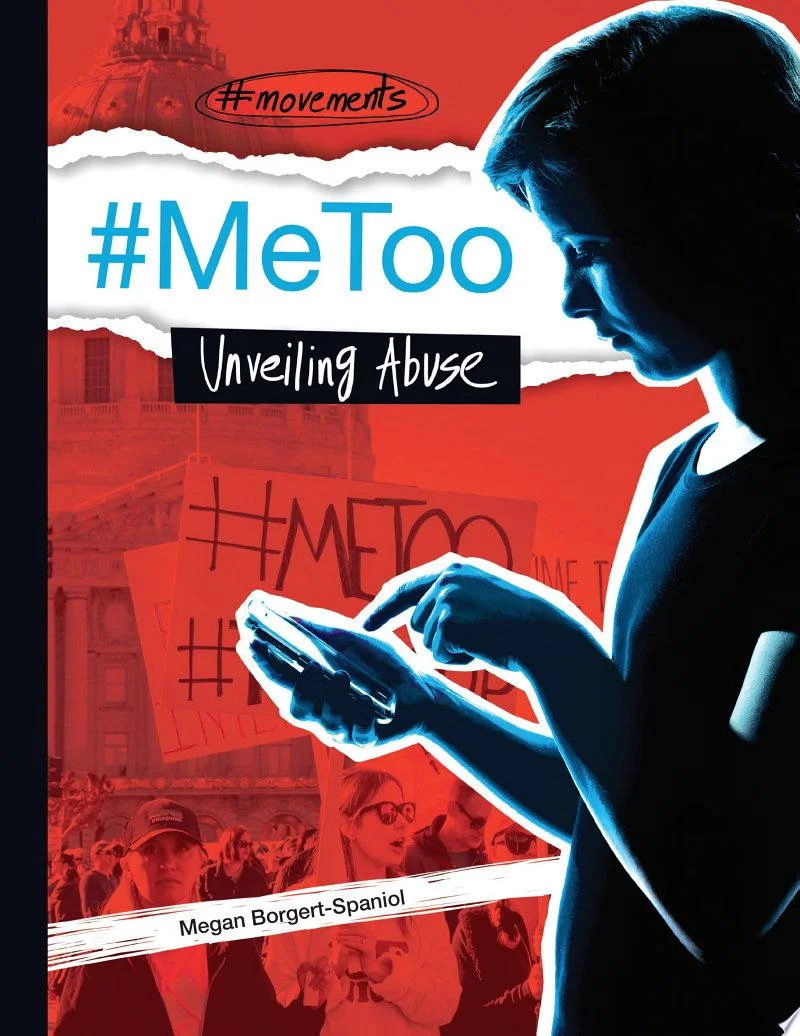
#MeToo: Unveiling Abuse
- Publication Date:
- August 1st, 2019
- Publisher:
- ABDO
- ISBN-13:
- 9781532173776
- ISBN-10:
- 1532173776
- Pages:
- 35
Why #MeToo: Unveiling Abuse Has Been Challenged
Objections to this title center on its subject matter rather than any explicit content within the text itself. See more ↓
Challenged or banned in 1 state across 1 school district.
Overview
This entry in a series of nonfiction titles for young readers traces the arc of the #MeToo movement, beginning with earlier legal efforts to address sexual harassment and moving through the surge of public attention that followed allegations against film producer Harvey Weinstein in 2017.
The book situates that moment within a larger, ongoing effort rather than treating it as an isolated news event. It introduces readers to the "Silence Breakers" recognized for coming forward, the #TimesUp initiative that grew alongside #MeToo, and the people most closely associated with popularizing the hashtag, including Tarana Burke, who coined the phrase over a decade earlier, and actress Alyssa Milano, whose 2017 post helped it spread widely on social media.
Written for a school and library audience, the book is structured to align with Common Core and state academic standards, framing its subject matter as a topic of civic and historical literacy rather than a narrative account of any single case.
Context and Significance
#MeToo: Unveiling Abuse belongs to a wave of educational titles published in the years immediately following 2017, when publishers moved quickly to help young readers make sense of a story dominating the news. Its central challenge is one shared by many books written for children about recent, unresolved social movements: presenting sensitive, adult subject matter—sexual harassment and abuse—in language and depth suited to a school-age audience, while still conveying why the movement mattered and how it changed public conversation.
The book's emphasis on named figures like Burke and Milano, alongside institutional developments such as #TimesUp, reflects an approach common to library nonfiction: grounding a large, diffuse social movement in identifiable people and events so students can trace cause and effect. That structure also makes the book a useful entry point for classroom discussions of media literacy, workplace rights, and the mechanics of how a movement spreads.
Why #MeToo: Unveiling Abuse Has Been Challenged
Objections to this title center on its subject matter rather than any explicit content within the text itself. Because the book addresses sexual harassment and abuse directly, some challengers have argued the topic is inappropriate for the age group targeted by the series, regardless of how the material is presented. Others have raised concerns tied more broadly to discomfort with movement-oriented books that discuss sexual misconduct, treating the subject as unsuitable for a school library collection even in an educational, standards-aligned format. In this catalog, the book has been challenged or restricted in 1 state and 1 school district, reflecting a narrow but notable instance of pushback against nonfiction that introduces younger readers to the #MeToo movement.
Where to Buy




Affiliate links may generate a small commission at no extra cost to you, which helps support this site.
Banned in Schools
Banned or challenged in 1 state across 1 school district.