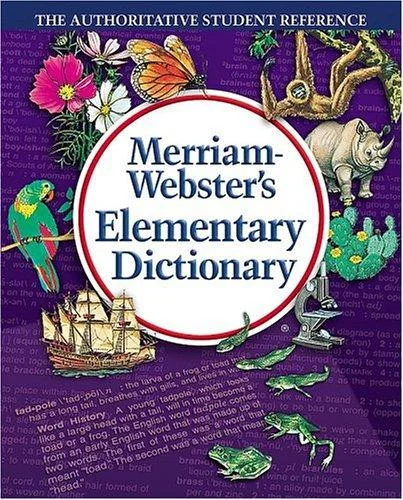
Merriam-Webster's elementary dictionary
- Publication Date:
- January 1st, 1994
- Publisher:
- Merriam-Webster
- ISBN-13:
- 9780877795759
- ISBN-10:
- 0877795754
- Pages:
- 587
Why Merriam-Webster's elementary dictionary Has Been Challenged
A standard reference work has drawn objection chiefly for a handful of entries whose definitions touch on sexual terminology that some parents consider inappropriate for the age group it targets. See more ↓
Challenged or banned in 1 state across 1 school district.
Overview
Merriam-Webster's Elementary Dictionary is a reference work compiled for readers roughly between the third and sixth grades. It defines more than 32,000 words, with entries written to be accessible to young readers while still conveying the range of meanings and typical usages a word can carry.
Beyond the word list itself, the volume includes introductory material meant to teach students how a dictionary works: how entries are organized, how to interpret pronunciation guides, and how to use the book as a tool for building vocabulary and improving writing. This apparatus reflects its purpose as both a reference and a teaching aid, intended for classroom and home use alike.
As with other dictionaries aimed at this age range, the editors faced the task of representing English comprehensively and accurately without excluding words a student might reasonably encounter in reading or conversation.
A Reference Book Caught in a Larger Debate
Dictionaries occupy an unusual place in discussions of school materials. Unlike a novel or a work of narrative nonfiction, a dictionary does not advance a perspective or tell a story; it catalogs the language as it is used, including words and senses that may be uncomfortable for some audiences. This has made elementary dictionaries, including this one, occasional subjects of scrutiny distinct from the kind usually directed at fiction.
The tension arises from the dual purpose of such a book: it must be thorough enough to serve as a genuine reference, yet it is marketed explicitly to children, which raises the bar for what some adults consider age-appropriate content. Publishers like Merriam-Webster have long navigated this balance, aiming to produce dictionaries that are comprehensive without being gratuitous, but the line between the two is drawn differently by different readers. This particular title's presence in school libraries has made it a test case for how far that line should extend in elementary settings.
Why Merriam-Webster's Elementary Dictionary Has Been Challenged
Sexual content is the category most often cited by those who have raised concerns about this dictionary, specifically the inclusion of definitions for anatomical or sexual terms among its tens of thousands of entries. Objectors argue that such definitions are unnecessary or unsuitable for a reference book intended for elementary-age students, and that their presence in a school library effectively grants young children access to information adults believe should be introduced later or in a different context.
Defenders of the dictionary counter that omitting such terms would make the book a less complete and less useful reference, and that a dictionary's role is to define words that exist in the language rather than to curate which ones a student should be allowed to look up. This disagreement reflects a broader debate about the purpose of reference materials in schools: whether they should be exhaustive tools for understanding language or selectively edited to match community standards for a given age group. In this catalog, the title has been formally challenged in 1 state and 1 school district, with the objection centered on this question of age-appropriate completeness rather than on narrative content, since the book contains none.
Where to Buy



Affiliate links may generate a small commission at no extra cost to you, which helps support this site.
Banned in Schools
Banned or challenged in 1 state across 1 school district.
Florida 1 district
- Escambia County Public Schools Banned pending investigation