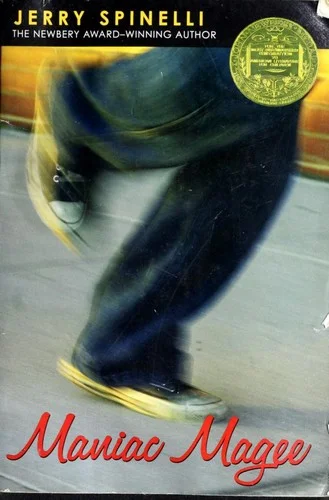
Maniac Magee
- Publication Date:
- January 1st, 1990
- Publisher:
- Little, Brown & Company
- ISBN-13:
- 9780316738248
- ISBN-10:
- 0316738247
Why Maniac Magee Has Been Challenged
Some readers have pushed back on the novel's unvarnished portrayal of a segregated town, worried that its racial language and tension could unsettle young readers without adult guidance nearby. See more ↓
Challenged or banned in 1 state across 1 school district.
The Boy Who Ran
Jeffrey Lionel Magee loses his parents in a sudden accident and spends the next eight years shuttled into the care of an aunt and uncle whose marriage has curdled into silence and resentment. Rather than stay in a house held together by nothing but appearances, Jeffrey does the only thing that makes sense to him: he runs. Not away from one place toward another, but simply runs, and keeps running, until the running itself becomes the story people tell.
That story arrives in a small town cut in two along racial lines, and Jeffrey — soon reborn in local legend as "Maniac" Magee — moves through it as an outsider unbound by the boundaries everyone else takes for granted. His exploits, exaggerated with each retelling, turn a homeless boy into folk hero, and his presence begins to loosen, however briefly, the town's rigid lines.
The novel leans into the register of tall tale as much as realistic fiction, letting rumor and myth accumulate around an ordinary, hurting kid until the reader has to sort the boy from the legend he's become.
Myth-Making Across a Color Line
What the book is really interested in is the gap between the stories communities tell about themselves and the lines they actually live by. Maniac's homelessness puts him outside the usual claims of family and neighborhood, and that outsider status is precisely what lets him cross a boundary that everyone else treats as fixed. Spinelli uses folklore and exaggeration not as decoration but as a mechanism: legend is how a segregated town processes a boy who refuses to recognize its geography of race.
The book has long held a place in middle-grade classrooms as an entry point for discussing segregation, prejudice, and belonging with younger readers, precisely because it filters those subjects through adventure and tall-tale humor rather than didactic explanation. That approach has made it a durable favorite in Spinelli's body of work, which repeatedly returns to resourceful, half-feral kids navigating adult failures around them.
Why Maniac Magee Has Been Challenged
The town's racial divide isn't background scenery in the novel — it surfaces directly, in slurs, in suspicion between neighbors, and in the casual cruelty kids absorb from the adults around them before they're old enough to question it. Because the book renders that prejudice plainly rather than softening it, some parents and educators have argued that the language and racial tension are too raw for the age group most likely to encounter the book in a classroom, and that without careful framing, students might come away unsettled rather than instructed. Others have raised concerns about a runaway child being cast as a sympathetic, even heroic, figure, worried that the story romanticizes leaving home rather than addressing the neglect that prompts it. In the records tracked here, that unease has translated into a single formal challenge, spanning one state and one school district.
Where to Buy




Affiliate links may generate a small commission at no extra cost to you, which helps support this site.
Banned in Schools
Banned or challenged in 1 state across 1 school district.
Florida 1 district
- St. John's County School District Banned by restriction