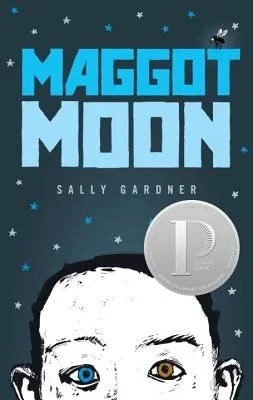
Maggot Moon
- Publication Date:
- January 1st, 2013
- Publisher:
- Candlewick Press (MA)
- ISBN-13:
- 9780763665531
- ISBN-10:
- 0763665533
- Pages:
- 279
Why Maggot Moon Has Been Challenged
Readers have pushed back on the novel less for its premise than for how unflinchingly it carries that premise through to violence against its own young characters. See more ↓
Challenged or banned in 1 state across 1 school district.
Overview
Sally Gardner's Maggot Moon follows Standish Treadwell, a teenager dismissed by nearly everyone around him as slow. His eyes don't match, his letters won't stay in order, and his country—the Motherland—has little patience for anyone who doesn't fit its mold. What the people around him miss is that Standish notices what "train-track thinkers" cannot: the gaps, the silences, the things nobody is supposed to ask about.
The story turns on an ordinary act of trespass. When a stray football sends Standish and his friend and neighbor Hector over the wall separating their world from a forbidden zone, the two boys find themselves face to face with a secret the state has gone to enormous lengths to bury. It involves a triumphant, heavily publicized moon landing—and the possibility that none of it is what it seems.
What follows is less a mystery than a reckoning. Gardner builds a narrow, watchful world—half-familiar, half-nightmare—in which curiosity is dangerous and truth is rationed. Standish's determination to understand what he's seen, and to decide what to do with it, drives the novel toward a conclusion shaped as much by loyalty and loss as by defiance.
A Dissenting Voice in a Managed World
Gardner sets her novel in an alternate history built on surveillance, propaganda, and enforced conformity, where a regime's authority rests on controlling not just behavior but belief. The premise draws deliberately on twentieth-century totalitarianism and Cold War-era space-race mythmaking, using an invented moon landing to ask what happens when a triumphant national narrative is manufactured rather than earned.
Standish's narration is the book's sharpest instrument. By making its truth-teller a boy the Motherland has already written off—illiterate, visually mismatched, socially marginal—Gardner inverts the usual hierarchy of who gets believed. The novel has drawn attention for pairing a bleak, unsparing setting with an unusually tender friendship at its center, and for refusing the reassurance that courage guarantees survival. That combination of dystopian violence and emotional intimacy has made the book a distinctive entry in young adult speculative fiction, one frequently discussed for how far it's willing to follow its premise toward loss.
Why Maggot Moon Has Been Challenged
Much of the scrutiny directed at Maggot Moon centers on what happens to its characters once they cross the wall, and to others who resist the Motherland before them. The novel does not soften the mechanics of an authoritarian state: informants, disappearances, and executions are part of its fabric, and violence lands on people the reader has come to care about, including children. Some readers and parents have found the book's willingness to depict state brutality against young characters, without a redemptive softening at the end, too harsh for its intended audience.
Objections have also touched on the novel's frank treatment of death and its refusal to separate the story's political horror from personal grief, arguing that the combination is too intense for middle-grade or early teen readers even when framed as speculative fiction. Others have pushed back on removing the book, arguing that its portrayal of a boy dismissed as unintelligent who turns out to be the only one seeing clearly offers exactly the kind of complication that engaged young readers benefit from. In this catalog, the book is recorded as having been challenged in 1 state and 1 district.
Where to Buy




Affiliate links may generate a small commission at no extra cost to you, which helps support this site.
Banned in Schools
Banned or challenged in 1 state across 1 school district.
Wisconsin 1 district
- Elkhorn Area School District Banned pending investigation