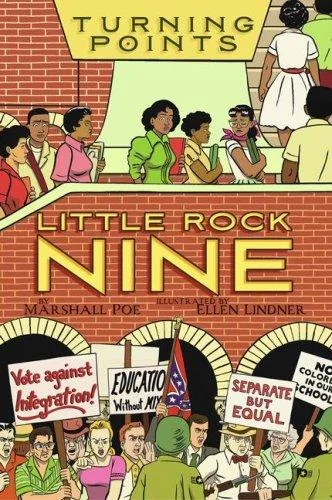
Little Rock Nine
by Marshall Poe
- Publication Date:
- July 1st, 2008
- Publisher:
- Aladdin
- ISBN-13:
- 9781416950660
- ISBN-10:
- 1416950664
- Pages:
- 128
Why Little Rock Nine Has Been Challenged
Some reviewers have pushed back on this history for young readers because its unvarnished depiction of racist hostility and mob threats strikes them as too harsh for the classroom, even as others defend that same bluntness as essential to understanding the era. See more ↓
Challenged or banned in 1 state across 1 school district.
Overview
Marshall Poe's Little Rock Nine recounts one of the most closely watched episodes of the civil rights era: the effort by nine Black teenagers to attend a previously all-white high school in Little Rock, Arkansas, in 1957. Written for younger readers, the book lays out how a Supreme Court ruling meant to end segregated schooling collided with local resistance, mob intimidation, and a governor willing to defy federal authority.
The narrative follows the students through the lead-up to their first day at Central High School, the crowds and threats that met them, and the extraordinary step of federal troops being sent to escort them into the building. Rather than treating the moment as a settled triumph, the book traces the strain the students endured in the months that followed, inside classrooms and hallways that remained hostile long after the cameras left.
As a work aimed at students, the book favors clear narrative and concrete detail over abstraction, using the experience of nine individuals to make a constitutional dispute legible as lived history.
Historical Context and Significance
The Little Rock crisis sits at a hinge point in American history, arriving three years after Brown v. Board of Education declared segregated public schools unconstitutional but before the federal government had built any consistent machinery to enforce that ruling. Poe's account situates the nine students' experience within that gap, showing how a legal victory on paper required individual children to absorb the cost of making it real.
The book also reflects a broader pattern in how civil rights history has been packaged for classrooms: as a story with a clear moral arc, heroism rewarded, resistance overcome, that nonetheless preserves the discomfort of the actual events. That tension, between accessible storytelling and unflinching detail, is part of what makes the title a recurring presence on school reading lists, and also what has occasionally drawn scrutiny from parents and administrators reviewing curricular materials.
Why Little Rock Nine Has Been Challenged
Books chronicling this period are frequently praised by educators for making a pivotal civil rights event concrete and age-appropriate, yet that same directness is what periodically draws objection. The friction tends not to be about factual accuracy, the events are a matter of historical record, but about how plainly a young-reader book should depict racial hatred, mob violence, and government defiance of federal law.
Objections raised against the title, which has drawn challenges in 1 state and 1 district tracked in this catalog, have centered on concerns that its descriptions of racist taunting and physical threats are too intense for the age group it targets, and on broader discomfort with how the book frames segregationist officials and crowds. Some critics have questioned whether the material is suited to the grade levels where it is commonly assigned, arguing for a gentler or more summarized treatment of the events. Others have objected on the grounds that confronting students directly with the era's open racism, rather than softening it, is itself the point of including the book in a curriculum, and that removing or restricting it risks sanitizing a history still relevant to current debates over civil rights and school integration.
Where to Buy




Affiliate links may generate a small commission at no extra cost to you, which helps support this site.
Banned in Schools
Banned or challenged in 1 state across 1 school district.
Florida 1 district
- Hillsborough County Public Schools Banned Pending Investigation