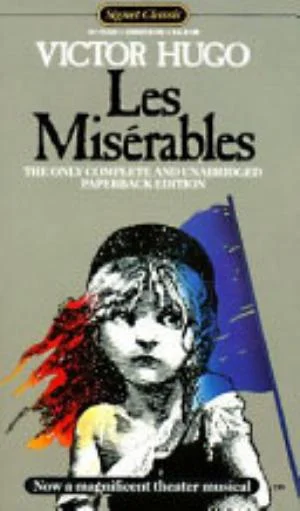
Les Miserables
by Victor Hugo
- Publication Date:
- January 1st, 1987
- Publisher:
- Signet Classics
- ISBN-13:
- 9780451525260
- ISBN-10:
- 0451525264
- Pages:
- 1492
Why Les Miserables Has Been Challenged
Critics have taken issue with the novel's candid rendering of poverty, sexual exploitation, and violent unrest, arguing that its grim realism outweighs its moral aims for younger readers. See more ↓
Challenged or banned in 1 state across 1 school district.
Overview
Victor Hugo's sprawling novel traces the life of Jean Valjean, a man broken by a disproportionate sentence for a minor theft, as he attempts to remake himself under a series of assumed identities. His path is shadowed for decades by Inspector Javert, whose rigid devotion to the letter of the law makes him less a villain than a mirror to Valjean's own struggle with what justice actually requires.
Around this central pursuit, Hugo builds out an enormous portrait of French society in the decades following the Revolution, folding in factory workers, students, street children, and the poor of Paris. The narrative widens repeatedly into digression and social commentary, using its characters' individual hardships to examine the systems that produced them.
What holds the book together is less its plot than its insistence that a single life can turn on an act of unearned kindness, and that redemption, once begun, is rarely a clean or finished thing. The famous pursuit across the city functions as both a piece of tense storytelling and a structural device for asking whether people can outrun what they once were.
A Novel of Conscience and Consequence
Hugo wrote from lived political conviction, and the novel doubles as an argument against the punitive machinery of nineteenth-century France — its prisons, its policing, its treatment of poverty as a moral failing rather than a circumstance. That argument is carried less through polemic than through accumulated detail: the barricades, the convents, the sewers, the courtroom, each rendered with a novelist's patience for the texture of institutions.
The book's endurance owes something to how it resists a single genre. It has been read as adventure fiction, as historical epic, and as a work of moral philosophy in narrative form, and it has shaped later depictions of the reformed criminal and the implacable pursuer across other media. Within Hugo's own body of work, it stands as his fullest attempt to fuse the personal and the political — a private story of guilt and grace set inside a public one about revolution and reform.
Why Les Misérables Has Been Challenged
The novel's frank treatment of prostitution, particularly the descent of the character Fantine, along with its unflinching depictions of poverty, violence, and imprisonment, has drawn objections from those who consider such material too mature or bleak for younger readers. Its sympathetic framing of a lawbreaker as a moral hero, and its open skepticism toward legal and religious authority, have also troubled some who feel the book blurs the line between rule-breaking and virtue. In this catalog, that unease has translated into a recorded challenge in 1 state and 1 school district.
Where to Buy




Affiliate links may generate a small commission at no extra cost to you, which helps support this site.
Banned in Schools
Banned or challenged in 1 state across 1 school district.
Florida 1 district
- Escambia County Public Schools Banned pending investigation