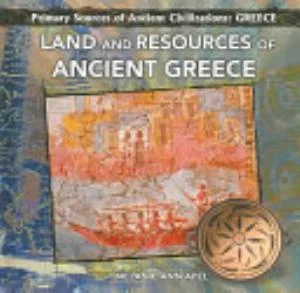
Land and Resources of Ancient Greece
- Publication Date:
- January 1st, 2004
- Publisher:
- Powerkids Press
- ISBN-13:
- 9780823967698
- ISBN-10:
- 0823967697
- Pages:
- 24
Why Land and Resources of Ancient Greece Has Been Challenged
Unlike works challenged for graphic content or mature themes, this book's presence on removal lists reflects a different pattern common to nonfiction reference titles: inclusion in broader reviews of library and classroom collections rather than objections to any passage within it. See more ↓
Challenged or banned in 1 state across 1 school district.
Overview
Melanie Ann Apel's "Land and Resources of Ancient Greece" approaches a familiar ancient civilization through an unusual lens: not myth or war, but dirt, coastline, and sky. The book asks how a rocky, sun-drenched peninsula jutting into the Mediterranean produced one of history's most influential societies, and it answers by tracing the practical realities of daily survival — what grew in thin mountain soil, what could be fished from the sea, and how scarce rainfall shaped the rhythms of farming and trade.
From there, the book widens its scope to consider how geography bled into politics. Greece's mountains and islands didn't just limit farmland; they isolated communities from one another, a physical fact the book connects to the rise of independent city-states rather than a single unified nation. Readers are walked through this cause-and-effect relationship as a way of understanding why Greek government took the fragmented, localized shape it did.
Written for a young audience, the book favors concrete, observable detail over abstraction — sun counts, rainfall patterns, coastlines — as the building blocks for understanding a civilization's character.
Environment as Explanation
The book belongs to a familiar genre of educational nonfiction: civilization studies told through environmental determinism, where climate and terrain are treated as the hidden architects of culture. This approach has a long pedigree in how ancient Greece is taught, since the connection between a fragmented, mountainous landscape and a fragmented, competitive political system is one of the more intuitive lessons available to young readers first encountering the ancient world.
What distinguishes this treatment from a straightforward history lesson is its refusal to start with kings, wars, or myths. Instead, it starts with the land itself, asking readers to understand the Greeks as people first shaped by hunger, thirst, and terrain, and only later as philosophers, playwrights, or soldiers. That framing places the book alongside other resource-and-geography titles designed to build a foundation for later, more complex study of ancient history and government.
Why "Land and Resources of Ancient Greece" Has Been Challenged
Unlike works challenged for graphic content or mature themes, this book's presence on removal lists reflects a different pattern common to nonfiction reference titles: inclusion in broader reviews of library and classroom collections rather than objections to any passage within it. Series nonfiction covering ancient civilizations is often swept into these reviews alongside more contested material, evaluated less on its own content than on its association with a particular collection, publisher line, or curriculum unit under scrutiny. Records in this catalog show the book has been challenged in 1 state and 1 district, a footprint consistent with a title caught up in a wider administrative review rather than one targeted for a specific passage or claim.
Where to Buy



Affiliate links may generate a small commission at no extra cost to you, which helps support this site.
Also by Melanie Ann Apel
Banned in Schools
Banned or challenged in 1 state across 1 school district.
Tennessee 1 district
- Monroe County Schools Banned