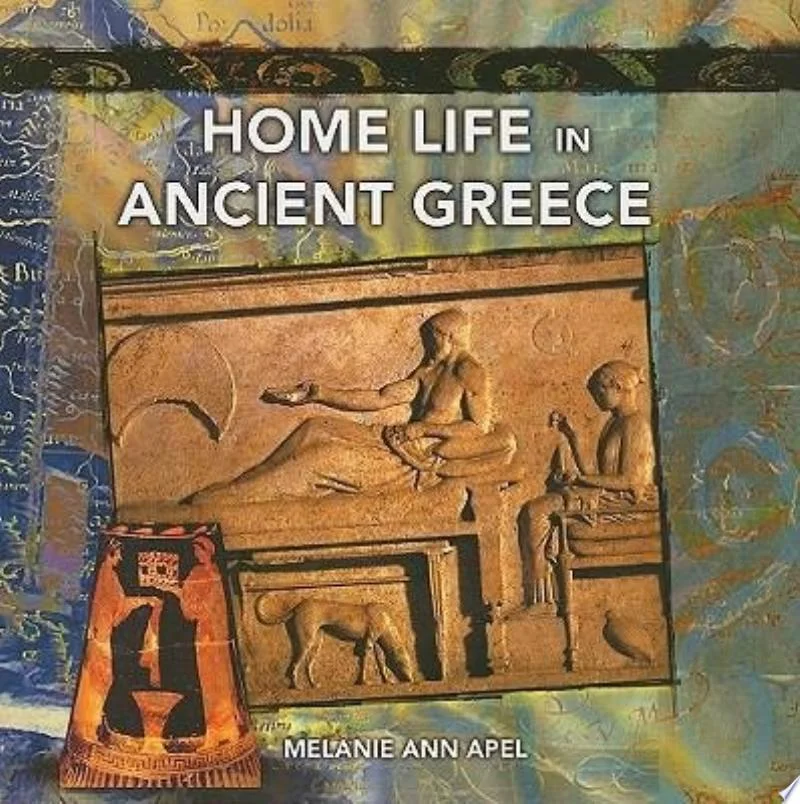
Home Life in Ancient Greece
- Publication Date:
- December 15th, 2003
- Publisher:
- The Rosen Publishing Group, Inc
- ISBN-13:
- 9780823989409
- ISBN-10:
- 0823989402
- Pages:
- 28
Why Home Life in Ancient Greece Has Been Challenged
Some reviewers have questioned whether a straightforward, uneditorialized account of ancient gender roles gives young readers enough framing to understand those customs as historical rather than instructive. See more ↓
Challenged or banned in 1 state across 1 school district.
Overview
Melanie Ann Apel's Home Life in Ancient Greece takes a domestic approach to a civilization more often remembered for its philosophers, playwrights, and generals. Rather than tracing wars or political reforms, the book settles into the household itself, walking younger readers through the routines that filled an ordinary Greek day.
Chapters move between the practical and the social: how a house was laid out and furnished, what people ate, how children were raised and educated, and how courtship and marriage were arranged. Entertainment and leisure receive their own attention as well, giving readers a sense of how Greeks spent time outside of work and obligation.
Threaded through these subjects is a recurring focus on women's place within the household — their responsibilities, restrictions, and the expectations placed on them from girlhood onward. The result is less a narrative than a structured reference, organized so a student can look up a single facet of daily life without needing the whole book.
Domestic Life as a Lens on a Civilization
Books of this kind occupy a particular niche in classroom libraries: they exist to make an ancient culture legible through its ordinary textures rather than its monuments. By foregrounding marriage customs, gender roles, and child-rearing, Apel's volume implicitly argues that a society is best understood through its households, not just its temples and battlefields.
That framing carries a built-in tension. Presenting historical gender roles factually — describing what was expected of women and girls in a patriarchal ancient society — requires the book to state those roles plainly, without necessarily editorializing about them. For an audience encountering ancient Greece for the first time, that plainness is also what gives the book its usefulness: it lets students draw their own comparisons between then and now rather than having the comparison made for them.
Why Home Life in Ancient Greece Has Been Challenged
Most objections to this title center less on any single passage than on where and to whom it should be handed — a question of grade-level fit and shelving rather than outright suitability. Reviewers weighing the book have questioned whether its treatment of marriage customs and the constrained role assigned to women in ancient Greek households is presented with enough context for younger readers to process critically, rather than simply absorb as description. Some challengers have also expressed unease at educational material that walks through historical gender inequities in matter-of-fact terms, worrying that the absence of overt commentary could read as tacit endorsement rather than neutral reporting. The book has been challenged or restricted in 1 state and 1 school district tracked in this catalog, reflecting a narrow but persistent concern about how historical material on gender and family life should be framed for young students rather than any dispute over its factual content.
Where to Buy




Affiliate links may generate a small commission at no extra cost to you, which helps support this site.
Also by Melanie Ann Apel
Banned in Schools
Banned or challenged in 1 state across 1 school district.
Tennessee 1 district
- Monroe County Schools Banned