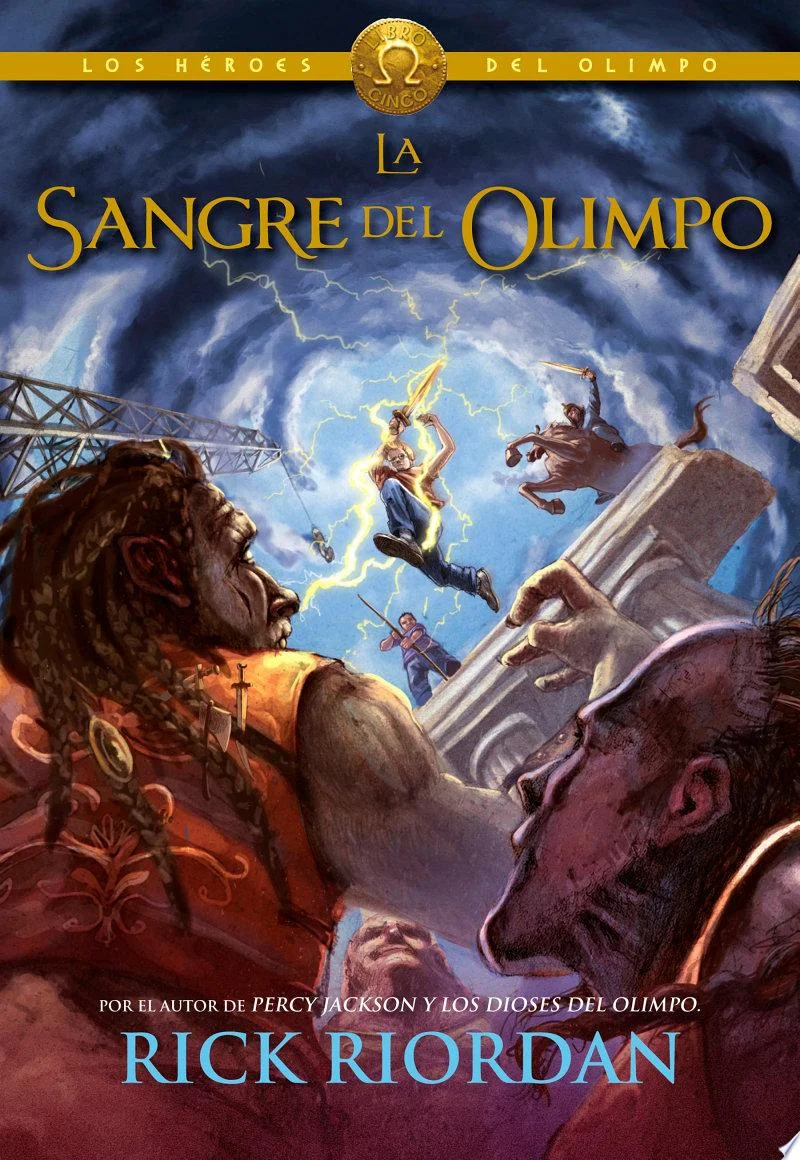
La sangre del Olimpo (Los héroes del Olimpo 5)
by Rick Riordan
- Publication Date:
- February 12th, 2015
- Publisher:
- MONTENA
- ISBN-13:
- 9788490436455
- ISBN-10:
- 8490436452
- Pages:
- 558
Why La sangre del Olimpo (Los héroes del Olimpo 5) Has Been Challenged
Some parents and reviewers have pushed back on this installment less for its fantasy violence than for the continued, matter-of-fact presence of a gay teenage character's feelings and for a plot built entirely around pagan gods and ritual sacrifice. See more ↓
Challenged or banned in 1 state across 1 school district.
Overview
"La sangre del Olimpo" closes out Rick Riordan's five-book Heroes of Olympus saga, bringing the crew of the flying warship Argo II to the brink of a war they never chose. Having survived a string of near-fatal missions, the seven demigods aboard find that their enemy, Gaia, has only grown stronger: she has roused her giants and set her sights on a ritual that requires the blood of two half-gods to fully wake.
Away from the ship, a second crisis brews. The Roman legion from Camp Jupiter, under a commander eager for conflict, is marching toward the Greek demigods' home at Camp Half-Blood, and only the recovery of an ancient statue can head off a war between the two camps before Gaia's forces can exploit it. As the Argo II presses on toward Athens, the novel juggles these converging threats, forcing its young heroes to weigh what they are willing to lose.
The result is a dense, fast-moving finale that ties off character arcs built across the preceding four books while keeping its focus on sacrifice: by this point in the series, the characters have already paid steep personal costs, and the narrative makes clear that the stakes of this last stand are final rather than renewable.
Context and Themes
As the capstone to Heroes of Olympus, the book inherits the series' central project: retelling Greek and Roman mythology through the lens of contemporary teenagers who discover they are literally descendants of the gods. Riordan uses that premise to explore chosen family and cooperation across difference, since the story's demigods are drawn from rival Greek and Roman traditions and must learn to trust one another despite inherited suspicion.
The novel also continues a strand introduced earlier in the series concerning Nico di Angelo, a son of Hades whose private struggles with grief and identity have made him one of the more psychologically complex figures in Riordan's middle-grade output. His arc, along with the ensemble's broader reckoning with loss, gives the finale a weightier register than the series' earlier, lighter adventures.
Within Riordan's body of work, the book is often read as a turning point: it closes the loosely mythological "Camp Half-Blood" universe's second series while setting the stage for the author's later, more deliberately diverse franchises. Critical reception has generally praised its handling of a large ensemble cast and its willingness to let consequences stick, even as some readers found the plotting, split across many points of view, more diffuse than the series' earlier volumes.
Why La Sangre del Olimpo Has Been Challenged
Much of the scrutiny directed at this installment traces back to its continuation of Nico di Angelo's story, in which the character's attraction to another male demigod, introduced in the preceding volume, remains part of his emotional arc. Objectors to this thread have argued that acknowledging a young character's sexual orientation is inappropriate for the book's middle-grade readership, treating the detail as adult content rather than as one facet of a character already defined by grief and isolation.
A second line of objection concerns the series' wholesale use of Greek and Roman religious material: gods, prophecies, sacrificial rites, and an earth goddess bent on ending the world are rendered as adventure-fiction furniture rather than historical belief, which some challengers have read as either promoting a non-Christian theology to children or trivializing religious subject matter generally. The book's climax, which turns on the literal shedding of demigod blood to empower Gaia, has also drawn concern as an example of violence and occult imagery marketed to a young audience.
In this catalog, the title has been formally challenged in one state and one school district, reflecting a narrower pattern of objection than the series experiences overall, but one consistent with the concerns raised elsewhere about mythological content and identity representation in books aimed at younger readers.
Where to Buy




Affiliate links may generate a small commission at no extra cost to you, which helps support this site.
Banned in Schools
Banned or challenged in 1 state across 1 school district.
Texas 1 district
- North East Independent School District Banned by Restriction