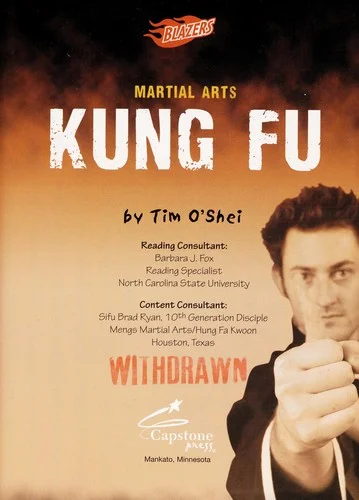
Kung fu
by Tim O'Shei
- Publication Date:
- January 1st, 2009
- Publisher:
- Blazers
- ISBN-13:
- 9781429619639
- ISBN-10:
- 1429619635
Why Kung fu Has Been Challenged
Reviewers have mainly questioned whether illustrated step-by-step combat techniques belong in collections aimed at younger readers, rather than objecting to the subject of martial arts itself. See more ↓
Challenged or banned in 1 state across 1 school district.
Overview
"Kung Fu" is an illustrated nonfiction title that introduces young readers to one of the world's most recognizable martial arts traditions. Rather than following a single character through a plot, the book works more like a guided tour, walking through the origins, philosophy, and physical practice of kung fu in a format built for readers who respond to visuals as much as text.
Tim O'Shei, known for writing accessible nonfiction on action-oriented and historical subjects, structures the book to move between explanation and illustration, breaking down stances, forms, and training concepts alongside the cultural and historical threads that shaped the discipline. The goal is less about narrative drama and more about giving readers a clear, visual entry point into a subject many only know through film or popular culture.
As a reference-style graphic nonfiction work, it sits comfortably alongside other titles aimed at reluctant or visually oriented readers, using sequential art to make technical and historical material feel approachable rather than dense.
Martial Arts as a Gateway Subject
Books like this one occupy a particular niche in youth publishing: nonfiction built around action and physical discipline, designed to pull in readers who might not gravitate toward traditional prose. Martial arts in particular carry a dual appeal, combining athletic technique with layers of philosophy, history, and cultural tradition that stretch back centuries.
For a writer like O'Shei, whose catalog leans toward sports, extreme activities, and real-world skill-building, kung fu fits a broader pattern of presenting physical mastery as something worth studying seriously rather than treating it only as spectacle. The graphic format also reflects a wider shift in educational publishing toward visual literacy, where illustration carries as much explanatory weight as the text it accompanies, particularly for subjects involving movement and physical positioning that are difficult to convey in prose alone.
Why Kung Fu Has Been Challenged
Most of the friction around this title has less to do with its content being objectionable in the abstract than with where it should sit on a shelf and at what age it should be handed to a reader. Because the book illustrates physical techniques and combat stances as part of its instructional approach, some reviewers have questioned whether that material is suited to younger or more general collections rather than contexts specifically geared toward sports or martial arts instruction.
The underlying concern tends to center on the depiction of fighting movements themselves: whether presenting strikes, forms, and sparring concepts in an illustrated, step-by-step way risks normalizing physical aggression for readers who may not have the context to understand kung fu as a disciplined practice rather than a how-to for confrontation. That tension between educational intent and the visual depiction of combat technique has made the book, tracked here as challenged in one state and one district, a recurring subject of shelving and age-appropriateness review rather than broader ideological objection.
Where to Buy




Affiliate links may generate a small commission at no extra cost to you, which helps support this site.
Banned in Schools
Banned or challenged in 1 state across 1 school district.