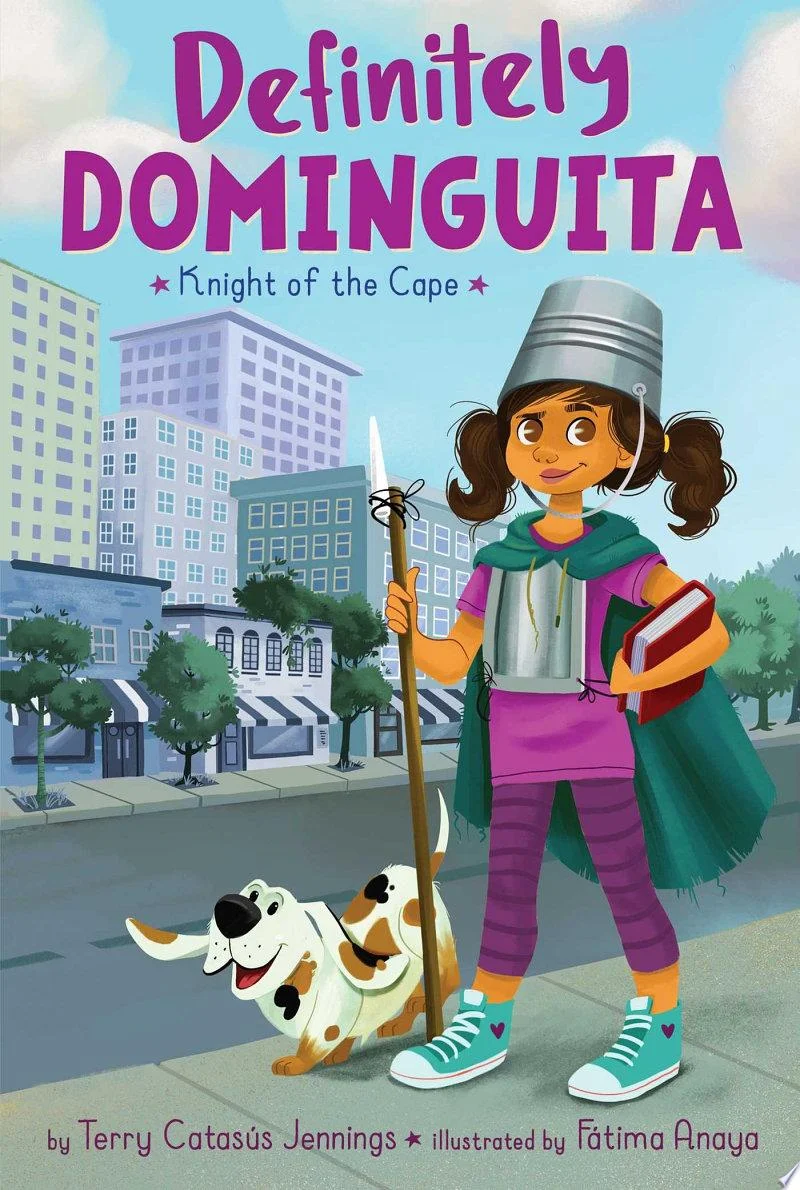
Knight of the Cape
- Publication Date:
- March 2nd, 2021
- Publisher:
- Simon and Schuster
- ISBN-13:
- 9781534465046
- ISBN-10:
- 1534465049
- Pages:
- 144
Why Knight of the Cape Has Been Challenged
A young protagonist's refusal to accept that knighthood is "for boys" has drawn objections from readers who see the book less as a child's adventure story and more as an argument about gender roles aimed at an audience too young to push back. See more ↓
Challenged or banned in 1 state across 1 school district.
Overview
Dominguita misses her grandmother fiercely, and the books Abuela left behind are the closest thing she has to her presence. These are the Spanish editions Abuela carried from Cuba as a girl herself, read aloud together before she moved away, and they've become Dominguita's private inheritance—a way of keeping a shared language and a shared imagination alive across the distance.
Among them is Don Quixote, and Dominguita latches onto its portrait of a knight errant who wanders the world righting wrongs. She decides she can do the same in her own neighborhood, turning errands and small kindnesses into chivalric quests she can narrate to Abuela later, as if the stories were still something they built together rather than something she now reads alone.
That ambition collides with a classmate's blunt insistence that knighthood is for boys. Rather than back down, Dominguita recruits a band of friends and sets out to prove, deed by deed, that the role she's claimed for herself is hers to keep.
A Grandmother's Library as Inheritance
The book is less interested in medieval knights than in what inherited stories do for a child processing absence. Abuela's books function as a kind of long-distance conversation—Dominguita isn't just reading Cervantes, she's reading him the way her grandmother taught her to, which makes the books a bridge between a Cuban childhood she never saw and her own American one. The choice to center Spanish-language texts specifically, rather than translations, underscores that the inheritance being passed down is linguistic and cultural as much as literary.
That framing also shapes how the novel handles its classroom conflict. The question of whether a girl can be a knight isn't treated as a debate to be won with arguments; it's answered the way Dominguita answers everything, by doing. The book sits at an intersection familiar to readers of character-driven chapter books: a child's imaginative life as both coping mechanism and training ground for asserting herself in a world that hasn't quite caught up to her.
Why Knight of the Cape Has Been Challenged
A complaint lodged against the book centered on whether a story built around a child openly rejecting a boy's claim that "girls can't be knights" amounts to steering young readers toward a particular view of gender roles, rather than simply telling a story. The objection framed Dominguita's insistence on claiming a traditionally male role as advocacy aimed at children too young to weigh the argument on their own, rather than as an organic feature of her character. This concern has driven the book's removal or restriction in 1 school district across 1 state tracked in this catalog. Separately, some reviewers raised the book's handling of a child's grief over a departed family member, questioning whether the emotional weight of that separation was appropriate for the chapter-book age range the series otherwise targets.
Where to Buy




Affiliate links may generate a small commission at no extra cost to you, which helps support this site.
Banned in Schools
Banned or challenged in 1 state across 1 school district.
Iowa 1 district
- Clear Creek-Amana Community School District Banned pending investigation