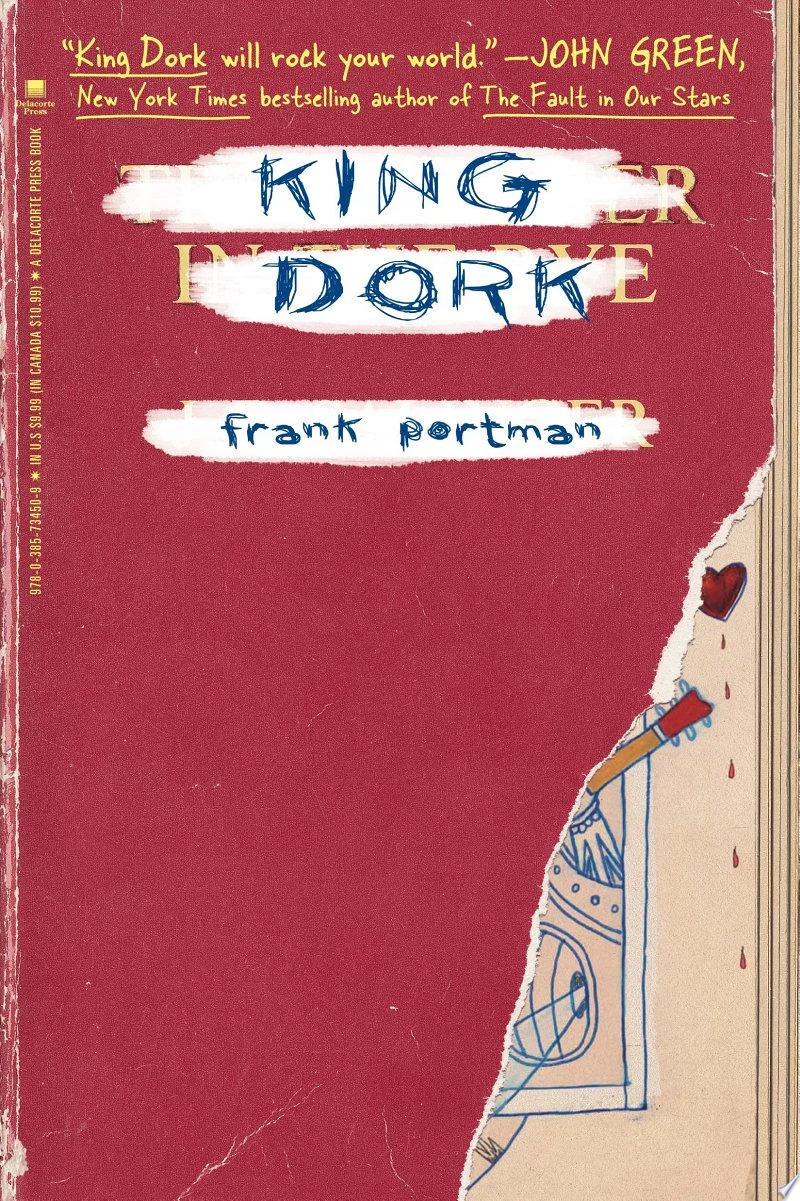
King Dork
- Publication Date:
- February 12th, 2008
- Publisher:
- Delacorte Press
- ISBN-13:
- 9780385734509
- ISBN-10:
- 0385734506
- Pages:
- 370
Why King Dork Has Been Challenged
Critics have pushed back against the novel largely over its unfiltered teenage voice, which leans on blunt profanity and matter-of-fact talk about sex rather than anything more explicit. See more ↓
Challenged or banned in 1 state across 3 school districts.
Overview
Tom Henderson is a self-described dork navigating the lower rungs of high school social order when he stumbles across something that belonged to his father, who died under circumstances nobody in the family fully explains: a worn paperback of The Catcher in the Rye, marked up with cryptic notes. That discovery sends Tom down a rabbit hole of half-connected mysteries, touching on his father's death, a series of odd coincidences, and the general absurdity of being a teenage boy trying to seem cool while starting a band with a rotating cast of barely competent musicians.
Frank Portman tells the story in Tom's own voice, restless and self-mocking, packed with the private slang, made-up band names, and running jokes that a certain kind of alienated teenager uses to make sense of an environment that doesn't make much sense at all. The plot moves less like a mystery novel and more like an extended riff, circling back on itself as Tom reassembles scraps of evidence about his father while also trying, without much success, to get a date.
The novel's structure leans heavily on artifacts — song lyrics, homemade zines, a glossary of invented terms — that reinforce the sense of Tom as a compulsive chronicler of his own small, chaotic world.
A Skeptic's Answer to a Canonical Text
King Dork positions itself in direct conversation with The Catcher in the Rye, using Tom's exasperation with his English class's reverent treatment of Holden Caulfield as a running joke and a genuine argument. Rather than simply parodying Salinger's novel, Portman uses it as a foil: Tom finds the canonization of "classic" alienated-teen literature almost as absurd as the alienation itself, and his skepticism becomes a way of questioning how schools teach coming-of-age stories to actual teenagers living through one.
That stance helped the book find an audience beyond typical young-adult readers, including musicians and writers drawn to its DIY, punk-inflected sensibility — Portman himself fronts the band the Mr. T Experience, and the novel's obsession with band names, setlists, and garage-rock minutiae reads as lived-in rather than research. Its afterlife as a word-of-mouth favorite, followed by a sequel, suggests a book that resonated less through mainstream visibility than through readers passing it along to one another.
Content and Language Concerns Have Drawn Scrutiny
Frank language and frequent, casual references to sex are the primary flashpoints for objections to King Dork. Tom's narration doesn't soften how teenage boys actually talk about bodies, hookups, and each other, and reviewers uncomfortable with that candor have argued the book is inappropriate for the middle and high school shelves where it's often shelved. Some critics have also pointed to the novel's irreverent treatment of a required-reading classic as a mark against its suitability for classroom use, on the theory that mocking assigned literature undermines the way it's taught. In the districts and libraries tracked in this catalog, the book has been the subject of formal challenges in one state and three districts, generally centered on this mix of profanity and sexual content rather than on any single passage or scene.
Where to Buy



Affiliate links may generate a small commission at no extra cost to you, which helps support this site.
Banned in Schools
Banned or challenged in 1 state across 3 school districts.
Florida 3 districts
- Clay County School District Banned
- Collier County Public Schools Banned
- Escambia County Public Schools Banned pending investigation