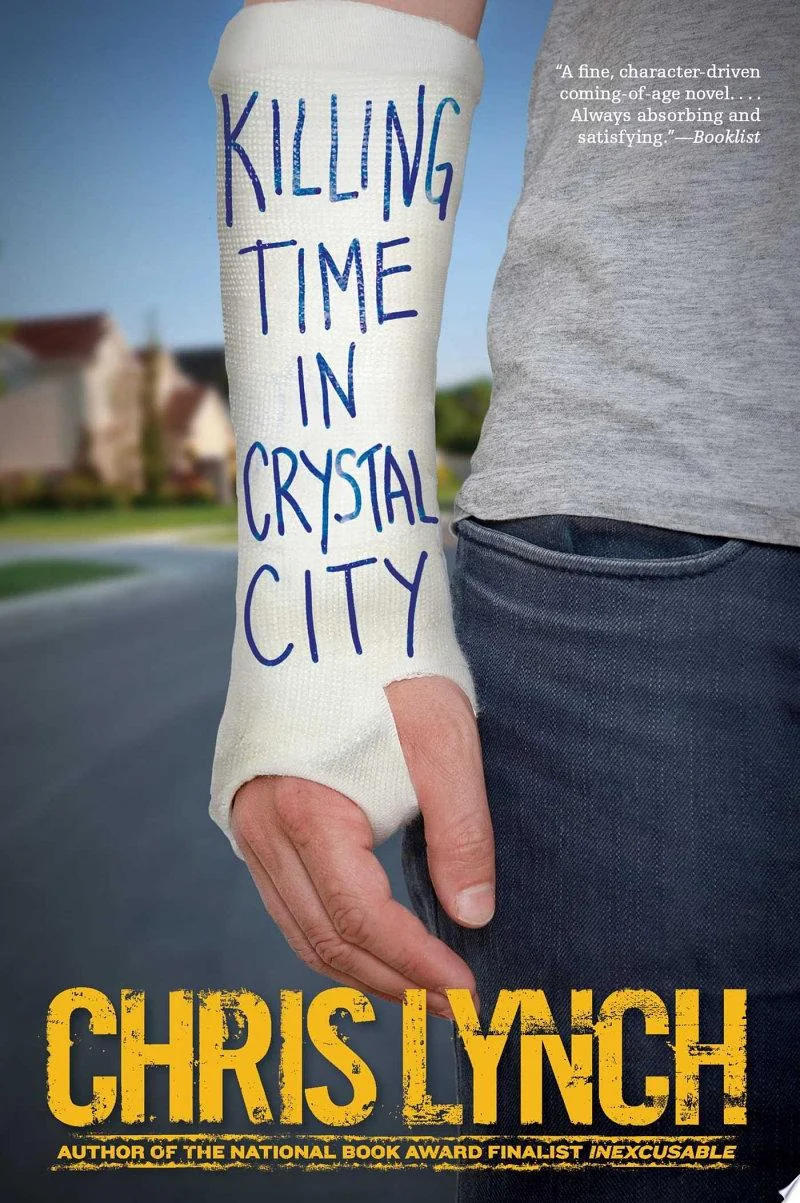
Killing Time in Crystal City
by Chris Lynch
- Publication Date:
- April 5th, 2016
- Publisher:
- Simon and Schuster
- ISBN-13:
- 9781442440128
- ISBN-10:
- 1442440120
- Pages:
- 24
Why Killing Time in Crystal City Has Been Challenged
Some readers have pushed back on the book's willingness to leave a teenage runaway in murky, adult-free territory without steering the story toward a reassuring resolution. See more ↓
Challenged or banned in 1 state across 1 school district.
Overview
Kevin is seventeen and finished with the version of himself his father built. When he leaves home, he leaves behind more than a bad relationship — he sheds a whole identity, hoping distance and a new name can undo years of fear and resentment.
What he finds instead is a stranger household: an uncle he barely knows, whose motives and habits remain unclear even after Kevin moves in, and two homeless girls whose friendship pulls him further from the tidy reinvention he had planned. Each relationship complicates the last, so that the freedom he was chasing keeps arriving with strings attached.
Chris Lynch builds the novel around that gap between the self Kevin wants to construct and the self circumstance keeps handing him, using the uncle's ambiguity and the girls' precarious survival to keep the story's ground shifting under its narrator.
Reinvention as Survival
Lynch has built much of his career around teenage boys under duress — often working-class, often estranged from the men who raised them — and Killing Time in Crystal City fits that pattern while pushing it toward something stranger. Running away is rarely treated in young-adult fiction as pure liberation, and Lynch resists that temptation here: Kevin's escape doesn't resolve his story so much as relocate it, trading one set of pressures for another he understands even less.
The uncle functions less as a rescuer than as a question mark, and that refusal to explain him keeps the novel closer to psychological suspense than to a straightforward coming-of-age arc. Meanwhile, the two girls Kevin befriends root the book in the material reality of homelessness rather than treating it as scenery for his personal growth. Read together, these choices position the novel as an interrogation of what "starting over" actually costs a teenager with no resources and no safety net.
Why Killing Time in Crystal City Has Been Challenged
Critics of Lynch's work have generally credited him with an unsentimental honesty about troubled adolescence, yet that same directness is what draws objections when the book reaches school shelves. Complaints have centered on its portrayal of family dysfunction — a father characterized in terms severe enough to justify his son's flight — along with the unsupervised, precarious circumstances Kevin enters once he's out from under any adult authority. The presence of homeless characters living outside institutional oversight, and the murky, unresolved nature of the uncle's household, have been cited as troubling for young readers by those who prefer stories where adult guidance is clearer and more reassuring. Underlying many objections is a discomfort with a runaway narrative that doesn't punish or fully redeem its protagonist's choices, leaving the ambiguity intact rather than resolving it into a clean moral lesson. The book has been challenged in 1 state and 1 district tracked in this catalog.
Where to Buy




Affiliate links may generate a small commission at no extra cost to you, which helps support this site.
Banned in Schools
Banned or challenged in 1 state across 1 school district.
Florida 1 district
- Escambia County Public Schools Banned pending investigation