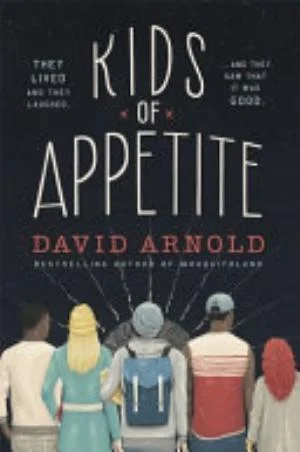
Kids of Appetite
by David Arnold
- Publication Date:
- September 20th, 2016
- ISBN-13:
- 9781472218957
- ISBN-10:
- 1472218957
Why Kids of Appetite Has Been Challenged
Critics of the novel have taken issue less with its central grief story than with the unfiltered teenage voice carrying it, particularly around sex, substance use, and a plot thread involving a death under investigation. See more ↓
Challenged or banned in 1 state across 1 school district.
Overview
Kids of Appetite opens with its ending already in motion: Vic Benucci and a girl named Mad are being questioned by police about a death neither of them expected to be tied to. The novel then loops backward to explain how they got there, beginning with the loss that reshaped Vic's life two years earlier — the death of his father, whose ashes sit in an urn Vic still can't bring himself to touch.
On a December afternoon, Vic crosses paths with a loose, roaming group of teenagers who call themselves the Kids of Appetite. Mad, sharp and guarded, draws him further into their world than he expects. Their friendship gives Vic the nerve to finally open his father's urn, where he finds a hidden message that sends the group on an unplanned journey through his old neighborhood and his own grief.
David Arnold, also known for Mosquitoland, structures the book as a dual narrative that moves between the present-day interrogation and the events leading up to it, blending comic banter among the Kids of Appetite with the heavier work of mourning underneath it.
A Story Built on Loss and Belonging
The novel sits at an intersection of grief narrative and found-family story, using humor as a counterweight rather than a distraction from its central loss. Vic's inability to open his father's urn becomes a physical stand-in for unresolved mourning, and the Kids of Appetite function less as a typical friend group than as a temporary refuge for teenagers each carrying their own damage. The structural choice to frame the story as testimony to police adds a layer of suspense to what is otherwise an interior story about processing death, and it lets Arnold reveal backstory gradually rather than all at once.
Reviewers have noted the book's resistance to easy categorization, describing it as a novel that moves between tones — tender, funny, melancholic — without settling comfortably into one. That blend fits within Arnold's broader body of work, which tends to pair offbeat, bantering dialogue with protagonists working through trauma or loss, and it has placed the book among notable youth literature in the years following its release.
Why Kids of Appetite Has Been Challenged
Much of the scrutiny directed at the novel centers on its teenage characters' language and the frank way they discuss sex, drugs, and the messier edges of adolescence as they navigate the world largely without adult supervision. Some readers have also raised concerns about the book's depiction of mature emotional content, including grief, death, and the characters' sometimes self-destructive coping mechanisms, arguing that the material is too heavy or too explicit for younger readers to encounter without guidance. Others have pointed to the murder-investigation frame itself, uneasy with pairing violent subject matter with a young-adult audience. This catalog records the book as challenged in 1 state and 1 district, reflecting a narrow but notable instance of pushback against its content.
Where to Buy




Affiliate links may generate a small commission at no extra cost to you, which helps support this site.
Banned in Schools
Banned or challenged in 1 state across 1 school district.