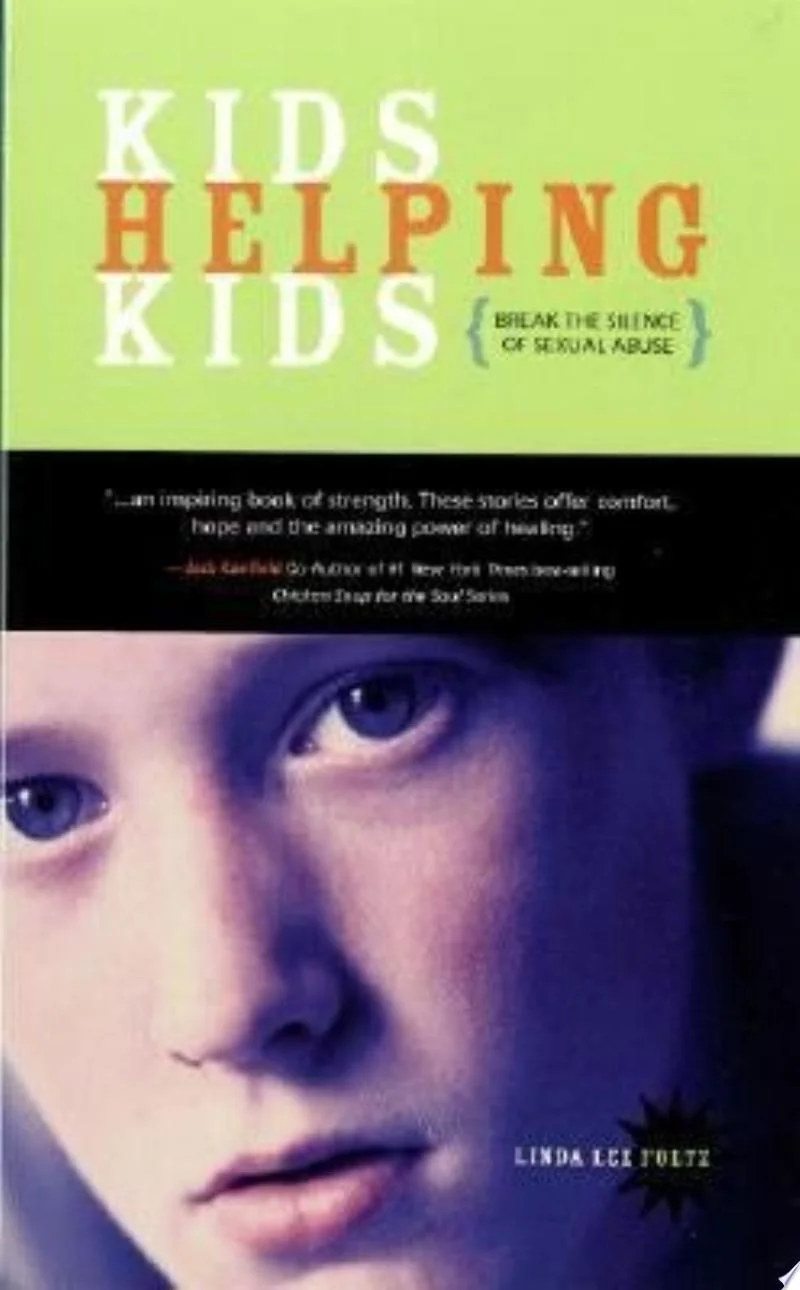
Kids Helping Kids Break the Silence of Sexual Abuse
- Publication Date:
- January 1st, 2003
- Publisher:
- Lighthouse Point Press
- ISBN-13:
- 9780963796691
- ISBN-10:
- 0963796690
- Pages:
- 148
Why Kids Helping Kids Break the Silence of Sexual Abuse Has Been Challenged
Critics have questioned whether a book built on children's own accounts of abuse belongs on open library shelves rather than in settings where an adult can guide how that material is read. See more ↓
Challenged or banned in 1 state across 1 school district.
Overview
Kids Helping Kids Break the Silence of Sexual Abuse assembles personal testimony from young people alongside commentary from professionals who work in abuse prevention and recovery. Rather than presenting a single narrative, the book is structured as a resource that parents and children can consult together, moving between lived experience and practical guidance.
Linda Lee Foltz frames the material around two goals: helping readers recognize warning signs before abuse occurs, and supporting those already affected as they work toward healing. The first-person accounts serve less as narrative entertainment than as evidence — proof, in the words of the children who share them, that disclosure is survivable and that silence is not the only option.
The tone throughout is instructional rather than literary. Sidebars, expert commentary, and direct address to young readers give the book the feel of a manual as much as a collection of stories, reflecting its origins as a tool for schools, counselors, and families rather than a work of fiction.
A Resource Built From Testimony
The book sits at an unusual intersection of genres: part survivor memoir anthology, part parenting and prevention guide. Its use of children's own words as the primary evidence base is a deliberate departure from the clinical detachment of many prevention pamphlets, on the theory that young readers are more likely to recognize their own experience in a peer's account than in an adult's abstract warning signs.
This approach also shapes how the book has circulated. It has been adopted less as leisure reading than as a resource handed out by counselors, placed in school libraries alongside other safety materials, or recommended by parents themselves. That practical, almost clinical function has not shielded it from scrutiny, however, since the same first-hand detail that makes the book effective as a prevention tool is what draws objection from readers who encounter it outside that intended context.
Why Kids Helping Kids Break the Silence of Sexual Abuse Has Been Challenged
A parent reviewing the book for a school library committee argued that its firsthand accounts of abuse were too explicit for the shelf where a child might encounter them without adult guidance, contending that material meant for supervised counseling settings was being made available for unsupervised, casual reading. The complaint centered less on the book's intent than on its placement: that a resource designed to be read alongside a parent or counselor loses its protective purpose when a child can simply pull it off a library shelf alone.
Other objections have focused on the graphic nature of the survivor testimony itself, with critics maintaining that describing sexual abuse in a child's own words — however honest or well-intentioned — exposes young readers to content they argue is inappropriate regardless of the book's stated preventive aim. Underlying both lines of criticism is a broader disagreement about age-appropriateness: whether books that directly discuss sexual abuse belong in general-collection children's or middle-grade sections at all, or whether they should be restricted to counseling offices and parent-mediated settings. The book has been challenged or restricted in 1 state and 1 school district tracked in this catalog, reflecting a narrower but still notable pattern of concern compared to fiction dealing with similar subject matter.
Where to Buy



Affiliate links may generate a small commission at no extra cost to you, which helps support this site.
Banned in Schools
Banned or challenged in 1 state across 1 school district.
Iowa 1 district
- Waterloo Community School District Banned pending investigation