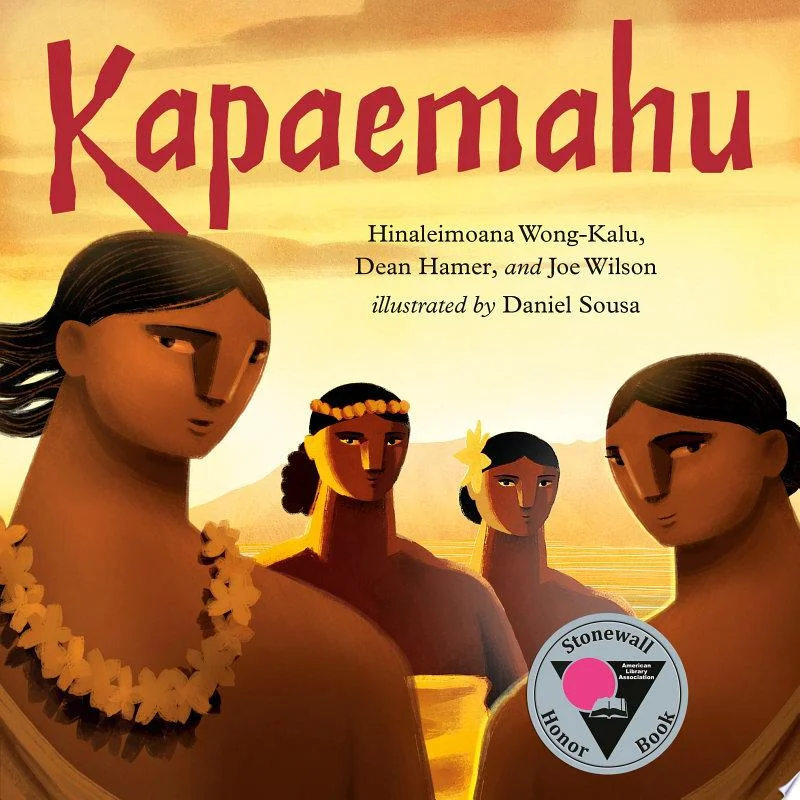
Kapaemahu
- Publication Date:
- June 7th, 2022
- Publisher:
- Penguin
- ISBN-13:
- 9780593530061
- ISBN-10:
- 0593530063
- Pages:
- 41
Why Kapaemahu Has Been Challenged
A children's retelling of Hawaiian oral tradition has drawn objection less for the legend it tells than for the dual-gender identity of the healers at its center. See more ↓
Challenged or banned in 1 state across 1 school district.
Overview
Kapaemahu retells a centuries-old Hawaiian oral tradition about four Mahu, people embodying both male and female spirit, who traveled from Tahiti to Waikiki carrying knowledge of healing. The islanders they helped, moved by what they received, raised a set of stones to honor them, and the Mahu are said to have placed their own healing power into those stones before departing.
The book follows the stones themselves across time, from the moment of their creation through generations in which newcomers to the islands lost track of what they meant and why they stood where they did. Only in the twentieth century did efforts begin to piece the story back together, and the book is candid that much of the original history remains incomplete.
Created by Hinaleimoana Wong-Kalu alongside Dean Hamer, Joe Wilson, and illustrator Daniel Sousa, the book grew out of an acclaimed short film and carries that project's visual sensibility onto the page, pairing spare narration with imagery meant to evoke the stones' quiet persistence in a now-crowded modern beach setting.
A Story About Memory and Erasure
What distinguishes Kapaemahu from a typical legend retelling is its interest in forgetting as much as in the legend itself. The narrative frames the stones as a kind of physical memory that outlasted the culture's ability to explain them, and it treats the eventual, partial recovery of their meaning as an act of cultural reclamation rather than simple rediscovery. In doing so, the book positions itself within a broader movement among Native Hawaiian artists and historians to recover histories that colonization interrupted or suppressed.
The figures at the center of the story, the Mahu, occupy a specific place in Hawaiian tradition as people who held both masculine and feminine spirit and were historically regarded as healers and keepers of knowledge. The book's choice to foreground this identity, rather than treat it as incidental, is central to its purpose: it asks readers to encounter a precolonial understanding of gender on its own cultural terms, not through a contemporary lens imposed from outside.
Why Kapaemahu Has Been Challenged
A formal request to remove the book argued that its portrayal of dual-spirit, dual-gender figures amounted to introducing gender identity concepts to young readers under the guise of folklore, and that the material was better suited to parental discretion than a school or library shelf. The complaint treated the Mahu's dual nature as the book's central and most objectionable feature, rather than as one element of a larger cultural narrative.
Other objections raised in the course of the same review centered on whether a picture book was an appropriate format for introducing children to a legend involving nontraditional gender roles at all, regardless of its basis in authentic oral tradition. Defenders of the book countered that removing it would suppress a documented piece of Native Hawaiian heritage on the grounds of a single, modern discomfort with gender variance. In the catalog tracked here, Kapaemahu has been the subject of 1 challenge across 1 state and 1 school district.
Where to Buy




Affiliate links may generate a small commission at no extra cost to you, which helps support this site.
Banned in Schools
Banned or challenged in 1 state across 1 school district.