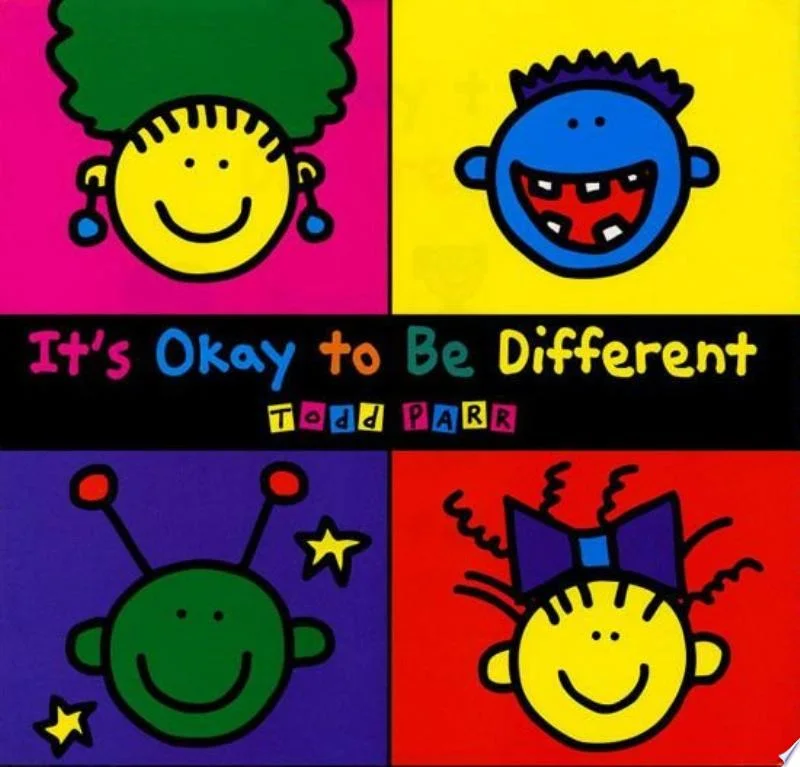
It's Okay to Be Different
by Todd Parr
- Publication Date:
- November 16th, 2008
- Publisher:
- Little, Brown Books for Young Readers
- ISBN-13:
- 9780316045902
- ISBN-10:
- 031604590X
- Pages:
- 44
Why It's Okay to Be Different Has Been Challenged
A handful of readers have pushed back on this book not for anything explicit, but for treating varied family arrangements and racial difference as simply unremarkable facts of childhood, without the framing some adults would prefer to provide themselves. See more ↓
Challenged or banned in 1 state across 1 school district.
Overview
Todd Parr built his career on picture books that take a single idea and repeat it in short, declarative sentences paired with bold, cartoonish art, and It's Okay to Be Different follows that formula closely. Each spread offers a brief statement — about needing glasses, living with one parent instead of two, having a different skin color, or simply feeling scared sometimes — and pairs it with a cheerful, simplified illustration drawn in Parr's flat, primary-color style.
There is no plot in the traditional sense. Instead, the book functions as a catalog of reassurances aimed at very young children, moving from physical traits to family circumstances to emotional states without lingering on any one topic for more than a page. The cumulative effect is a kind of checklist of belonging, meant to be absorbed quickly by a reader just learning to associate words with pictures.
The book sits alongside several other Parr titles built on the same template, and its simplicity is the point: it was designed for read-aloud settings and early independent reading, where repetition and visual clarity do more work than narrative complexity.
A Recurring Voice in Early Childhood Shelves
Parr's picture books occupy a specific niche in children's publishing — they are less interested in storytelling than in modeling language that adults can use with children about feelings, bodies, and family life. It's Okay to Be Different is often discussed alongside his other works as part of a broader project of giving very young readers vocabulary for self-acceptance before they encounter more complicated social situations.
That same breadth is also what has made the book a recurring subject of debate. Because it moves through so many categories of difference in quick succession, individual readers and institutions have tended to react to whichever page touches on a topic they consider sensitive, rather than to the book as a whole. Its place in library and classroom collections has as a result been shaped less by its narrative content, of which there is little, and more by how communities feel about introducing young children to the specific categories of difference it names.
Why It's Okay to Be Different Has Been Challenged
Family structure and identity are the categories most often cited by objectors to this title. Among the many short statements in the book are lines acknowledging that some children live with one parent, some with two, and some in households that don't match a conventional model, and a handful of readers have interpreted these pages as an endorsement of family arrangements, including same-sex parenting, that they believe should not be presented neutrally to young children. Because the book offers no commentary or caveat on any of its statements, objectors have argued that it normalizes topics they would prefer to introduce themselves, on their own terms and timeline.
A smaller number of complaints have focused on the book's brief references to race and skin color, with some challengers arguing that even a one-line acknowledgment of racial difference is inappropriate for the youngest readers or edges into territory they associate with classroom discussions of race more broadly. In this catalog, objections of this kind have been recorded in one state and one school district, reflecting a narrow but persistent concern with a book whose entire approach is built on naming differences plainly rather than qualifying them.
Where to Buy




Affiliate links may generate a small commission at no extra cost to you, which helps support this site.
Banned in Schools
Banned or challenged in 1 state across 1 school district.
Georgia 1 district
- Cobb County School District Banned pending investigation