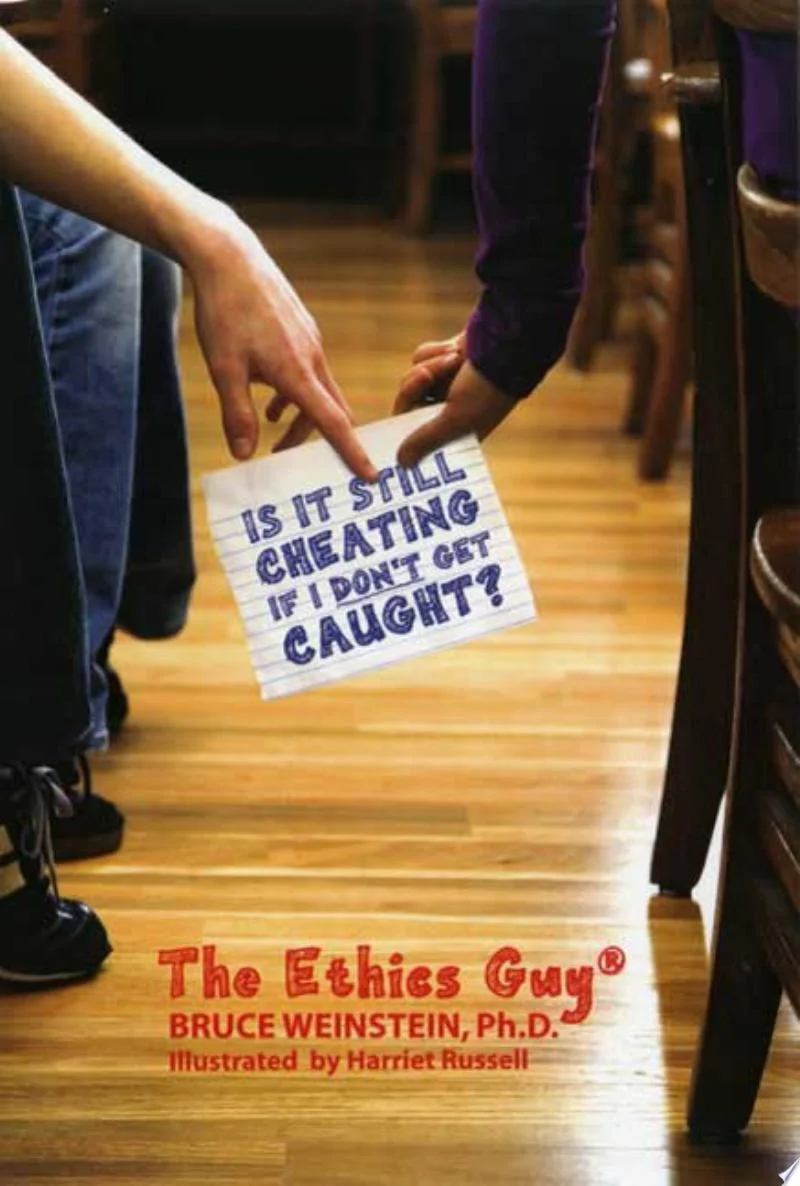
Is It Still Cheating If I Don't Get Caught?
- Publication Date:
- April 14th, 2009
- Publisher:
- Macmillan
- ISBN-13:
- 9781596433069
- ISBN-10:
- 159643306X
- Pages:
- 164
Why Is It Still Cheating If I Don't Get Caught? Has Been Challenged
Some adult reviewers have argued that a book which invites teenagers to reason through whether cheating, drug use, or dishonesty is "really" wrong ends up giving those behaviors more legitimacy than a straightforward warning against them would. See more ↓
Challenged or banned in 1 state across 1 school district.
Overview
Bruce D. Weinstein's guide takes on the small, nagging moral puzzles that make up adolescent life: an unearned grade, a friend's secret, a tempting shortcut on a homework assignment, a locker-room rumor about performance-enhancing drugs. Rather than issuing a list of rules, the book organizes these situations around five foundational ethical principles meant to give teenage readers a repeatable method for working through hard calls on their own.
Each chapter pairs a principle with a set of scenario-driven questions pulled from the ordinary terrain of school, sports, friendship, family, and early romance. The tone is conversational and direct, aimed at readers who want a usable framework rather than a philosophy lecture.
The result reads less like a moral lecture than a field manual—short on abstraction, long on the kind of situations a teenager might actually encounter between one class period and the next.
Ethics as a Practical Skill
What the book is really after is a shift in how young readers think about right and wrong: not as a fixed set of adult-issued prohibitions, but as a skill that can be practiced and improved through repeated reasoning. That framing places it closer to applied ethics and character-education literature than to religious or civic moral instruction, and it reflects a broader trend in adolescent self-help writing that treats decision-making itself, rather than any single correct answer, as the thing worth teaching.
This approach carries an implicit argument about authority. By inviting teenagers to weigh scenarios and reach their own conclusions using stated principles, the book positions its young readers as capable moral reasoners rather than passive recipients of rules handed down by parents, teachers, or coaches. That stance has made the book a useful classroom or library resource for educators interested in character education, even as it has occasionally unsettled adults who prefer more directive approaches to teaching right and wrong.
Why Is It Still Cheating If I Don't Get Caught? Has Been Challenged
One parent complaint centered on the concern that walking teenagers through the mechanics of cheating scenarios—weighing whether copying homework or downloading music without paying "really" counts as wrong—risked normalizing the behavior it claimed to critique, by treating dishonesty as a debatable question rather than a settled matter. A related objection focused on the book's inclusion of steroid use among its sports-related dilemmas, arguing that discussing performance-enhancing drugs in a book aimed at teenagers, even in a cautionary frame, gave the subject more airtime than young readers needed.
Other reviewers questioned whether a slim, scenario-based book was the right venue for topics touching on family conflict and early romantic relationships, suggesting that such guidance belonged with parents or counselors rather than in independent reading material. Underlying many of these objections was a broader discomfort with the book's central method: presenting ethical principles as tools for teenagers to apply themselves, rather than delivering fixed answers about what is right. Within this catalog's records, the title has been formally challenged in one state and one school district.
Where to Buy


Affiliate links may generate a small commission at no extra cost to you, which helps support this site.
Banned in Schools
Banned or challenged in 1 state across 1 school district.
Pennsylvania 1 district
- Lehighton Area School District Banned Pending Investigation