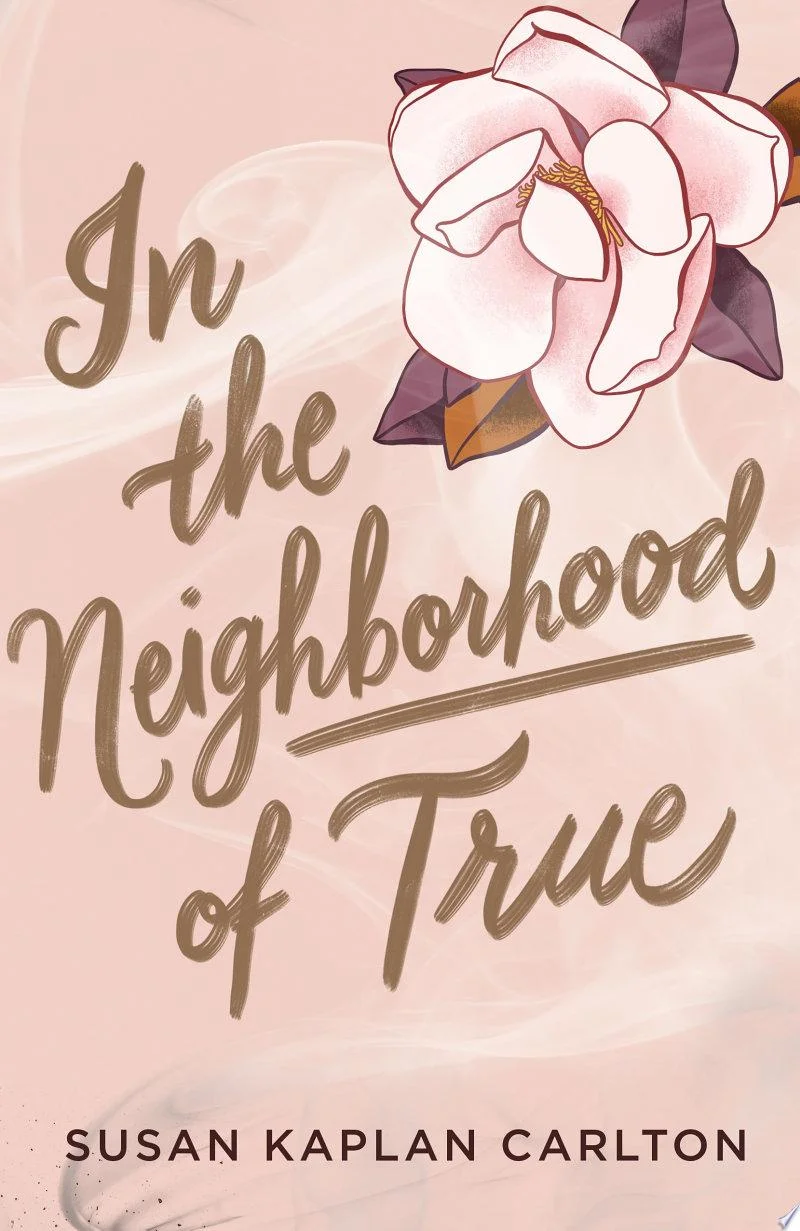
In the Neighborhood of True
- Publication Date:
- April 9th, 2019
- Publisher:
- Algonquin Young Readers
- ISBN-13:
- 9781616208608
- ISBN-10:
- 1616208600
- Pages:
- 321
Why In the Neighborhood of True Has Been Challenged
Some readers have pushed back against exposing teens to a storyline built around antisemitic violence and the era's entrenched racial hostility, arguing the content is too disturbing for school settings. See more ↓
Challenged or banned in 1 state across 1 school district.
Overview
Susan Kaplan Carlton's novel follows Ruth Robb, a teenager uprooted from New York City to Atlanta in the summer of 1958 after her father's death. The move drops Ruth into an unfamiliar social order of debutante culture, genteel manners, and a Jewish community that keeps a careful distance from the city's Christian establishment—one that, beneath its hospitality, still tolerates the presence of the Klan.
Eager to belong, Ruth conceals her religion from the popular girls she befriends and the boy she begins falling for, even as her mother insists the family keep up its weekly presence at the local synagogue. The arrangement holds only as long as the two halves of Ruth's life stay separate. A second relationship, with a boy deeply committed to civil rights activism, pulls her toward the very identity she has been suppressing.
The quiet balancing act Ruth has constructed collapses when an act of racially and religiously motivated violence forces the competing threads of her life into direct collision, leaving her to decide which version of herself she is willing to live as.
A Story of Assimilation and Reckoning
Carlton sets her coming-of-age story against a specific and volatile moment in Southern history, using one girl's private calculus about passing as Christian to illuminate larger questions about belonging, complicity, and courage. Ruth's dilemma is not abstract: fitting in offers real social rewards, while honesty carries real risk, and the novel resists easy resolution of that tension for much of its length.
The book also uses Ruth's divided loyalties—between a boyfriend inside the comfortable white Christian establishment and a boy actively engaged in the fight for justice—to dramatize a broader choice facing anyone with the option to stay silent: whether proximity to power is worth the erasure of self. By rooting this in a specific historical flashpoint rather than a generalized setting, the novel invites readers to consider how ordinary accommodation can coexist with, and even enable, extremism.
Why In the Neighborhood of True Has Been Challenged
The novel's frank treatment of antisemitism, including a depiction of a violent hate crime motivated by religious bigotry, sits at the center of most objections. Readers uncomfortable with young-adult fiction confronting historical bigotry directly have questioned whether the book's scenes of prejudice and violence are appropriate for school libraries and classrooms. Its portrayal of the Ku Klux Klan's presence in 1950s Atlanta, and the social normalization of exclusion that surrounds it, has similarly drawn scrutiny from those who view the material as too intense or politically charged for teen readers.
The book's handling of teen romance and social dynamics—including Ruth's secrecy, her relationships with two boys, and the pressures of adolescent conformity—has also factored into some objections, though the religious and racial violence at the story's core remains the primary source of concern. According to records maintained in this catalog, the title has been formally challenged in 1 state and 1 school district.
Where to Buy




Affiliate links may generate a small commission at no extra cost to you, which helps support this site.
Banned in Schools
Banned or challenged in 1 state across 1 school district.
Florida 1 district
- Escambia County Public Schools Banned pending investigation