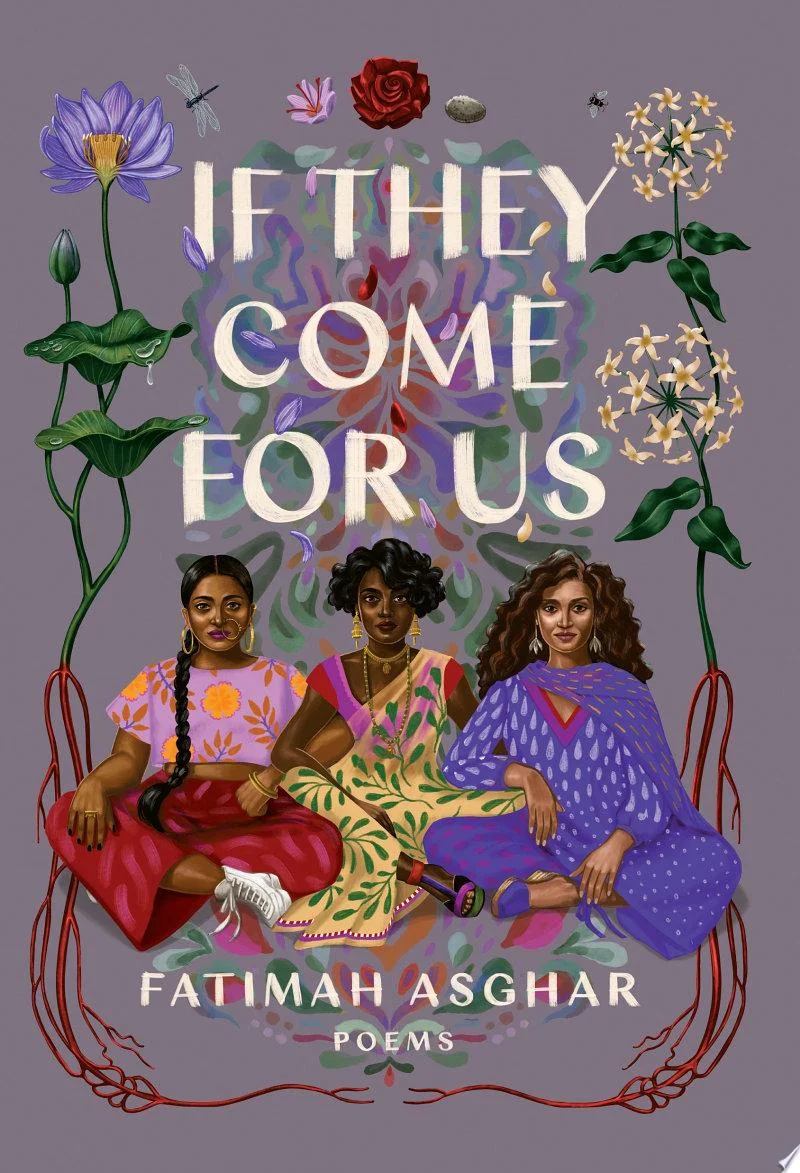
If They Come for Us
- Publication Date:
- August 7th, 2018
- Publisher:
- One World
- ISBN-13:
- 9780525509790
- ISBN-10:
- 0525509798
- Pages:
- 130
Why If They Come for Us Has Been Challenged
Its unguarded treatment of sexuality, grief, and inherited violence has made this collection a target for those who consider such material unsuitable for young readers, even as literary critics count those same qualities among its strengths. See more ↓
Challenged or banned in 1 state across 1 school district.
Overview
Fatimah Asghar's debut collection gathers poems that move between memory, myth, and the blunt textures of everyday American life. Written by a poet orphaned young, the book returns again and again to the absence of parents and the improvised forms of family and self-protection that fill that gap — an aunt's warning about which flowers are safe to eat becomes, in Asghar's hands, a quiet lesson in vigilance passed from one generation to the next.
The poems track a Pakistani Muslim woman's coming of age across questions of gender, sexuality, and national belonging, often bending traditional forms or inventing new ones to hold experiences that resist tidy narration. Loss and inheritance run alongside moments of humor and tenderness, so that grief is never presented as the whole story.
Rather than offering a single, linear account of identity, the collection layers personal recollection with broader histories of displacement and violence, suggesting that one person's story cannot be fully told apart from the collective histories that shape it.
Craft, Inheritance, and the Space Between Forms
Much of what distinguishes this collection is its formal restlessness. Asghar treats received poetic structures as material to be reshaped rather than rules to be followed, and that willingness to experiment mirrors the book's larger argument: that identity itself is not fixed but assembled, contested, and revised across a lifetime. The recurring figure of the orphan becomes a lens for examining how people construct selfhood without the usual scaffolding of family narrative, and how communities step in — imperfectly, urgently — to fill that role.
The book also sits at an intersection of the personal and the historical, weaving inherited trauma and cultural memory into individual coming-of-age material. This positions the collection within a broader lineage of contemporary poetry that treats the lyric "I" as inseparable from questions of nation, migration, and belonging, giving the book resonance beyond its author's particular biography.
Why If They Come for Us Has Been Challenged
Reviewers have singled out the collection for its formal inventiveness and emotional candor, praising its unflinching treatment of coming-of-age experience; the objections raised against it in schools and libraries take a very different view of that same candor. Where critics see honesty about a difficult childhood, challengers have pointed to the book's frank engagement with sexuality and its unsparing depictions of violence — including sexual violence and its aftermath — as inappropriate for the young readers who might encounter it on a library shelf.
Other objections center on the book's treatment of religious and cultural identity, with some challengers uneasy about a Muslim woman's poetry addressing gender and sexuality in terms that depart from more conventional or devotional framings. Still others have questioned the collection's suitability for school settings simply because of its adult themes and explicit imagery, regardless of the literary intent behind them. In this catalog, the book has drawn a challenge in 1 state and 1 school district, reflecting how a small number of objections can nonetheless place a work under formal review.
Where to Buy


Affiliate links may generate a small commission at no extra cost to you, which helps support this site.
Banned in Schools
Banned or challenged in 1 state across 1 school district.
Iowa 1 district
- Clarion-Goldfield-Dows Community School District Banned pending investigation