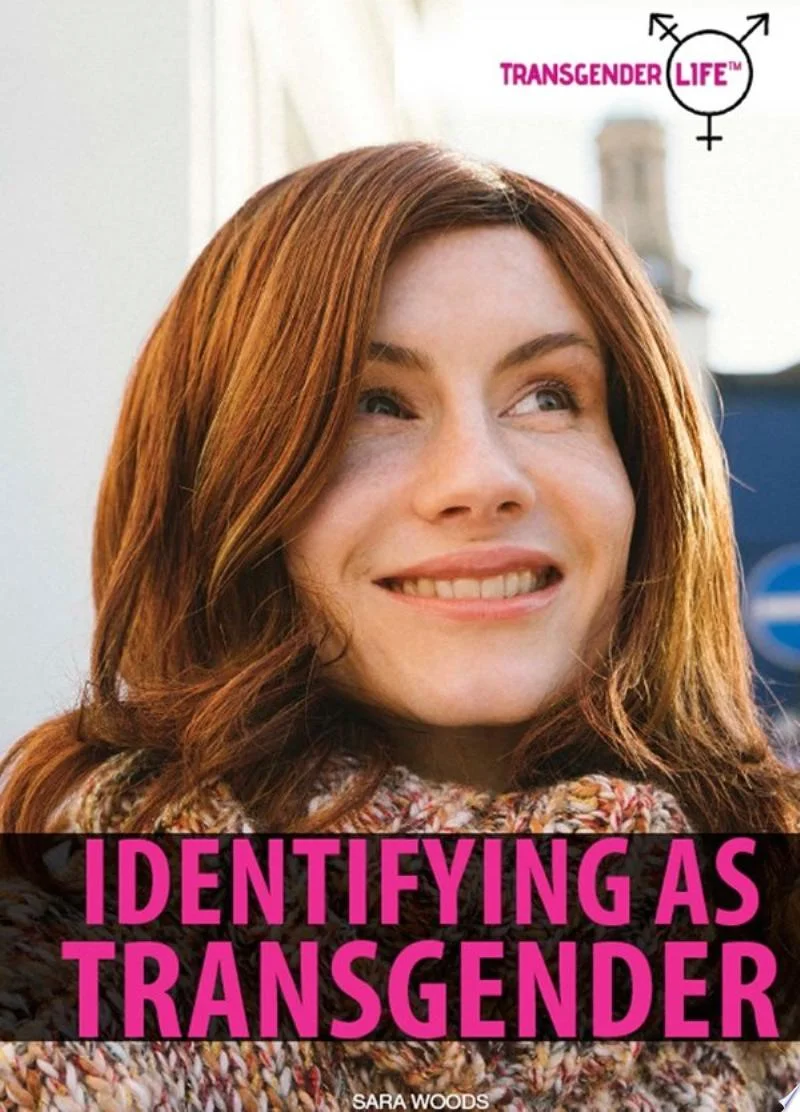
Identifying as Transgender
by Sara Woods
- Publication Date:
- December 15th, 2016
- Publisher:
- The Rosen Publishing Group, Inc
- ISBN-13:
- 9781499464573
- ISBN-10:
- 1499464576
- Pages:
- 66
Why Identifying as Transgender Has Been Challenged
Critics of this title have taken issue less with any single passage than with the premise that children's shelves are the right place to introduce vocabulary for gender identities beyond male and female at all. See more ↓
Challenged or banned in 1 state across 1 school district.
Overview
Sara Woods's "Identifying as Transgender" is a nonfiction introduction aimed at helping young readers understand the range of identities that fall outside a strict male/female binary. Rather than focusing on a single narrative or character, it functions as a vocabulary-building guide, walking through terms such as trans man, trans woman, genderfluid, bigender, and two-spirit, and explaining how each describes a different relationship to gender.
The book also draws distinctions that are often blurred in casual conversation: how a person expresses gender outwardly, how a person internally identifies, and how a person experiences attraction are presented as three separate axes rather than one package deal. It further touches on the idea that bodies themselves don't sort neatly into two categories.
Beyond definitions, the book addresses the social reality facing transgender people, including transphobia and cissexism, and the mistreatment that can result. It balances this by pointing to the networks of support that trans communities have built for one another, framing the material as both descriptive and reassuring.
Context and Reception
The book belongs to a wave of children's and middle-grade nonfiction published over the past decade that treats gender diversity as a factual topic suitable for early literacy, similar in spirit to books that introduce readers to family structures, disability, or racial identity. Its structure as a glossary-style primer, rather than a story, places it closer to a reference work than to narrative fiction, which shapes how it tends to be used: as a classroom or library resource for building shared vocabulary rather than as a book read start to finish for entertainment.
Within the broader landscape of children's publishing, the book sits alongside a growing number of titles that have become flashpoints in debates over what information is appropriate for young readers and who should decide that question, parents, educators, or school and library professionals. Its plain, instructional tone, explaining terms the way a book might explain weather patterns or historical events, has made it a frequent reference point in discussions about how gender-related topics should be introduced to children, separate from any questions about literary merit or narrative content.
Why Identifying as Transgender Has Been Challenged
Gender identity is the substance at the center of nearly every objection this book has drawn. Critics argue that introducing concepts like genderfluidity and non-binary bodies to young readers amounts to teaching a particular viewpoint on a contested social question rather than presenting neutral, factual material, and some contend that the terminology itself presumes conclusions that should be left to individual families to discuss. Others object to the book's treatment of gender expression and sexuality as developmental topics appropriate for children's shelves at all, regardless of how the information is framed.
A second strand of objection concerns the book's discussion of discrimination, with some challengers arguing that describing transphobia and the mistreatment trans people face casts the subject in overtly political terms rather than as straightforward information. Supporters of the book counter that naming the difficulties trans people encounter, alongside the support systems available to them, is essential to giving readers an accurate and compassionate picture rather than a sanitized one. In the catalog tracked here, the book has drawn a single formal challenge, recorded in one state and one district, reflecting a localized but pointed dispute over its place in children's collections.
Where to Buy


Affiliate links may generate a small commission at no extra cost to you, which helps support this site.
Banned in Schools
Banned or challenged in 1 state across 1 school district.
Texas 1 district
- Katy Independent School District Banned by Restriction