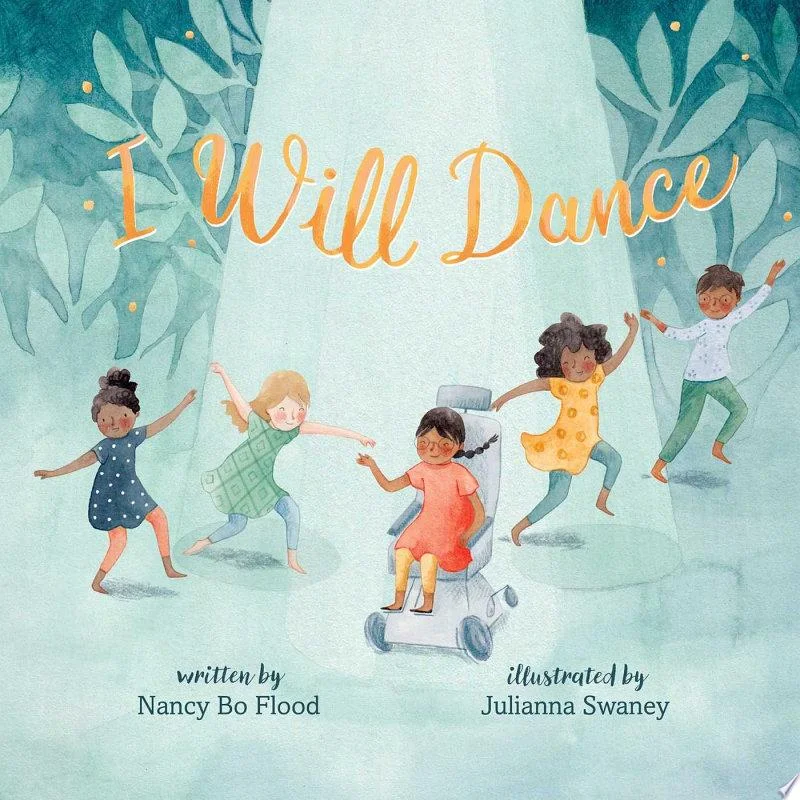
I Will Dance
- Publication Date:
- May 26th, 2020
- Publisher:
- Simon and Schuster
- ISBN-13:
- 9781534430624
- ISBN-10:
- 1534430628
- Pages:
- 48
Why I Will Dance Has Been Challenged
A quiet story about a wheelchair-using girl finding her place in a dance class has drawn objection less for anything on its pages than for broader disagreements about introducing disability and inclusion themes to young children. See more ↓
Challenged or banned in 1 state across 1 school district.
Overview
Told in spare, lyrical language, this picture book centers on Eva, a girl who dreams of becoming a dancer. Because Eva has cerebral palsy and uses a wheelchair, she has never seen anyone who moves the way she does take the stage, and she isn't sure what dance could look like for her.
The story turns on Eva's discovery of a studio that welcomes dancers of every physical ability. Her early attempts are hesitant, shaped by uncertainty about whether her body "counts" as a dancer's body, but the patience of her teacher and the camaraderie of her classmates gradually loosen that doubt.
By its close, the book arrives at a quiet affirmation: Eva finds not just technique but belonging, and her wish to dance is realized on her own terms rather than by conforming to a narrower idea of what dance requires.
Representation and the Shape of a Dream
What distinguishes this book within the picture-book landscape is its refusal to treat disability as an obstacle to be overcome before the "real" story can begin. Eva's cerebral palsy is not a problem solved by the plot; it is simply the condition under which she seeks, and finds, a form of dance suited to her. The narrative's interest lies less in triumph over adversity than in the expansion of a community's definition of who gets to dance at all.
That reframing places the book alongside a small but growing body of children's literature that foregrounds disabled protagonists as the subject of their own stories rather than as lessons for nondisabled readers. Its emotional register stays understated throughout, favoring the texture of a single girl's experience over any broader statement, which has contributed to its reception as a gentle, affirming entry point for conversations about inclusion and difference in early childhood settings.
Why I Will Dance Has Been Challenged
Reviewers and educators have generally praised the book for its warmth and its unforced handling of disability, yet it has still drawn formal objection in the single state and single district tracked in this catalog. The friction does not center on language or imagery in any conventional sense, but on the book's underlying subject matter: a wheelchair-using child's inclusion in an activity, and a space, historically imagined as requiring able-bodiedness.
Challenges to books foregrounding disability and inclusion of this kind often stem from broader disputes over which topics belong in early-grade curricula and classroom libraries, rather than from any specific passage. In practice, objections of this type tend to reflect discomfort with normalizing disability as an unremarkable part of childhood experience, or disagreement over whether such themes should be introduced by schools versus left to families. The result is that a book built around encouragement and belonging has nonetheless become swept up in wider curricular disputes far removed from its own quiet narrative content.
Where to Buy




Affiliate links may generate a small commission at no extra cost to you, which helps support this site.
Banned in Schools
Banned or challenged in 1 state across 1 school district.
Florida 1 district
- Clay County School District Banned pending investigation