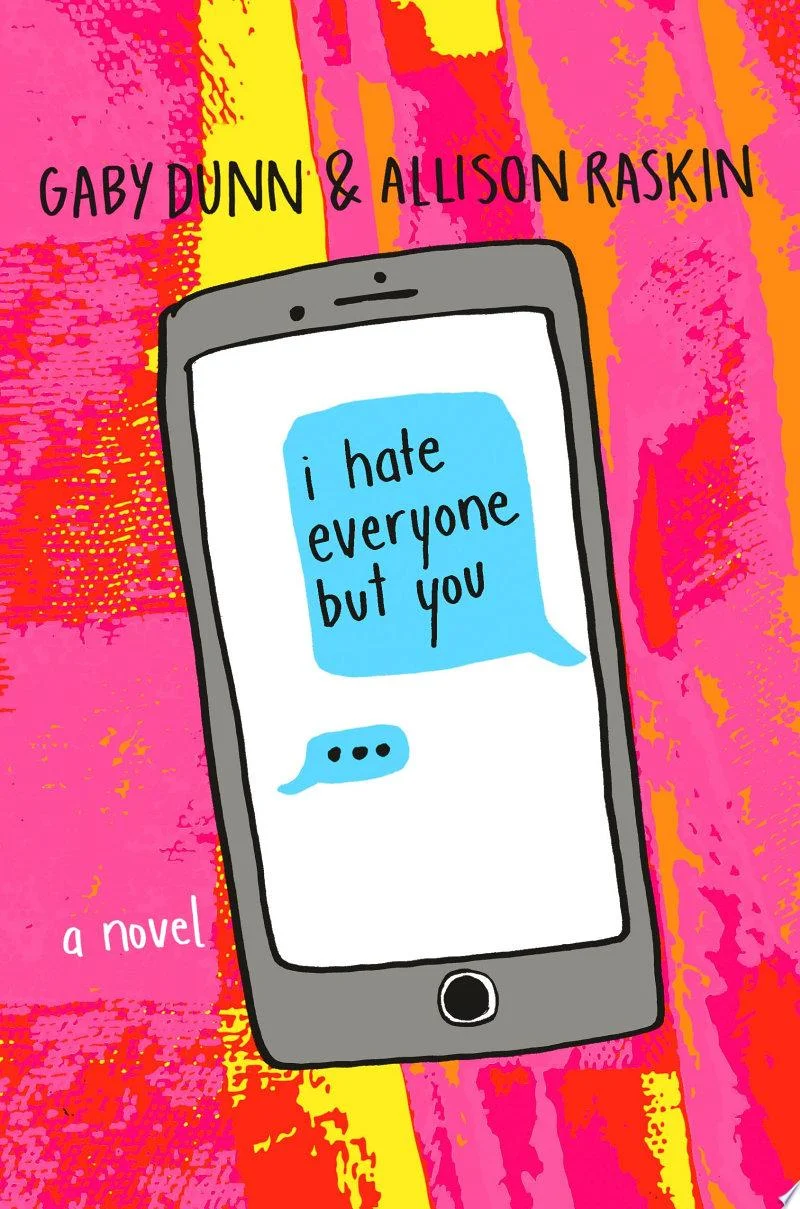
I Hate Everyone But You
by Gaby Dunn
- Publication Date:
- September 5th, 2017
- Publisher:
- Wednesday Books
- ISBN-13:
- 9781250129321
- ISBN-10:
- 125012932X
- Pages:
- 353
Why I Hate Everyone But You Has Been Challenged
Critics of the novel have taken issue less with any single scene than with its overall candor, arguing that its message-by-message intimacy exposes teen readers to mature content without the softening of adult oversight. See more ↓
Challenged or banned in 2 states across 2 school districts.
Overview
Gaby Dunn's "I Hate Everyone But You" follows two inseparable friends who, upon graduating high school, head off to colleges on opposite sides of the country. What begins as an easy, constant correspondence of texts and emails becomes the lifeline that keeps their friendship intact as new roommates, classes, relationships, and personal crises pull them in different directions.
Told entirely through the two friends' messages to one another, the novel captures the unglamorous, in-between moments of starting over: homesickness, awkward social missteps, the thrill and anxiety of first romances, and the slow realization that growing up sometimes means growing apart from the people who knew you best. The epistolary format gives the story an intimate, unfiltered quality, as the characters confide things to each other they might not say aloud.
At its core, the book is less about plot incident than about the texture of a long-distance friendship under strain, and whether honesty and vulnerability are enough to sustain a bond once two people are no longer living the same daily life.
A Portrait of Friendship in Transition
Dunn's novel sits within a tradition of coming-of-age fiction that uses correspondence, whether letters, diary entries, or digital messages, to dramatize the gap between who we are to ourselves and who we present to others. By rendering the entire story as an exchange of texts and emails, the book foregrounds a very contemporary form of intimacy: closeness maintained not through shared physical space but through a constant, low-grade stream of digital check-ins.
The novel also resists tidy resolution. College, in this telling, is not simply a backdrop for self-discovery but a force that exposes cracks in a friendship that once seemed unshakeable. That willingness to sit with discomfort, rather than reassure readers that everything works out neatly, is part of what distinguishes the book within the young-adult shelf, and likely part of why it has drawn attention from readers and gatekeepers alike for its candor about young adult life away from home.
Why I Hate Everyone But You Has Been Challenged
Much of the scrutiny directed at the novel centers on its frank treatment of its characters' early experiences with sex, alcohol, and romantic relationships as they navigate campus life for the first time. Because the story is delivered through unfiltered, peer-to-peer messages rather than an adult narrator's mediating voice, these experiences are presented with little editorial distance or moralizing, which some reviewers have found more appropriate for older teen or new-adult readers than for a general young-adult audience. Objectors have also pointed to the book's casual, often profane language as out of step with what they consider suitable for school library shelves. The novel's inclusion of a queer character's romantic life has additionally drawn complaints from those who object to LGBTQ+ content appearing in materials accessible to younger students. Taken together, these concerns reflect a broader disagreement over whether realistic, unvarnished depictions of first-year college experience belong in school collections or are better reserved for readers who seek them out elsewhere. The book has been the subject of 2 state-level and 2 district-level challenges tracked in this catalog.
Where to Buy




Affiliate links may generate a small commission at no extra cost to you, which helps support this site.
Banned in Schools
Banned or challenged in 2 states across 2 school districts.
Tennessee 1 district
- Wilson County Schools Banned