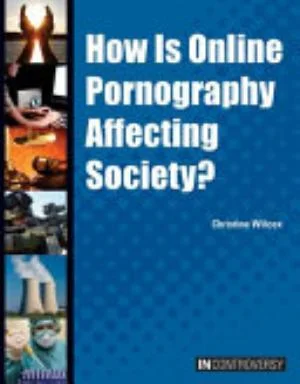
How is Online Pornography Affecting Society?
- Publication Date:
- January 1st, 2016
- ISBN-13:
- 9781601528834
- ISBN-10:
- 1601528833
- Pages:
- 96
Why How is Online Pornography Affecting Society? Has Been Challenged
Some parents and administrators have argued that a nonfiction title probing the mechanics and effects of internet pornography has no place on a shelf accessible to minors, regardless of its clinical framing. See more ↓
Challenged or banned in 1 state across 1 school district.
Overview
Christine Wilcox's title takes stock of a genuinely modern phenomenon: an internet saturated with sexually explicit material, now numbering in the millions of sites, and asks what that abundance has done to the people who encounter it. Rather than moralizing from the outset, the book proceeds by posing a series of direct questions and letting research, expert commentary, and case examples supply the answers.
The chapters trace a logical arc, beginning with how the online pornography industry took shape and grew alongside the internet itself, then moving into contested territory: whether habitual viewing functions like an addiction, how early or heavy exposure shapes adolescent development, and what patterns researchers have observed in couples and relationships where pornography use is a factor. A closing section turns from diagnosis to response, surveying proposed remedies ranging from parental controls to public policy.
Visual aids and quoted testimony are woven throughout, giving the text a documentary quality more common to journalism than to a typical reference volume, while still maintaining the structure and citation practices expected of the series it belongs to.
A Snapshot of a Still-Unsettled Debate
What distinguishes this book within the broader shelf of adolescent-health nonfiction is its refusal to settle the argument it describes. The addiction question, in particular, remains genuinely contested among clinicians and researchers, and Wilcox presents competing frameworks rather than adjudicating between them. That posture reflects the state of the science at the time of writing more than any editorial timidity.
The book also sits at an uneasy intersection of subjects that rarely share a page in young-adult nonfiction: sexuality, technology, and mental health. Its inclusion in a series aimed at teen and pre-teen readers signals a belief, common among library and educational publishers, that frank information delivered in a structured, sourced format serves young people better than silence. Reception of the book has tracked closely with reception of that broader premise, drawing both the interest of educators looking for a starting point on a difficult subject and the wariness of those who question whether the topic belongs in youth collections at all, whatever the tone.
Why How Is Online Pornography Affecting Society? Has Been Challenged
Sexual content is the throughline of every objection this book has drawn, even though its treatment of the subject is analytical rather than depictive. Critics have focused less on any explicit description within the text — there is essentially none — and more on the premise that a young reader should be handed a book whose organizing subject is pornography at all. For some challengers, the clinical framing does not neutralize the concern; it simply means the objection is to the topic's presence on the shelf rather than to any particular passage.
A related strand of criticism concerns age-appropriateness and parental authority: objectors have argued that decisions about when and how a minor learns about pornography's effects belong to families, not school or public libraries, and that shelving the book in youth sections preempts that choice. The book's public-health framing — treating exposure and use as matters of habit, development, and relationships — has done little to soften this objection, since the disagreement is less about accuracy than about audience and access. This has resulted in the book being challenged in 1 state and 1 district tracked in this catalog, a modest but notable footprint for a title whose stated purpose is prevention and understanding rather than provocation.
Where to Buy


Affiliate links may generate a small commission at no extra cost to you, which helps support this site.
Banned in Schools
Banned or challenged in 1 state across 1 school district.
Pennsylvania 1 district
- Lehighton Area School District Banned Pending Investigation