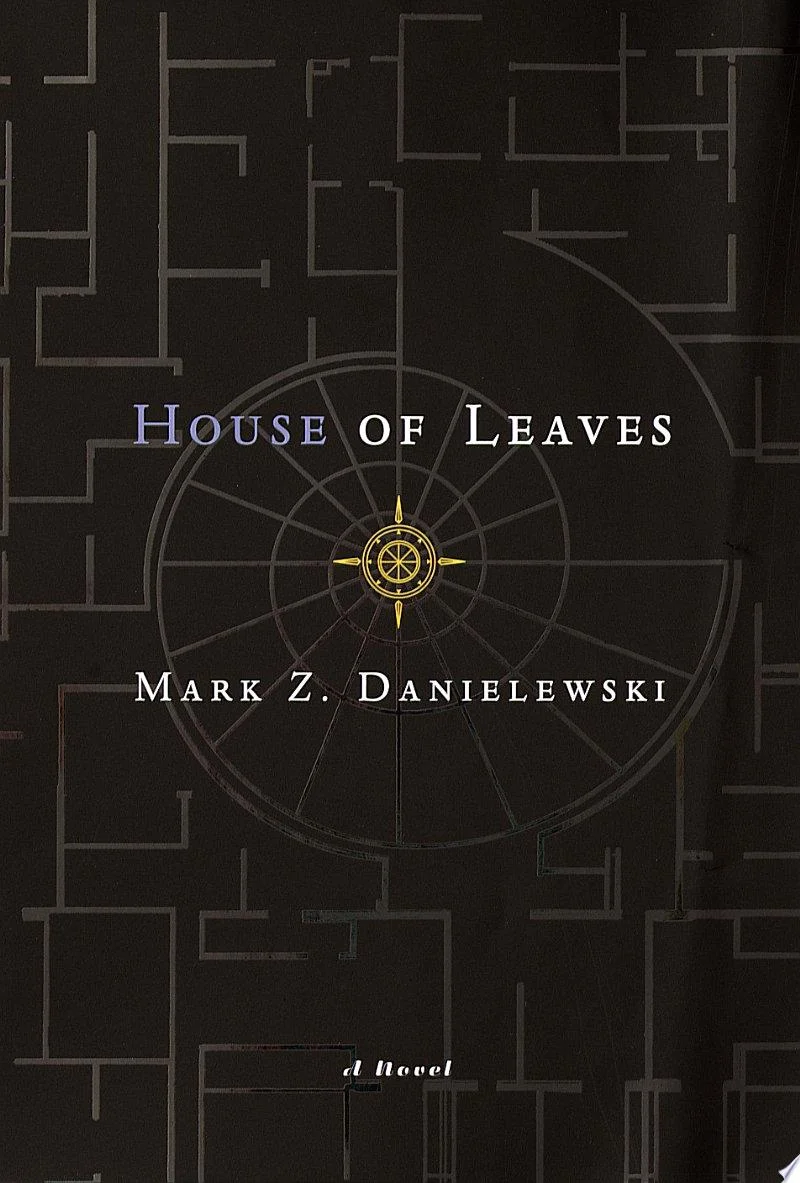
House of Leaves
- Publication Date:
- March 7th, 2000
- Publisher:
- Pantheon
- ISBN-13:
- 9780375420528
- ISBN-10:
- 0375420525
- Pages:
- 738
Why House of Leaves Has Been Challenged
Some parents and librarians have argued that the book's disorienting horror and frank, unfiltered passages make it a poor fit for shelves shared with younger readers, regardless of its literary reputation. See more ↓
Challenged or banned in 1 state across 1 school district.
Overview
House of Leaves presents itself as a manuscript within a manuscript. At its core is the Navidson Record, an account of a photojournalist and his family who discover that their new home contains a hallway, and eventually a vast dark expanse, that has no business existing according to the house's exterior measurements. That story is filtered through the notes of a blind scholar named Zampanò, who wrote extensively about a film that may never have existed, and those notes are in turn assembled and annotated by Johnny Truant, a troubled young man whose own sanity frays as he edits the text.
The novel is as much an object as a story. Footnotes branch into other footnotes, pages turn sideways or contain a single word, and typographic choices track the characters' descent both physically and psychologically. Readers are asked to navigate the book much as the characters navigate the house: uncertain of scale, uncertain of what is solid ground.
Mark Z. Danielewski's approach turns a haunted-house premise into an extended meditation on how stories get told, edited, and distorted by the people who pass them along.
A Novel About Reading Itself
Much of the critical and academic attention paid to House of Leaves centers on its refusal to separate form from content. The house's impossible geometry becomes a metaphor for the unreliability of the narrators recounting it, and for the reader's own growing disorientation as competing texts, appendices, and correspondence compete for authority on the page. The novel has been read as a work of horror, a puzzle box, a critique of academic annotation, and a study of grief and estrangement within families.
Its influence has extended well past literary circles. The image of an interior space that expands into featureless, echoing dark has been credited with shaping later internet folklore about liminal, uncanny architecture, and the book continues to be assigned in university courses on postmodern fiction and media theory. Its endurance owes less to conventional plotting than to the way it implicates the reader directly in its central unease: the sense that something is wrong with the space you occupy, and that the wrongness cannot be fully documented, only circled.
Why House of Leaves Has Been Challenged
Most objections cite the book's suitability for high school-age readers, arguing that its unconventional structure and unfiltered content make it a difficult fit for a shared secondary school library rather than a college or adult collection. Critics of the book's inclusion point to passages of frank sexual content, along with the visceral, cumulative dread that builds around the Navidson family's unraveling, as material better suited to mature or self-selecting readers than to a general teenage audience. The novel's treatment of mental instability, isolation, and family breakdown, rendered through Johnny Truant's increasingly unreliable narration, has also drawn concern from those who feel its psychological intensity is presented without enough narrative distance for younger readers. In the catalog tracked here, that objection has resulted in a challenge recorded in one state and one district, reflecting a narrow but persistent concern about where experimental, adult-oriented horror fiction belongs on school shelves.
Where to Buy



Affiliate links may generate a small commission at no extra cost to you, which helps support this site.
Banned in Schools
Banned or challenged in 1 state across 1 school district.
Texas 1 district
- Fort Bend Independent School District Banned by Restriction