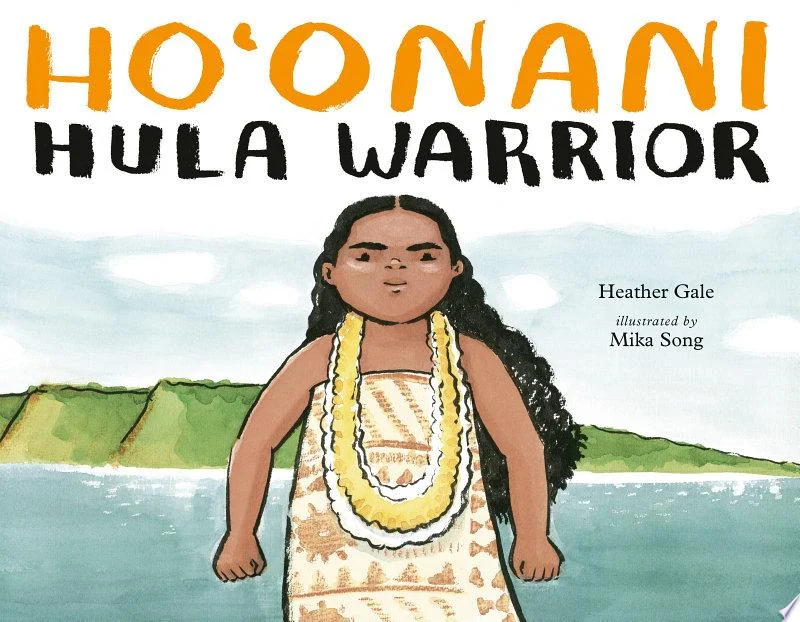
Ho'onani: Hula Warrior
by Heather Gale
- Publication Date:
- October 1st, 2019
- Publisher:
- Tundra Books
- ISBN-13:
- 9780735264502
- ISBN-10:
- 0735264503
- Pages:
- 22
Why Ho'onani: Hula Warrior Has Been Challenged
Critics of this title have taken issue less with any single passage than with the premise itself: a real child's refusal to be sorted into girl or boy, told plainly enough for young readers to take as simply true. See more ↓
Challenged or banned in 1 state across 1 school district.
Overview
Ho'onani: Hula Warrior tells the true-life-inspired story of a schoolgirl in Hawaiʻi who does not fit neatly into the categories of wahine or kane. She describes herself as living comfortably in the middle, and the narrative follows her as that self-understanding is tested by a specific, concrete goal: leading her school's upcoming performance of a traditional kane hula chant, a role that has always belonged to boys.
Rather than framing her ambition as rebellion, the book presents it as a natural extension of who Ho'onani already is. Her path to the front of the troupe is not instant or uncontested; classmates and teachers have to reconcile their expectations with her request, and the story traces that adjustment alongside her own preparation and resolve.
The book draws its emotional weight from its grounding in an actual person and place. Hawaiian language and cultural practice are woven throughout, giving the story a specificity that extends beyond a generic lesson about gender roles into a portrait of one community's particular traditions and the way they bend, or don't, to accommodate an individual.
Cultural and Thematic Context
The book sits at an intersection of two subjects that don't always appear together in children's literature: Native Hawaiian cultural preservation and questions of gender identity. Hula, and particularly the kane chant Ho'onani wants to lead, carries weight as a form of cultural transmission, something passed down and performed with seriousness rather than treated as costume or spectacle. The story's stakes come as much from this cultural gravity as from the gender question itself.
Its origin in documentary filmmaking (Ho'onani's story was first told on screen before being adapted for young readers) shapes its tone. The book reads less like an invented parable about acceptance than like a record of something that actually happened to a specific child in a specific community, which gives its resolution a quieter, more documentary feel than a typical issue-driven picture book.
Within the broader landscape of children's books addressing identity, Ho'onani stands out for resisting a binary resolution. The girl at its center isn't shown transitioning toward one category or the other; she remains in between, and the book's idea of progress is the community's willingness to make room for that, not her own change.
Why Ho'onani: Hula Warrior Has Been Challenged
Disputes over this title have generally centered on whether its subject matter belongs in elementary and early-grade collections at all, rather than on any explicit content within the text itself. Because the book is aimed at young children and uses straightforward, accessible language, some adults have argued that the concepts it introduces are better suited to older readers or to conversations initiated by parents rather than encountered on a library shelf.
At the core of most objections is discomfort with a children's book that presents a gender identity outside the usual girl/boy framework as a settled, unremarkable fact rather than a question to be debated. Critics have characterized this as introducing ideology to young readers under the guise of a cultural story, while defenders point out that the book never uses clinical or political language, instead staying close to one child's lived experience and her relationship to her own culture.
A smaller thread of concern has touched on the book's handling of traditionally gendered cultural roles, with some objecting to a narrative in which a long-standing, sex-specific practice is reshaped to include someone who doesn't fit its original terms. According to the records compiled in this catalog, the book has drawn a challenge in 1 state and 1 district, reflecting a narrow but persistent concern among a subset of reviewers rather than widespread contention.
Where to Buy




Affiliate links may generate a small commission at no extra cost to you, which helps support this site.
Banned in Schools
Banned or challenged in 1 state across 1 school district.
Iowa 1 district
- Clear Creek-Amana Community School District Banned pending investigation