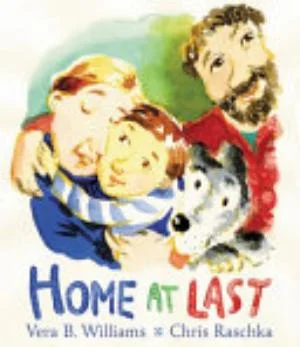
Home at Last
- Publication Date:
- September 13th, 2016
- Publisher:
- Greenwillow Books
- ISBN-13:
- 9780061349737
- ISBN-10:
- 0061349739
Why Home at Last Has Been Challenged
Complaints have centered less on the book's gentle bedtime story than on its choice to depict a two-father household as an unremarkable, loving norm. See more ↓
Challenged or banned in 1 state across 1 school district.
Overview
Lester has a new family and a new house, but he cannot sleep. Every night after his adoption by Daddy Albert and Daddy Rich, he pads down the hall to their bedroom, certain that curling up beside his fathers and their dog, Wincka, is the only way to keep the dark at bay. His parents, gentle but firm, walk him back to his own room each time, trusting that the fear will fade as Lester settles into his new life.
By day, there is real joy: a new bike, ice cream outings, cocoa with newly met cousins, the small rituals through which a family gets acquainted with itself. But daylight happiness doesn't reach into the night, and Lester's dread returns with the dark until Wincka, not his fathers, finds the fix — climbing into his bed to serve as pillow and guardian at once, and letting him feel, finally, that he belongs.
The book was among the last Vera B. Williams worked on before her death in 2015, completed with her longtime collaborator Chris Raschka, whose paintings draw on her sketches and carry forward her intentions for the story.
Family, Fear, and the Meaning of Belonging
Williams built a career on picture books attentive to the textures of family life — its economies, its improvisations, its tenderness — and Home at Last extends that focus to a family formed through adoption rather than birth. The anxiety at the story's center is not about the two fathers themselves but about the universal childhood fear of not yet belonging: the sense, common to many adopted children, that safety must be tested and retested before it can be trusted.
What distinguishes the book within Williams's body of work is its quiet insistence that this reassurance can come from an unexpected source — not a parent's words, but a dog's simple presence. That choice keeps the story from moralizing; the resolution is felt rather than explained. Raschka's brushwork, completed in the shadow of his collaborator's death, has been read as an act of tribute as much as illustration, extending a shared artistic voice past the point where one half of it could keep working.
Why Home at Last Has Been Challenged
Most objections to the book target its intended audience of preschool and early-elementary readers, arguing that children this young should not be introduced to a household headed by two fathers before they have the context, as critics see it, to process family structures outside the conventional. The concern is less about any explicit content — there is none — than about the normalization of a same-sex parented family as simply one more version of home, presented without comment or explanation to readers whose own understanding of family is still forming.
Some challengers have also framed the book as an example of values being introduced through the school library or classroom rather than at home, treating its depiction of adoption by two dads as advocacy rather than a story reflecting an existing family form. The catalog records this title as challenged or banned in one state and one district to date, disputes that center on the presence of a same-sex household in a book for very young readers rather than on any other element of the story.
Where to Buy




Affiliate links may generate a small commission at no extra cost to you, which helps support this site.
Banned in Schools
Banned or challenged in 1 state across 1 school district.