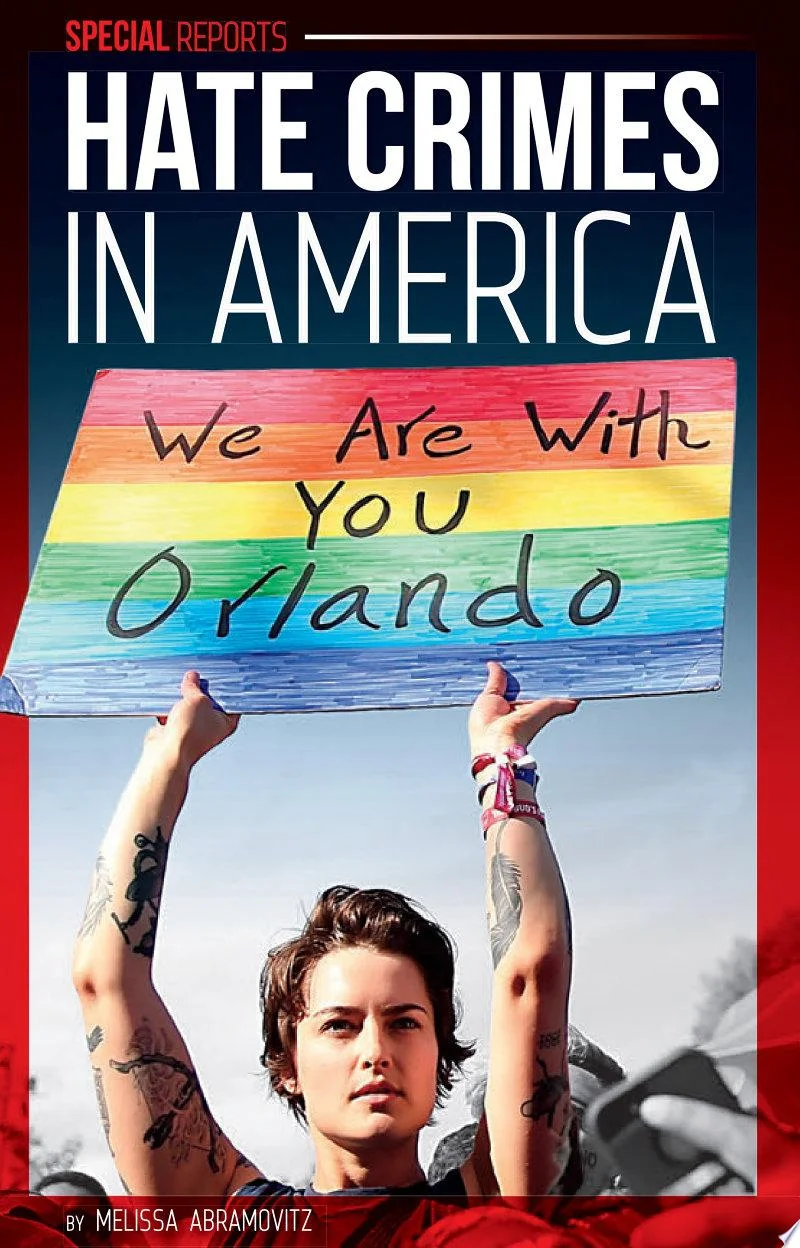
Hate Crimes in America
- Publication Date:
- December 15th, 2016
- Publisher:
- ABDO
- ISBN-13:
- 9781680797497
- ISBN-10:
- 1680797492
- Pages:
- 115
Why Hate Crimes in America Has Been Challenged
Some parents and community members have argued that a nonfiction survey of hate-motivated violence exposes young readers to disturbing material before they are equipped to process it. See more ↓
Challenged or banned in 1 state across 1 school district.
Overview
Hate Crimes in America is a nonfiction work by Melissa Abramovitz that traces bias-motivated violence in the United States from its historical roots through contemporary incidents. Rather than treating hate crimes as isolated events, the book situates them within longer patterns of racial, religious, ethnic, and other forms of prejudice that have periodically erupted into organized or individual violence.
The book moves between historical account and current-events reporting, drawing on cases that have drawn national attention to illustrate how prejudice translates into criminal acts. It also devotes attention to the response side of the story: law enforcement categorization of hate crimes, legislative efforts to address them, and grassroots or institutional efforts by affected communities to rebuild and advocate for change.
Written for a middle-grade to young-adult readership and structured around curricular standards, the book functions as an entry point for students encountering the subject in a classroom setting, pairing factual grounding with discussion of ongoing social response.
Context and Reception
The book belongs to a genre of standards-aligned nonfiction designed to bring difficult social-studies topics into classrooms and school libraries in a format teachers can assign with confidence that it meets curricular benchmarks. Its subject sits at the intersection of American history, civics, and current events, areas where publishers have increasingly sought to give younger readers factual, age-appropriate accounts of subjects once reserved for older students or adult readers.
What the book is ultimately grappling with is how to present real, sometimes recent violence to young readers without either sanitizing it into abstraction or overwhelming them with graphic detail. That balancing act, common to the broader library of social-issues nonfiction for young readers, is also what tends to draw scrutiny: a text can be judged too clinical by some and too unflinching by others, often depending less on the book itself than on differing views of what students are ready to encounter.
Why Hate Crimes in America Has Been Challenged
Most objections to the book cite its use with middle-school-aged readers, arguing that students at that age are not yet prepared to process detailed accounts of real-world violence motivated by prejudice. Critics in these cases have contended that the book's case studies, drawn from actual incidents, expose younger students to disturbing content without sufficient context or adult guidance to help them process it.
A related strand of objection concerns the book's treatment of the social and political dimensions of prejudice, with some critics arguing that its discussion of ongoing bias and discrimination introduces contested or divisive material into the classroom rather than settled historical fact. Others have raised concerns that presenting hate crimes as an ongoing, unresolved problem, rather than a closed historical chapter, casts current institutions or communities in an unflattering light.
The book has been the subject of 1 challenge tracked in this catalog, spanning 1 state and 1 school district, reflecting the broader tension school libraries face when shelving nonfiction that treats prejudice and violence as live social issues rather than settled history.
Where to Buy




Affiliate links may generate a small commission at no extra cost to you, which helps support this site.
Banned in Schools
Banned or challenged in 1 state across 1 school district.
Florida 1 district
- Okaloosa County School District Banned pending investigation