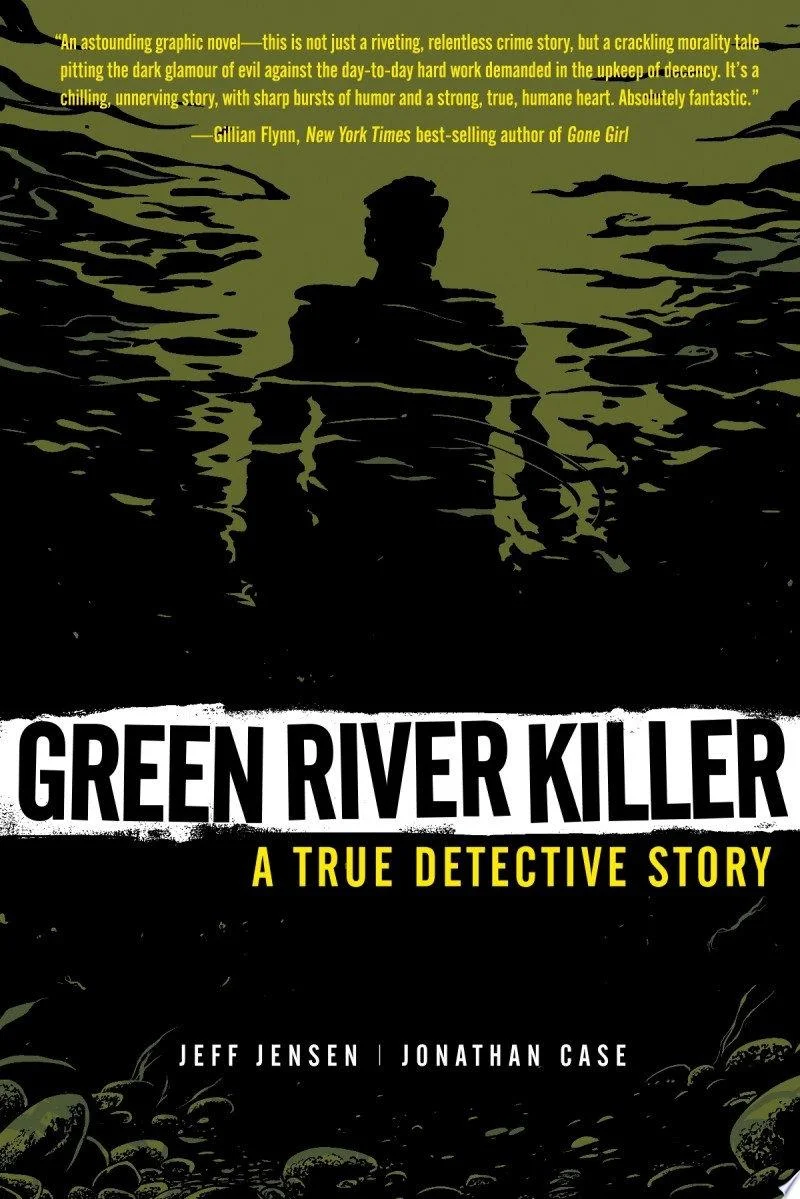
Green River Killer
by Jeff Jensen
- Publication Date:
- November 10th, 2015
- Publisher:
- Dark Horse Comics
- ISBN-13:
- 9781616558123
- ISBN-10:
- 1616558121
- Pages:
- 241
Why Green River Killer Has Been Challenged
Critics have objected to the book's unflinching illustrated depictions of murder victims and a serial killer's own account of his crimes, arguing the material is too graphic for young readers regardless of its basis in a real investigation. See more ↓
Challenged or banned in 1 state across 1 school district.
Overview
This graphic novel follows Tom Jensen, a King County detective assigned for years to a single open case: the unsolved killings attributed to a man the press dubbed the Green River Killer. Across the 1980s and into the 1990s, the investigation absorbed enormous resources without producing an arrest, even as the number of known victims climbed past four dozen.
The story's second half shifts from manhunt to interrogation room. Once DNA evidence finally identified Gary Leon Ridgway, Jensen was given an unusual assignment: spend half a year talking with the man he had spent his career chasing, trying to extract details about crimes that had gone unsolved for decades.
Written by the detective's own son and rendered in comics form, the book pairs procedural detail with a more intimate question — what does it cost an investigator to sit, day after day, across from the person responsible for so much loss?
A Father's Case, A Son's Telling
Part of what distinguishes this book from other true-crime accounts is its authorship: the writer is the detective's own child, working from his father's recollections rather than secondhand reporting. That vantage shapes the book's interest less toward spectacle and more toward the psychological toll of sustained proximity to violence — what two decades on one case does to the person assigned to it, and what 180 days of conversation with a confessed killer demands of someone whose job was simply to listen.
The comics format itself matters here. Illustration allows the narrative to render crime-scene and interrogation-room material without the explicit visual documentation that photography or film might require, while still conveying the weight of what is being discussed. The book sits within a broader body of true-crime graphic nonfiction that uses sequential art to process cases too vast or too disturbing to summarize in a single narrative arc, and it has drawn attention both for its insider source material and for the ethical discomfort built into its premise — a lawman spending half a year in sustained, almost collegial, dialogue with a serial killer.
Why Green River Killer Has Been Challenged
The book's subject matter is drawn directly from one of the deadliest documented serial murder cases in American history, and its pages depict the discovery of victims' remains, descriptions of how the killings occurred, and the killer's own recounting of his crimes during interrogation. Reviewers have taken issue with exposing younger readers to graphic depictions of violence against women and to a first-person-adjacent account of a murderer explaining his methods, arguing the content is disturbing regardless of its documentary intent.
Objections have also centered on the book's visual format: because it renders crime scenes and victims in illustrated form, some reviewers argue the imagery is more viscerally graphic, and therefore less appropriate for school or library shelves, than an equivalent passage of prose would be. This catalog tracks 1 state and 1 district where the title has been formally challenged or restricted.
Where to Buy




Affiliate links may generate a small commission at no extra cost to you, which helps support this site.
Banned in Schools
Banned or challenged in 1 state across 1 school district.
Florida 1 district
- Orange County Public Schools Banned pending investigation