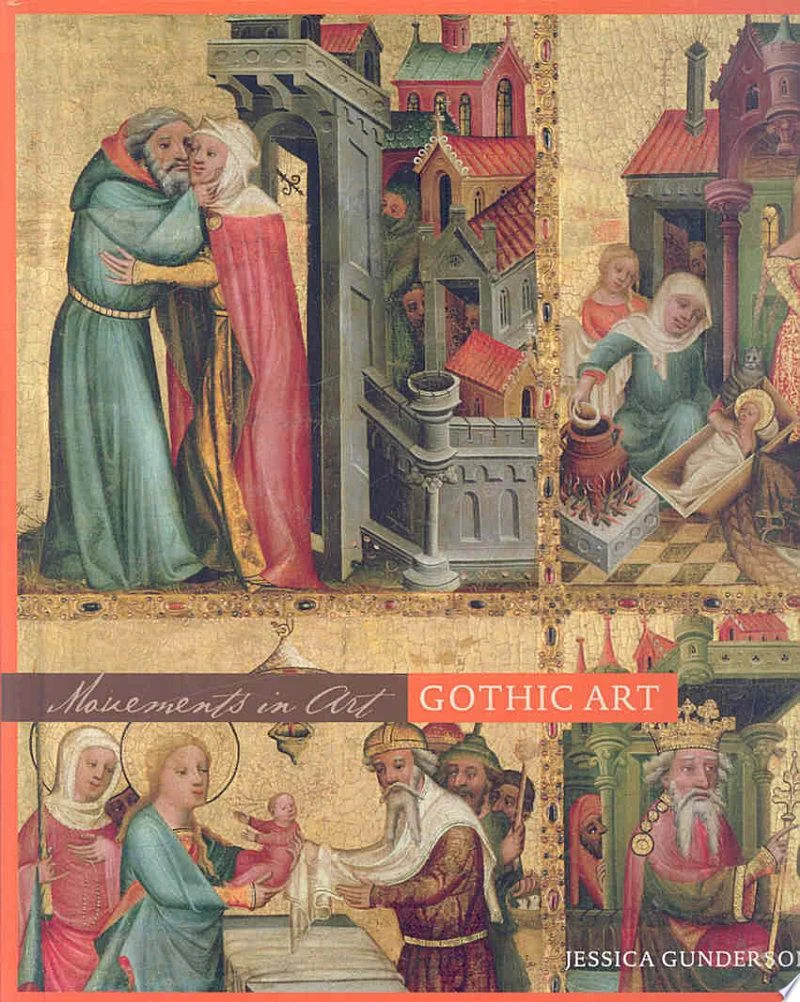
Gothic Art
- Publication Date:
- July 1st, 2008
- Publisher:
- The Creative Company
- ISBN-13:
- 9781583416105
- ISBN-10:
- 1583416102
- Pages:
- 48
Why Gothic Art Has Been Challenged
Reviewers have taken issue less with the book's text than with the unsettling religious and mortality-themed imagery inherent to reproducing genuine Gothic artworks for a young audience. See more ↓
Challenged or banned in 1 state across 1 school district.
Overview
Jessica Gunderson's Gothic Art offers a compact survey of one of art history's more misunderstood eras. Rather than assuming prior knowledge, the book walks readers through the circumstances that gave rise to the Gothic style, situating it against the artistic conventions it broke from and the cathedrals, manuscripts, and sculpture that carried it forward.
The book's structure favors clarity over exhaustive detail: it identifies the core visual and philosophical traits that define Gothic work, traces a rough timeline of the movement's emergence, and highlights the figures whose contributions are considered most representative of the period. This makes it less an academic treatise than an entry point for a reader encountering the subject for the first time.
Throughout, the emphasis stays on art as a historical artifact — a way of seeing that reflected the concerns of its era — rather than on any single masterpiece or biography. The result is a guide meant to orient rather than to overwhelm.
Art History as a Lens on the Past
Books that introduce a historical art movement to younger readers occupy an interesting niche: they double as art instruction and as a quiet lesson in how belief, architecture, and craft were once inseparable. Gothic art, in particular, emerged alongside profound shifts in medieval religious and civic life, and any honest introduction to it has to gesture toward that context, even in broad strokes.
This kind of survey also sits within a broader publishing category of illustrated, single-topic nonfiction aimed at students and casual readers — books designed to be encountered in a library or classroom rather than read cover to cover. Their value is often less about original scholarship than about accessibility: giving a reader unfamiliar with art history a vocabulary and a mental map before they encounter the subject in more depth elsewhere.
Why Gothic Art Has Been Challenged
Much of the friction around books like this one has less to do with the text itself than with questions of shelving and audience: whether a given volume belongs in an elementary collection, a middle-grade one, or should be reserved for older students. In the case of Gothic Art, objections have generally centered on the visual content inherent to the subject matter — Gothic art frequently drew on religious, mortal, and macabre imagery, including depictions tied to death, judgment, and suffering, and reproductions of such works can read very differently out of their historical context than within it. Some reviewers have also raised concerns about religious imagery appearing in a general-audience educational text, questioning whether it is presented with sufficient neutrality for a school setting. Records maintained by this catalog show the book has been formally challenged in one state and one district, a narrow but notable footprint for a work whose purpose is fundamentally educational rather than provocative.
Where to Buy




Affiliate links may generate a small commission at no extra cost to you, which helps support this site.
Banned in Schools
Banned or challenged in 1 state across 1 school district.