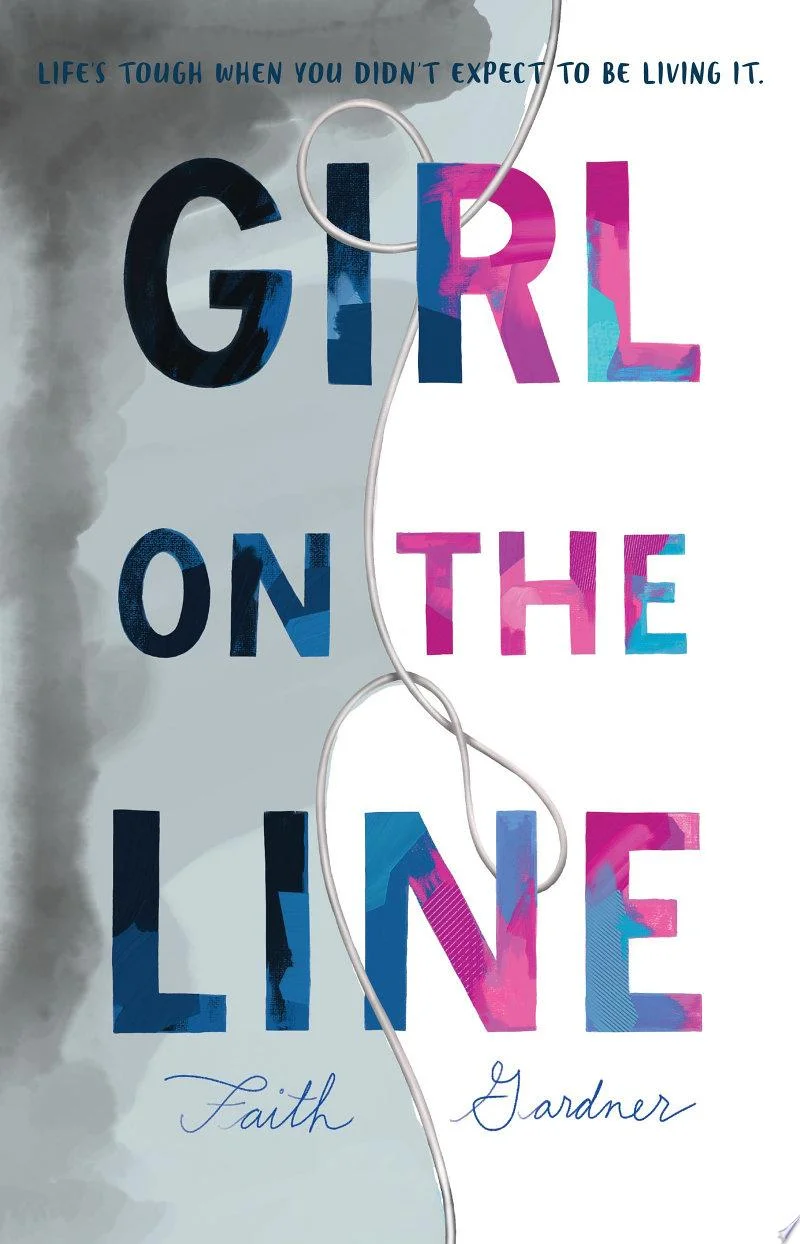
Girl on the Line
- Publication Date:
- January 19th, 2021
- Publisher:
- HarperCollins
- ISBN-13:
- 9780063022324
- ISBN-10:
- 006302232X
- Pages:
- 291
Why Girl on the Line Has Been Challenged
Critics have pushed back against the book's frank, close-up portrayal of a teen's suicide attempt and ongoing mental illness, arguing the material is too raw for the shelves it occupies. See more ↓
Challenged or banned in 1 state across 1 school district.
Overview
Faith Gardner's novel follows Journey, a teenager navigating the aftermath of a suicide attempt. The story opens not at the moment of crisis but in its long, uneven wake, when the acute emergency has passed but the work of living with herself has only just begun.
Journey's bipolar II disorder shapes her days in ways that resist easy narrative arcs: some mornings are survivable only in increments, while others open onto unexpected connection, including a new friendship with Etta, a college student whose self-possession offers Journey a different way of imagining her own future. Her parents fumble for the right words, her closest friend leans on humor that lands wrong, and the gap between how she is perceived and how she actually feels becomes its own quiet subplot.
A volunteer crisis hotline becomes an unlikely anchor, introducing Journey to people who are, in their own ways, holding themselves together. Through these relationships, the novel traces a slow, nonlinear movement toward self-understanding rather than a tidy recovery.
Mental Health and the Work of Staying Alive
Gardner, whose earlier novel The Second Life of Ava Rivers drew praise for its unsentimental handling of family trauma, brings a similar restraint to this story's treatment of mental illness. Rather than positioning Journey's recovery as a single turning point, the novel is more interested in the ongoing, often unglamorous labor of managing a mood disorder: medication, routine, the strain it places on family communication, and the small, cumulative acts that make a day bearable.
The book also pays close attention to the people surrounding Journey, suggesting that crisis rarely isolates one person alone. Her parents' uncertainty and her friend's misplaced jokes are treated with empathy rather than blame, framing mental illness as something a whole household and friend group has to learn to live alongside. The hotline setting widens the lens further, placing Journey among volunteers and callers whose own fragility and resilience mirror hers, and reinforcing the idea that struggle is common rather than isolating. In this way, the novel sits within a growing body of young adult fiction that treats depression, suicidality, and recovery as ongoing processes rather than plot devices to be resolved and left behind.
Why Girl on the Line Has Been Challenged
The novel's unguarded depiction of Journey's suicide attempt and the emotional terrain that follows it is the element most often cited by those who have sought its removal from shelves. Because the story lingers in the specific, painful details of that day and its aftermath rather than summarizing them at a distance, some readers have argued that the material is too explicit or too heavy for younger teen audiences, worried that depicting the experience so directly risks normalizing or even instructing rather than warning against it. Others have objected to the book's candid treatment of mental illness and its depiction of a teenager forming an intense bond with an older college student, viewing both as inappropriate subject matter for a school library's intended age range. This book has been challenged or banned in 1 state and 1 school district tracked in this catalog, reflecting the broader debate over how directly young adult literature should portray suicide and psychiatric illness.
Where to Buy




Affiliate links may generate a small commission at no extra cost to you, which helps support this site.
Banned in Schools
Banned or challenged in 1 state across 1 school district.