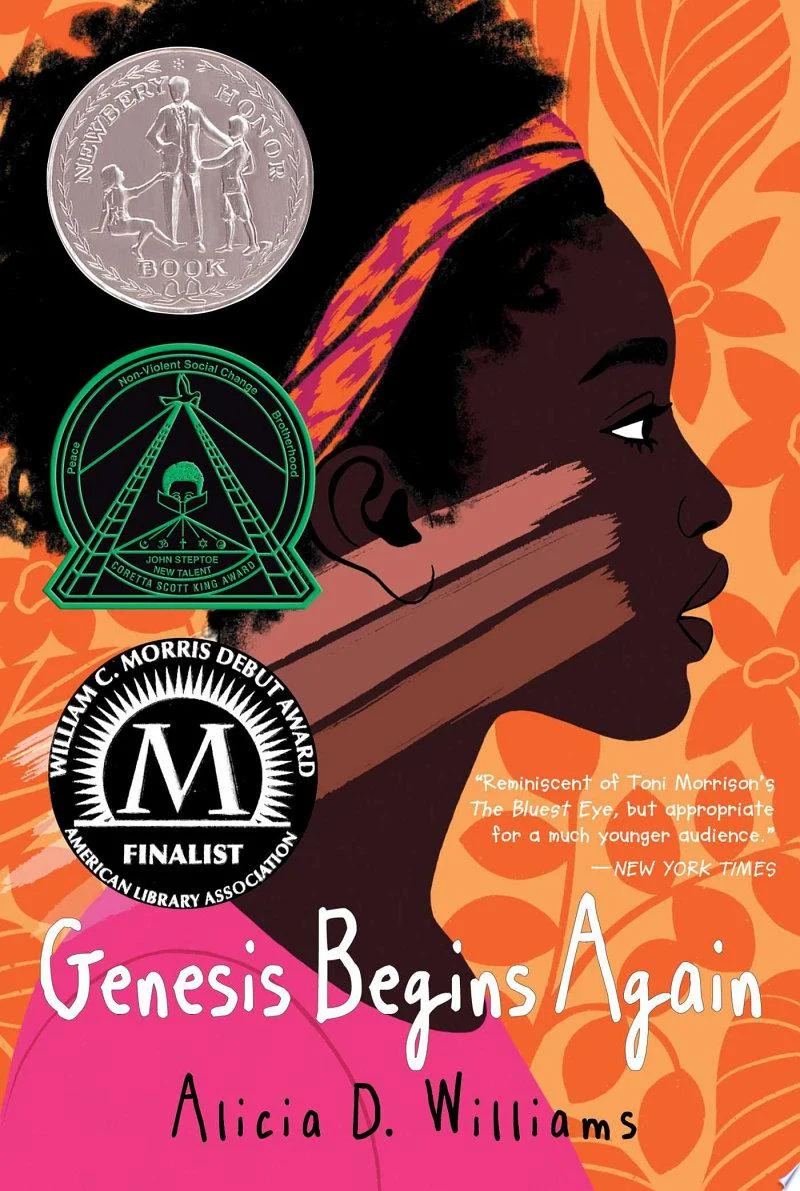
Genesis Begins Again
- Publication Date:
- August 18th, 2020
- Publisher:
- Atheneum/Caitlyn Dlouhy Books
- ISBN-13:
- 9781481465816
- ISBN-10:
- 1481465813
- Pages:
- 384
Why Genesis Begins Again Has Been Challenged
Readers have pushed back on the book largely over its unsparing look at self-harm, addiction in the home, and a child's internalized belief that her own skin color makes her unlovable. See more ↓
Challenged or banned in 1 state across 1 school district.
Overview
Alicia D. Williams's debut novel follows thirteen-year-old Genesis Anderson through a period of upheaval: her family has just been evicted again, her father's gambling and drinking have left them scrambling for stability, and Genesis has quietly decided that she is the source of the family's troubles. She copes by cataloging her perceived flaws in a running list, a device that gives the novel its emotional structure and its most unflinching material.
Much of that list circles back to Genesis's skin color and her belief that being "too black" makes her less lovable, less acceptable, and less like the mother she wishes she resembled. Williams traces how that belief takes root in offhand comments, family tension, and the general instability of a household in crisis, rather than presenting it as something Genesis invents on her own.
The novel's arc moves from self-erasure toward self-acceptance, as Genesis begins to notice her own talents and worth even while her family's problems remain unresolved. The ending offers hope without pretending that hope alone fixes an unstable home.
A Coming-of-Age Story About Colorism
Williams's novel sits within a lineage of middle-grade and young-adult fiction that examines how children absorb and internalize racial bias, including bias that circulates within their own families and communities. Rather than depicting racism only as something imposed from outside, the book is concerned with colorism specifically — the idea that lighter skin is treated as more desirable even among Black characters — and how a young person can come to see her own body as a problem to be solved.
The novel also pairs that theme with a candid look at economic instability and a parent's addiction, tying Genesis's self-image to the chaos of eviction, secrecy, and a household organized around managing a parent's behavior. Critics have noted the book's willingness to sit with discomfort rather than resolve it neatly, and it has been discussed alongside other contemporary works that center Black girlhood and interior emotional life rather than plot-driven adventure. Its combination of a specific, personal voice with a difficult social theme has made it a frequently recommended title for classroom discussions of identity and self-worth.
Why Genesis Begins Again Has Been Challenged
Disputes over this book have generally centered on whether its subject matter is suitable for the middle-grade readers it's shelved for, rather than on its literary merit. Reviewers and challengers alike acknowledge the novel's craft; the disagreement is about whether younger students should encounter its content without more guidance or context.
Specifically, objections have focused on the book's portrayal of a verbally abusive home environment, a parent's gambling and drinking, and Genesis's self-harming behavior as she tries to cope with her family's instability. Some readers have also raised concerns about the book's frank engagement with colorism and racial self-hatred, arguing that the material is emotionally heavy for the age group even as others point to it as exactly the kind of representation younger Black readers rarely see. In this catalog, the book has been the subject of formal challenge activity in 1 state and 1 school district.
Where to Buy




Affiliate links may generate a small commission at no extra cost to you, which helps support this site.
Banned in Schools
Banned or challenged in 1 state across 1 school district.
Florida 1 district
- Clay County School District Banned by restriction