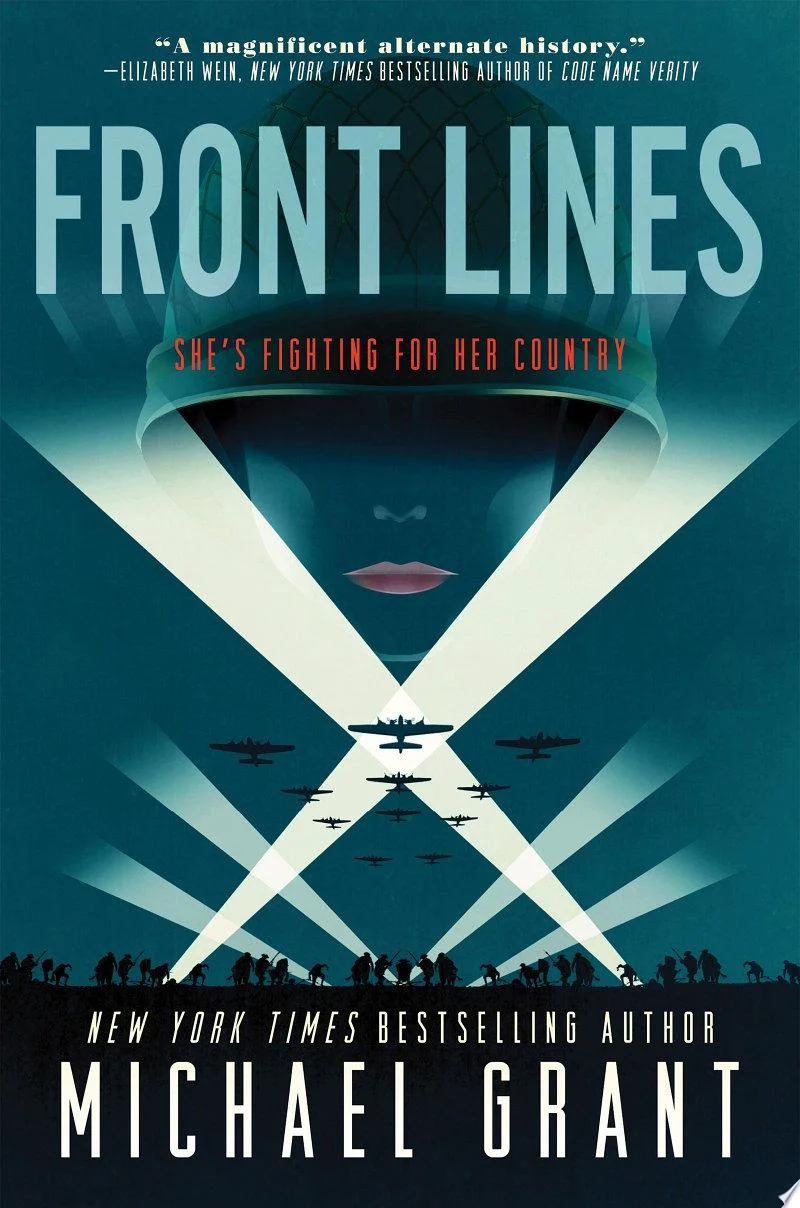
Front Lines
- Publication Date:
- January 26th, 2016
- Publisher:
- HarperCollins
- ISBN-13:
- 9780062342171
- ISBN-10:
- 0062342177
- Pages:
- 219
Why Front Lines Has Been Challenged
Some parents and administrators have argued that its unflinching combat scenes and portrayals of prejudice within the ranks make it too intense for the age group it's marketed to. See more ↓
Challenged or banned in 1 state across 1 school district.
Overview
Michael Grant's Front Lines opens with a single altered fact: in 1942, a court decision makes American women eligible for the draft alongside men. From that premise, Grant builds a version of World War II history that runs parallel to the real one, following three teenage recruits as they leave home for basic training and, eventually, the front.
Rio Richlin enlists to carry on after her sister's death in the fighting; Frangie Marr, who dreams of becoming a doctor, needs the paycheck to support her family; Rainy Schulterman signs up with a much colder motive, wanting to kill the soldiers of the army that is exterminating Jews in Europe. Their paths cross and diverge as they're funneled into a military that isn't built or ready for them.
The novel tracks their transformation from civilians into soldiers, weighing what each of them gains and loses in the process, against the backdrop of a war whose outcome, unlike its premise, isn't up for revision.
A War Novel Built on a Question
Grant is best known for young-adult series built around disaster and survival, and Front Lines channels that same instinct toward extremity into a more grounded setting: the training camps and battlefields of a war that actually happened. The alternate-history conceit isn't decorative. By putting women into combat roles a generation before it happened in reality, the book asks what would have had to change in the army, and in the country, to make room for them — and what would have stayed exactly the same.
That question extends to race and religion as well as gender. Frangie's path intersects with the segregation of the era's armed forces, and Rainy's motivations are shaped by her awareness, as a Jewish American, of what the war is actually being fought to stop. The book treats its three leads as case studies in how different kinds of exclusion operated side by side within a single institution, rather than isolating gender as the sole axis of injustice. It's the first installment of a trilogy, and it has drawn comparisons to other YA war fiction that puts young narrators inside historical atrocity rather than at a remove from it.
Why Front Lines Has Been Challenged
Reviewers have generally credited the novel for its research and for refusing to soften the realities its characters face, but that same commitment to unsparing detail is what has drawn objections in the single school district where the book has been formally challenged. Combat sequences are depicted with graphic violence, and the training-camp chapters include harassment and discrimination directed at the female recruits by their fellow soldiers, sometimes rendered in blunt, ugly language that reflects the period rather than condoning it.
Challengers have also pointed to sexual content and coarse language scattered throughout the book as inappropriate for the younger end of its intended readership. Taken together, these objections center on tone and intensity — whether a war story told this literally belongs in a middle- or high-school library — rather than on any single scene or line, and the book has been the subject of one challenge tracked in this catalog across one state and one district.
Where to Buy




Affiliate links may generate a small commission at no extra cost to you, which helps support this site.
Banned in Schools
Banned or challenged in 1 state across 1 school district.
Florida 1 district
- Escambia County Public Schools Banned pending investigation