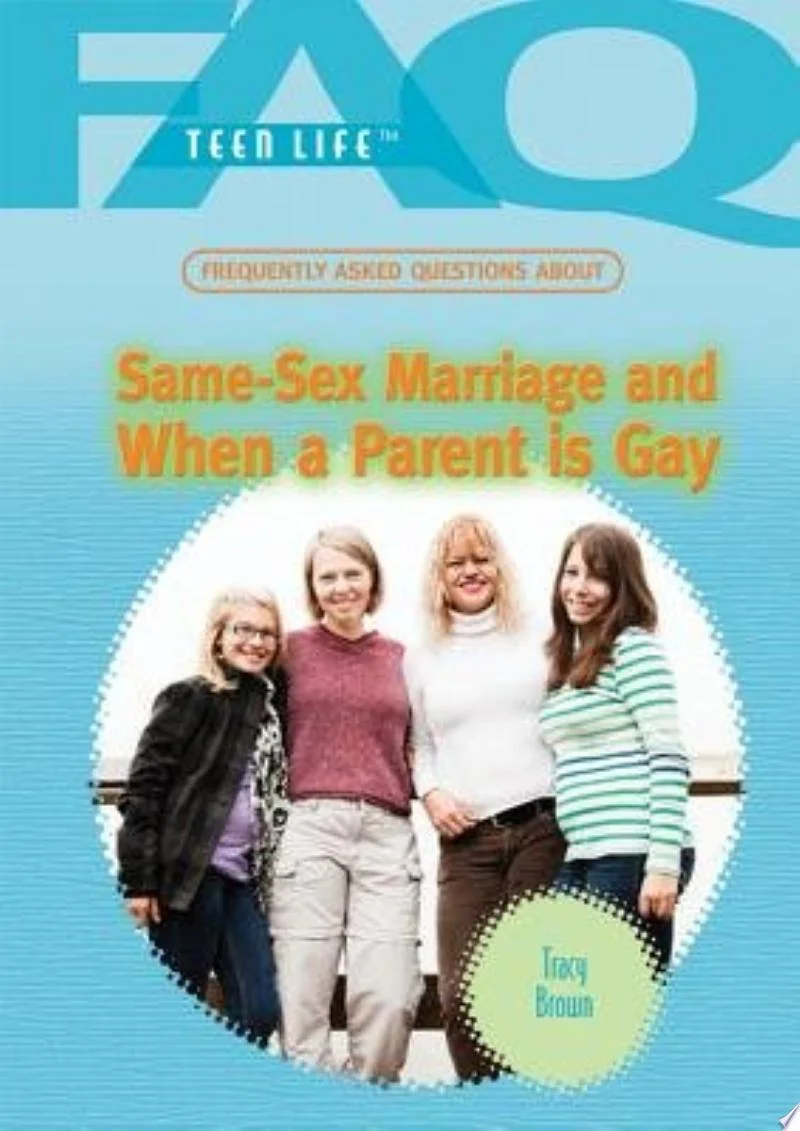
Frequently Asked Questions About Same-Sex Marriage and When a Parent Is Gay
by Tracy Brown
- Publication Date:
- December 15th, 2012
- Publisher:
- The Rosen Publishing Group, Inc
- ISBN-13:
- 9781448883363
- ISBN-10:
- 1448883369
- Pages:
- 66
Why Frequently Asked Questions About Same-Sex Marriage and When a Parent Is Gay Has Been Challenged
Critics have objected less to any single passage than to the book's premise: that a child's questions about a gay parent or same-sex marriage deserve direct, neutral answers rather than silence or moral framing. See more ↓
Challenged or banned in 1 state across 1 school district.
Overview
Tracy Brown's book approaches a subject many young readers encounter long before adults think to prepare them for it: what happens when the debate over same-sex marriage, a near-constant presence in news coverage and political argument, becomes personal. Rather than framing the topic purely as an abstract policy question, the book considers the specific position of a child or teenager whose own family is touched by it, most directly when a parent identifies as gay.
Structured around the kinds of questions young people actually ask, the book works through unfamiliar vocabulary, the mechanics of the legal and social debate, and the emotional terrain of having a parent whose relationship is publicly contested. It acknowledges, without taking sides, that people hold strongly differing views on gay marriage, and it tries to equip readers to make sense of that disagreement rather than resolve it for them.
The tone throughout is explanatory and practical, closer to a reference guide than a narrative. It anticipates confusion, embarrassment, and curiosity alike, treating a young reader's questions as legitimate rather than premature.
Context and Reception
The book belongs to a small but persistent category of young-reader nonfiction built to help children process a parent's sexual orientation and the social controversy surrounding it, written during a period when gay marriage was still being actively contested in courts, legislatures, and ballot measures across the country. That timing shapes the book's project: it was conceived less as a historical or civics lesson and more as a direct response to a live, unsettled public argument that families were living through in real time.
Because it takes no advocacy position and instead presents the dispute as ongoing, the book occupies a middle ground that can draw scrutiny from multiple directions, from those who feel any neutral treatment of gay parenting normalizes it and from those who feel a truly neutral framing understates the stakes for children in LGBTQ+ families. Its place in the broader landscape of family-diversity resources for young readers is defined largely by that attempt to stay descriptive rather than persuasive on a question that few adults discuss dispassionately.
Why Frequently Asked Questions About Same-Sex Marriage and When a Parent Is Gay Has Been Challenged
Discussions of sexual orientation and family structure are the substance of objections to this book. Critics have argued that presenting gay parenthood and same-sex marriage as ordinary, answerable topics for a young audience amounts to endorsing a position on a matter they believe belongs to parents or religious instruction, not a library shelf or classroom collection. Some objectors have specifically contested the book's matter-of-fact tone, arguing that explaining these subjects without moral caveat implicitly validates them.
Other challenges have centered on age-appropriateness, with concerns that children encountering the book may not yet have the context to process debates over marriage law and sexual identity, regardless of how plainly the material is presented. The book has been challenged or restricted in one state and one district tracked in this catalog, reflecting the broader pattern in which materials addressing LGBTQ+ family life draw objections even when, as here, the stated aim is to help children already navigating these questions at home.
Where to Buy


Affiliate links may generate a small commission at no extra cost to you, which helps support this site.
Banned in Schools
Banned or challenged in 1 state across 1 school district.
Iowa 1 district
- Norwalk Community School District Banned pending investigation