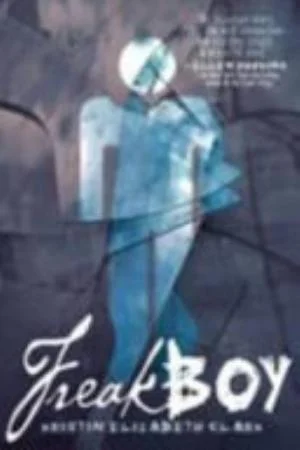
Freakboy
- Publication Date:
- January 1st, 2016
- ISBN-13:
- 9781484498545
- ISBN-10:
- 1484498542
- Pages:
- 448
Why Freakboy Has Been Challenged
A quiet, sympathetic account of a teenage boy questioning his gender has repeatedly run into adults who believe that subject has no place on a school shelf at all. See more ↓
Challenged or banned in 3 states across 3 school districts.
Overview
Kristin Elizabeth Clark's Freakboy follows Brendan Chase, a high school wrestler whose outward life reads like a checklist of teenage success: athletic standing, a devoted girlfriend named Vanessa, a reputation as one of the guys. Clark uses this surface to set up the novel's real subject, which is the private and often frightening experience Brendan has of his own body — moments where he longs for softness, for hair past his shoulders, for a physical self that doesn't match the one he was given.
Told in verse and shifting narration, the novel doesn't offer Brendan easy answers. He has no vocabulary yet for what he's feeling, and much of the book's tension comes from that absence — the fear that there's no name for a boy like him, or worse, that "freak" is the only name available. Clark builds the story around his search for language and community as much as around any single event.
The novel sits alongside a small but growing shelf of young adult fiction that takes gender identity as its central concern rather than a subplot, and it's frequently discussed in that context for the way it renders confusion and self-doubt without rushing toward resolution.
Context and Reception
Freakboy arrived at a moment when YA literature was only beginning to make room for transgender and gender-nonconforming protagonists, and it has often been cited as an early example of a mainstream novel centering a character questioning his gender rather than treating that questioning as background texture. Clark's choice to write Brendan's chapters in verse, interleaved with other perspectives, has drawn attention for how it mirrors the fragmented, incomplete way he understands himself — the form doing some of the emotional work that straightforward prose might flatten.
The book is also notable for refusing to let Vanessa or Brendan's friends function as simple props. Their reactions complicate the story rather than resolve it, which keeps the novel closer to lived uncertainty than to a tidy coming-out arc. That refusal to simplify is part of why the book continues to be assigned and discussed in conversations about gender identity in adolescence, even as the broader landscape of YA fiction on the subject has expanded since its publication.
Why Freakboy Has Been Challenged
Reviewers and educators have often praised Freakboy for treating a difficult subject with restraint and emotional honesty rather than sensationalism, which makes the objections raised against it notable for targeting the very subject matter that critics single out as its strength. The book has been challenged or banned in 3 states and 3 districts tracked in this catalog, and the objections center on its handling of gender identity itself.
Challengers have argued that a novel built around a teenage boy questioning his gender is inappropriate for school libraries and classrooms, framing the content as a matter for parents to introduce rather than a topic for shared reading. Some objections point to passages depicting Brendan's physical and emotional discomfort with his body, treating that material as sexual content rather than as an account of gender dysphoria. Others have challenged the book as part of broader efforts to limit the number of titles addressing transgender identity or gender nonconformity available to students, regardless of how the particular story is told. In most cases, the dispute is less about any single scene than about whether a sympathetic portrayal of a questioning teenager belongs on school shelves at all.
Where to Buy


Affiliate links may generate a small commission at no extra cost to you, which helps support this site.
Banned in Schools
Banned or challenged in 3 states across 3 school districts.
Kentucky 1 district
- Boyle County Schools Banned
Nation 1 district
Texas 1 district
- Katy Independent School District Banned by Restriction