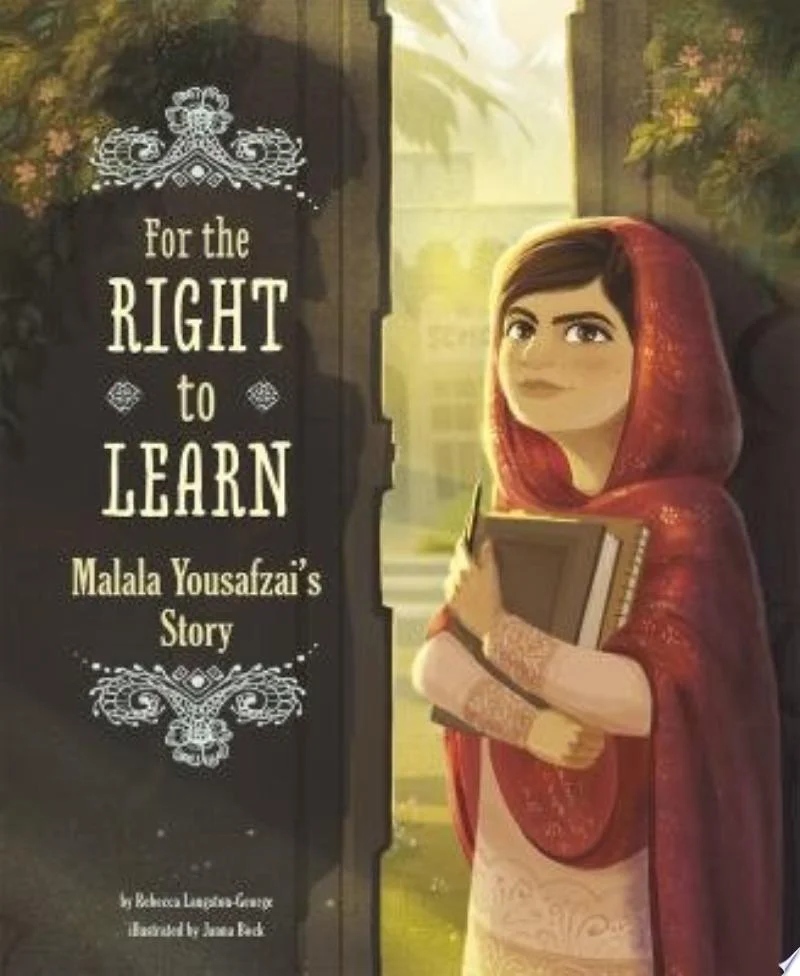
For the Right to Learn: Malala Yousafzai's Story
- Publication Date:
- July 1st, 2016
- Publisher:
- Capstone
- ISBN-13:
- 9781491465561
- ISBN-10:
- 1491465565
- Pages:
- 41
Why For the Right to Learn: Malala Yousafzai's Story Has Been Challenged
Some parents and administrators have questioned whether young readers are ready for a true story built around an act of targeted gun violence against a child. See more ↓
Challenged or banned in 1 state across 1 school district.
Overview
Rebecca Langston-George's book follows Malala Yousafzai from a childhood spent listening to her father debate ideas in their corner of Pakistan's Swat Valley to the moment militant rule closed her school's doors to girls. Rather than treating Malala as a distant symbol, the narrative grounds her activism in the ordinary details of a specific girl who loved to study and refused to accept that her gender should end that chance.
The book does not look away from the violence that followed her defiance: the gunman who boarded her school bus and the gunshot wound she survived. It gives that moment weight without lingering on it for shock value, using it as a hinge between the Malala who spoke up locally and the Malala who, after a long recovery, carried her message to an international audience.
Closing chapters trace her transformation into a public advocate, emphasizing resilience and purpose over spectacle. The result is a compact, chronological account aimed at young readers who may be encountering both girls' education as a human-rights issue and the Taliban as a historical force for the first time.
A Young Reader's Introduction to a Living History
Langston-George's account belongs to a growing shelf of biographical works that bring recent, ongoing world events into children's nonfiction rather than waiting for history to settle into safer distance. Malala Yousafzai's story is unusual among subjects commonly profiled for young audiences in that it involves a living teenager whose activism was still unfolding as the book was written, which gives the narrative an immediacy that more retrospective biographies lack.
That immediacy is also what gives the book its classroom appeal. Teachers have used it to open discussions about education access, gender inequity, and extremism in ways that connect directly to current events coverage students may have already encountered. The book's place within the broader library of Malala-related titles, including her own memoir written for adult and teen readers, positions it as an entry point: a simplified, age-calibrated introduction to a story more fully explored elsewhere.
Its reception has generally framed the book as inspirational nonfiction, part of a tradition of children's literature that uses real courage rather than invented heroics to model perseverance. At the same time, its unflinching subject matter sets it apart from gentler biographical narratives, raising the recurring question of how much real-world danger belongs in books intended for elementary and middle-grade readers.
Why For the Right to Learn Has Been Challenged
The book's account of the attack itself has drawn the most attention: a description of an armed gunman targeting a school bus and shooting a child in the head for speaking publicly about her right to an education. For some parents and administrators, that sequence introduces young readers to real, targeted gun violence more directly than they are prepared to process, regardless of the resilience the story eventually affirms.
A related concern centers on how the book portrays the Taliban and the religious justification the group used for banning girls from school. Because the narrative ties that violence to a specific interpretation of Islamic law, some challengers have worried that young readers, lacking fuller context, could come away with an oversimplified or skewed impression of religion and political extremism in the region.
Underlying both objections is a broader disagreement about readiness: whether grade-school and middle-grade audiences benefit from encountering an unfiltered account of real-world persecution and violence, or whether such material should wait until students are older. According to the records tracked in this catalog, the book has been formally challenged in 1 state and 1 school district.
Where to Buy




Affiliate links may generate a small commission at no extra cost to you, which helps support this site.
Banned in Schools
Banned or challenged in 1 state across 1 school district.
Florida 1 district
- Clay County School District Banned pending investigation