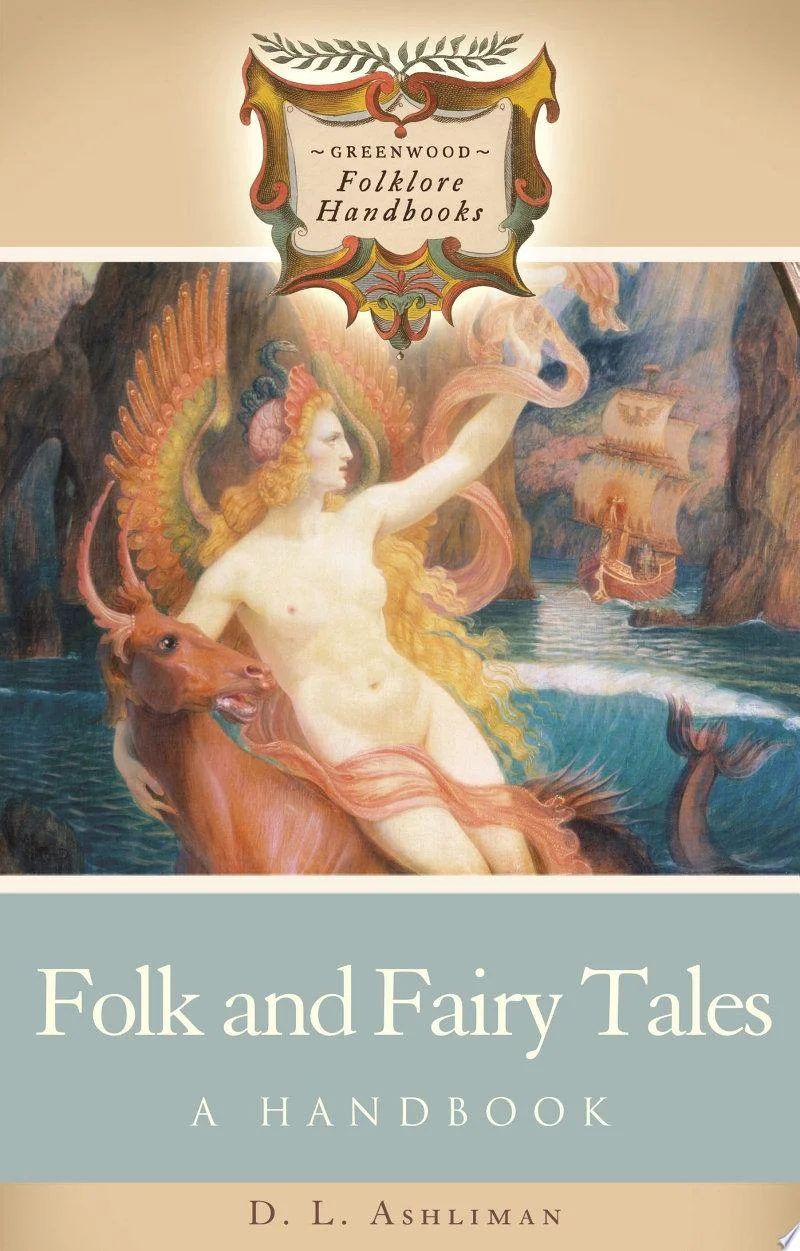
Folk and Fairy Tales
- Publication Date:
- May 30th, 2004
- Publisher:
- Bloomsbury Publishing USA
- ISBN-13:
- 9780313058592
- ISBN-10:
- 0313058598
- Pages:
- 278
Why Folk and Fairy Tales Has Been Challenged
Some readers have balked at a scholarly survey of fairy tales that includes their older, unvarnished forms rather than the softened versions most people grew up with. See more ↓
Challenged or banned in 1 state across 1 school district.
Overview
D. L. Ashliman's handbook approaches folk and fairy tales not as bedtime stories but as objects of study. Rather than retelling familiar narratives, the book maps the terrain around them: how folklorists define the category, how tales are classified into types and motifs, and how a single story migrates across cultures while taking on local shape. Readers encounter tales drawn from a wide range of traditions, chosen to illustrate the analytical points rather than to entertain for their own sake.
The book also tracks the afterlife of these stories once they leave oral tradition. Ashliman surveys how fairy and folk tales resurface in novels, films, visual art, and music, and how each new medium reshapes inherited material to fit contemporary tastes. A closing section reviews the major scholarly schools that have shaped fairy-tale study, giving readers a sense of how interpretation of this material has shifted over time.
Supporting material rounds out the volume: a glossary clarifies the technical vocabulary of folklore studies, and an extensive bibliography points readers toward further reading. The result reads less like a story collection and more like an orientation manual for anyone approaching folklore as a subject rather than as entertainment.
A Reference Built for the Classroom and the Curious Reader
Ashliman writes from within the discipline of folklore studies, and the book reflects a career spent cataloguing and comparing tale traditions. Its intended audience is broad by design: students encountering folklore as a formal subject for the first time, and general readers who have absorbed fairy tales through childhood and pop culture without ever considering how the field studies them. That dual purpose shapes the book's structure, which favors definition and classification over narrative pleasure.
The volume also positions itself within a longer conversation about what fairy tales are for. Rather than treating these stories as fixed or innocent, it presents them as living material that scholars, artists, and audiences continually reinterpret. In doing so, it implicitly pushes back against the assumption that folk and fairy tales are simply children's fare, framing them instead as a genre worth serious, adult critical attention.
Why Folk and Fairy Tales Has Been Challenged
Objections have most often centered on its suitability for high school classrooms and library shelves, where critics have argued that a reference explicitly aimed at students should not linger on the harsher, older versions of tales that circulate before sanitized retellings soften them. Because the book surveys folklore as it actually exists across cultures, rather than the versions adapted for children, some of the examples it analyzes include violence, cruelty, and adult themes that predate modern, cleaned-up adaptations. Critics have described this content as mismatched with the age of readers likely to pull the book from a school shelf, even though the surrounding text treats the material analytically rather than sensationally.
A related strand of objection concerns the book's broader claim that fairy tales deserve serious scholarly treatment rather than being read purely as wholesome children's literature. By presenting these stories through the lens of academic folklore study, complete with variant versions and cross-cultural comparisons, the book exposes readers to renditions of familiar tales that diverge from the versions parents and younger readers may expect. In this catalog, that tension has translated into a modest but real record of challenge, with the title contested in one state and one district.
Where to Buy


Affiliate links may generate a small commission at no extra cost to you, which helps support this site.
Banned in Schools
Banned or challenged in 1 state across 1 school district.