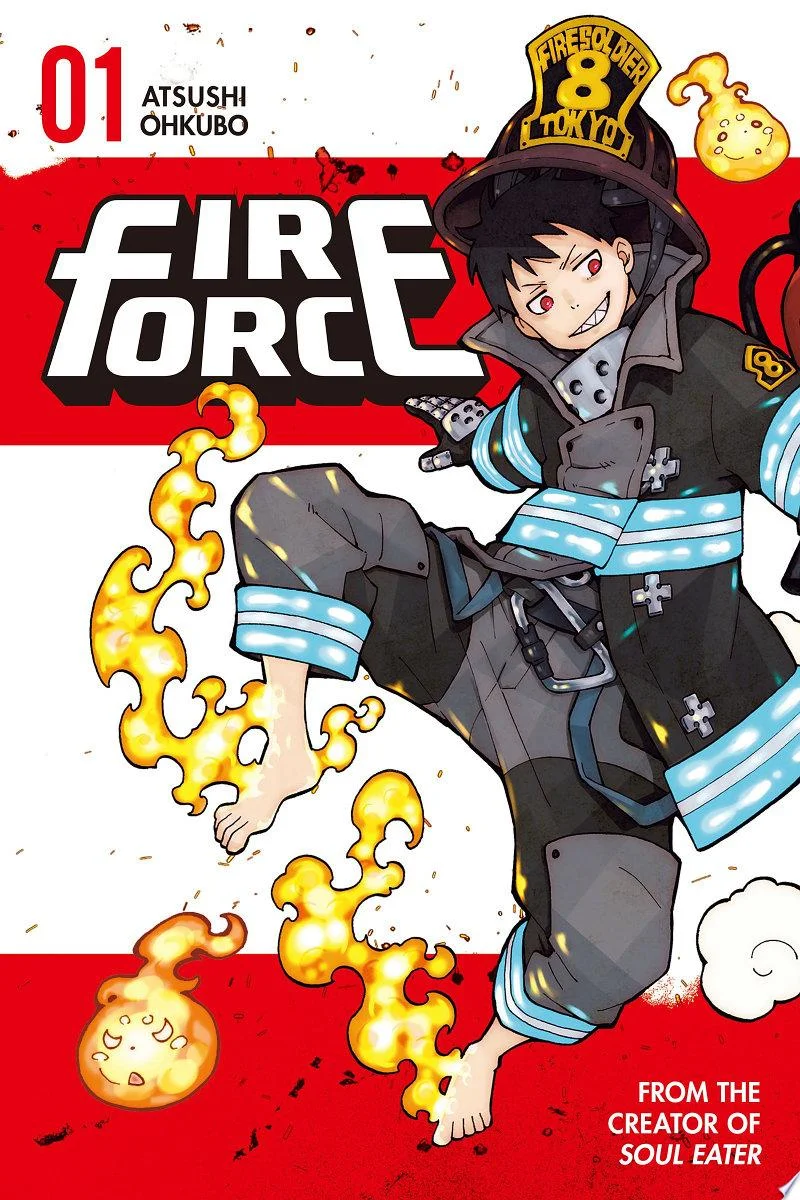
Fire Force
- Publication Date:
- January 1st, 2016
- Publisher:
- Kodansha Comics
- ISBN-13:
- 9781682335116
- ISBN-10:
- 1682335119
- Pages:
- 194
Why Fire Force Has Been Challenged
Objections to Fire Force, tracked in this catalog across 3 states and 4 districts, tend to follow patterns common to action-oriented manga generally: concerns about graphic violence and combat imagery rendered in detailed illustration, and about character designs or panels perceived as sexualized, a recurring flashpoint for manga aimed at teen audiences. See more ↓
Challenged or banned in 3 states across 4 school districts.
Overview
Fire Force is a serialized manga volume from Japanese artist Atsushi Ohkubo, known to English-language readers primarily through his earlier series Soul Eater. Like much of Ohkubo's work, it sits within the action-adventure register of shonen manga, built around striking full-page compositions and a premise organized around fire as both threat and power source.
As a single volume in an ongoing serialized story, the book functions less as a self-contained narrative than as an entry point into a larger illustrated arc, a structure typical of manga publishing, where individual volumes are collected chapters meant to be read in sequence rather than standalone works.
Because the title circulates primarily through graphic-novel and manga sections of library catalogs, its presence in a given collection often says as much about collection-development choices around the format as it does about the specific content of this installment.
Manga in the Library Landscape
Ohkubo's work belongs to a broader wave of Japanese manga that entered American library and school collections over the past two decades, riding the popularity of anime adaptations and a youth readership drawn to the format's visual immediacy. Manga series occupy an unusual place in collection debates: they are frequently shelved alongside prose YA and children's graphic novels, yet their visual conventions, ranging from exaggerated action choreography to stylized character designs, can read very differently from prose fiction to a parent or reviewer skimming a single page out of context.
That gap between how a manga volume is intended to be read (as one chapter of a long-running story, in a visual idiom with its own genre conventions) and how it is often evaluated (as an isolated image or scene) is a recurring feature of the format's reception, and it shapes much of the friction such titles encounter in school and public library settings.
Why Fire Force Has Been Challenged
Objections to Fire Force, tracked in this catalog across 3 states and 4 districts, tend to follow patterns common to action-oriented manga generally: concerns about graphic violence and combat imagery rendered in detailed illustration, and about character designs or panels perceived as sexualized, a recurring flashpoint for manga aimed at teen audiences. Reviewers raising these concerns have typically focused on age-appropriateness for the middle-grade and early-teen readers who make up a large share of manga's audience in school libraries, rather than on thematic or ideological content.
These challenges mirror a wider pattern seen across the manga genre, where the format's visual density means a small number of panels, rather than the overall arc of the story, often become the basis for a formal complaint.
Where to Buy




Affiliate links may generate a small commission at no extra cost to you, which helps support this site.
Banned in Schools
Banned or challenged in 3 states across 4 school districts.
Florida 1 district
- St. John's County School District Banned pending investigation
Tennessee 2 districts
- Oak Ridge Schools Banned
- Rutherford County Schools Banned
Virginia 1 district
- King George County Schools Banned by Restriction