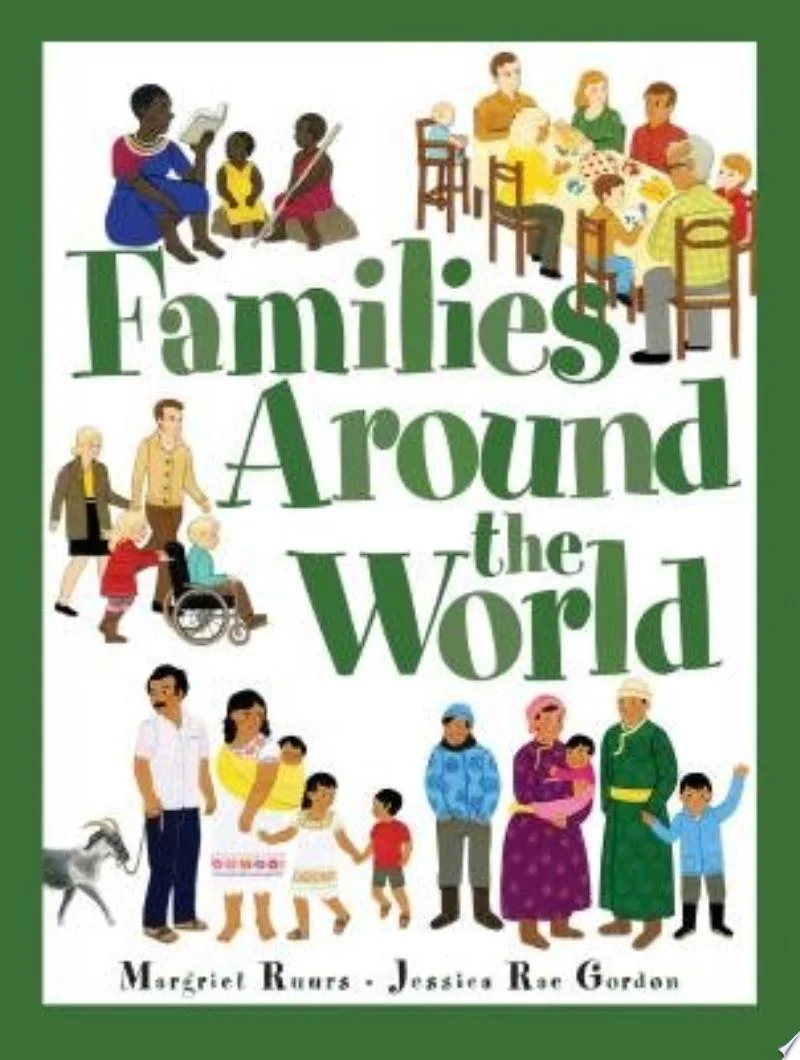
Families Around the World
- Publication Date:
- April 4th, 2017
- Publisher:
- Kids Can Press Ltd
- ISBN-13:
- 9781771388078
- ISBN-10:
- 1771388072
- Pages:
- 44
Why Families Around the World Has Been Challenged
Some parents and administrators have pushed back on this title simply because it treats same-sex parenting as one ordinary family arrangement among many rather than an exception to be flagged. See more ↓
Challenged or banned in 1 state across 1 school district.
Overview
Families Around the World assembles a photo-essay style survey of childhood as it's actually lived in fourteen different households scattered across the globe. Each entry centers on one child, grounding an abstract idea—what makes a family—in a specific kid, a specific home, and a specific daily routine.
The children Margriet Ruurs introduces range widely in circumstance: a girl in the Netherlands raised by two mothers, a boy on an Israeli kibbutz surrounded by an extended community of shared caregivers, a child in South Korea whose parents both work full-time outside the home. The book moves between these vignettes without ranking them, letting each stand as simply one more way people organize care and affection.
Rather than building an argument, the book works by accumulation. By the final page, the variety itself becomes the point: family turns out to be less a fixed template than a pattern that reappears, with variations, everywhere people live.
A Portrait of Family in Its Many Forms
The book belongs to a genre of children's nonfiction built around global comparison, the sort that also covers food, homes, or schools from country to country. Applying that comparative structure to "family" is a quieter move than it first appears, since it treats family composition as a matter of cultural and practical variation rather than a single correct model. A two-mother household sits alongside a kibbutz collective and a dual-career couple with the same descriptive tone applied to each.
That evenhandedness is largely why the book has found a place in classrooms and libraries emphasizing global awareness and inclusion, and also why it has occasionally drawn objection. Its reception reflects a broader, ongoing disagreement in children's publishing over whether a book aimed at young readers should present family diversity as unremarkable fact or should instead frame it as a topic requiring parental context. Ruurs's book, by design, does the former.
Why Families Around the World Has Been Challenged
The entry devoted to Sanne, a child with two mothers in the Netherlands, is the passage most often singled out by people who have raised concerns about the book. The objection isn't to any explicit content—there is none in a book aimed at young readers—but to the placement itself: a same-sex-parent household is presented in the same matter-of-fact register as every other family in the collection, without commentary marking it as different from the rest.
For challengers, that neutrality is the problem. They argue that introducing children to same-sex parenting as an unremarkable fact of life, rather than a subject requiring parental framing, oversteps what a school or library collection should decide on a family's behalf. Supporters of the book counter that its entire structure—fourteen households, none held up as the norm—depends on treating each family the same way, and that singling out one entry for removal would undercut the book's premise. This dispute is reflected in the catalog's tracking of one state and one school district recorded as having formally challenged the title.
Where to Buy




Affiliate links may generate a small commission at no extra cost to you, which helps support this site.
Banned in Schools
Banned or challenged in 1 state across 1 school district.