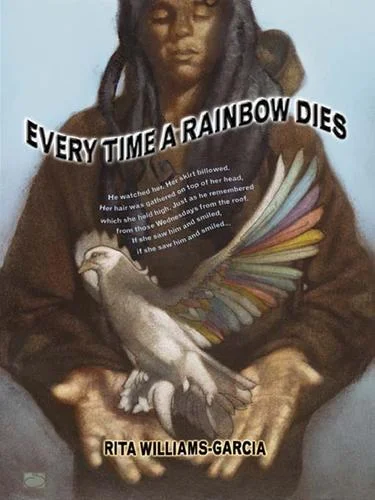
Every time a rainbow dies
- Publication Date:
- January 1st, 2009
- Publisher:
- HarperCollins
- ISBN-13:
- 9780061767128
- ISBN-10:
- 0061767123
Why Every time a rainbow dies Has Been Challenged
Reviewers have pushed back on the book's unflinching account of sexual violence and its aftermath, arguing the material is too disturbing for the shelves where it's typically found. See more ↓
Challenged or banned in 1 state across 1 school district.
Overview
Rita Williams-Garcia's novel centers on Thulani, a Brooklyn teenager who has retreated almost entirely into caring for the rock doves he raises on his rooftop since the death of his mother. His isolation is interrupted when he finds a girl named Ysa in an alley near his home, badly hurt and clearly the victim of a sexual assault.
The encounter gives Thulani his first real reason in years to climb down and re-engage with the world around him. But his growing fixation on Ysa is not met with the same openness in return: she keeps him at a distance, unwilling to let him into the life she is trying to piece back together.
What follows is less a conventional romance than a study of two damaged people circling each other — one trying to recover from violence, the other trying to recover from grief — each uncertain whether the other can actually help.
Trauma, Isolation, and the Weight of Rescue
The novel sits within a tradition of urban coming-of-age fiction that refuses to look away from hardship, pairing it with an intimate character study of loss. Thulani's rooftop pigeons function as more than a hobby; they're the one relationship he could sustain after his mother's death, a controlled and safe substitute for human connection. Ysa's arrival forces a reckoning between that safety and the messier, less controllable work of caring about another person.
The book also resists a tidy rescue narrative. Thulani's desire to help Ysa is genuine, but the story does not grant him easy success or her an easy recovery, and much of its tension comes from the gap between his need to be needed and her need to heal on her own terms. Williams-Garcia, who would go on to write acclaimed middle-grade and young adult fiction exploring family and identity, here takes on heavier, more adult material, examining how trauma reshapes the people nearest to it as much as the person who endured it directly.
Why Every Time a Rainbow Dies Has Been Challenged
A formal challenge brought against the novel centered on its opening depiction of the assault itself, with the complainant arguing that the scene's explicitness went beyond what was necessary to establish the plot and amounted to gratuitous content for a book shelved among young adult titles. That objection reflects the book's single most consistent source of controversy: its direct, unsoftened portrayal of sexual violence and its physical and emotional aftermath.
Related concerns have focused on the broader sexual content and mature themes that run through Thulani and Ysa's relationship, with some readers questioning whether the novel's intended teenage audience should be exposed to material addressing rape so candidly. Records tracked in this catalog show the book has drawn a challenge in one state and one school district, reflecting a narrower but notable pattern of concern compared to more widely banned titles. Defenders of the novel have countered that its frankness serves the story's larger purpose: portraying trauma honestly rather than minimizing its impact for the sake of comfort.
Where to Buy




Affiliate links may generate a small commission at no extra cost to you, which helps support this site.
Also by Rita Williams-Garcia
Banned in Schools
Banned or challenged in 1 state across 1 school district.