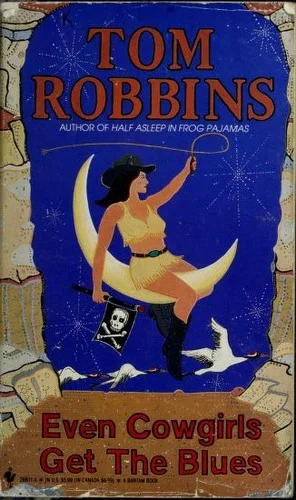
Even Cowgirls Get the Blues
by Tom Robbins
- Publication Date:
- November 1st, 1984
- Publisher:
- Bantam
- ISBN-13:
- 9780553257694
- ISBN-10:
- 0553257692
Why Even Cowgirls Get the Blues Has Been Challenged
Objections to the novel have centered on its explicit treatment of sex and sexuality, including its frank depiction of desire, nontraditional relationships, and the bodily particulars of its characters. See more ↓
Challenged or banned in 1 state across 1 school district.
Overview
Even Cowgirls Get the Blues centers on Sissy Hankshaw, a woman whose extraordinarily large thumbs make her a natural-born hitchhiker and something of a folk legend on America's highways. Her wandering eventually brings her to the Rubber Rose Ranch, a beauty-spa-turned-refuge where a group of young cowgirls has staged a takeover, drawn national attention with their handling of a flock of rare whooping cranes, and set themselves against the expectations of the outside world.
Robbins uses this collision of characters to spin out a sprawling, digressive story that moves between slapstick comedy and philosophical rumination. The FBI, a mystical Japanese counterculture figure, and a cast of eccentrics all orbit the ranch as the narrative considers what it costs to live entirely on one's own terms.
Written in a loose, aphoristic style full of authorial asides, the novel is less concerned with plot mechanics than with voice and ideas, treating Sissy's physical difference and the cowgirls' rebellion as launching points for a broader inquiry into bodies, gender roles, and self-determination.
Freedom as Subject and Style
Published in 1976, the novel arrived as a kind of literary artifact of its era, carrying forward the countercultural preoccupations of the 1960s into a form that is equal parts road novel, satire, and philosophical fable. Its interest in liberation is not limited to plot: Robbins extends the theme to language itself, favoring playful wordplay, extended metaphor, and narrative detours over conventional storytelling discipline. That style has made the book a touchstone of postmodern American fiction, admired for its inventiveness even by readers who find its digressions excessive.
The novel's treatment of the body, particularly through Sissy's physical anomaly and the cowgirls' reclamation of the ranch, has been read as an early and unusually direct engagement with questions of gender, sexuality, and bodily autonomy that later became more common in mainstream fiction. It remains one of Robbins's best-known works and a frequent reference point in discussions of the freewheeling, boundary-testing fiction that emerged from that period.
Why Even Cowgirls Get the Blues Has Been Challenged
Objections to the novel have centered on its explicit treatment of sex and sexuality, including its frank depiction of desire, nontraditional relationships, and the bodily particulars of its characters. Its casual, irreverent handling of drug use has also drawn scrutiny, as has language that some readers have found crude or inappropriate for younger audiences. Critics of the book have generally framed these elements as unsuitable for school settings rather than objecting to the novel's literary ambitions, and the challenges reflect discomfort with content rather than disputes over craft. In the catalog tracked here, the novel has been challenged in 1 state and 1 school district.
Where to Buy




Affiliate links may generate a small commission at no extra cost to you, which helps support this site.
Banned in Schools
Banned or challenged in 1 state across 1 school district.