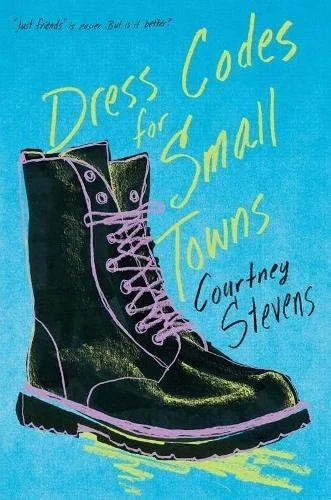
Dress Codes for Small Towns
- Publication Date:
- October 16th, 2018
- Publisher:
- HarperTeen
- ISBN-13:
- 9780062398529
- ISBN-10:
- 0062398520
- Pages:
- 368
Why Dress Codes for Small Towns Has Been Challenged
At the heart of the pushback is discomfort with placing a questioning, queer teenage protagonist in a small-town, church-centered setting that some readers feel should model more conventional expectations. See more ↓
Challenged or banned in 1 state across 1 school district.
Overview
Billie McCaffrey has spent her whole life inside a six-person friend group known around town as the Hexagon, in a Kentucky community small enough that everyone's business is everyone's business. She is a preacher's kid, a tomboy, and a known quantity to her neighbors — until the ground under that identity starts to shift.
Over the course of a single eventful season, Billie finds herself re-examining a friendship that may be something more, questioning assumptions she and everyone around her have made about her sexuality, and reckoning with a grief that has never fully loosened its grip. A town-wide clothing drive, staged as a kind of public performance, becomes the backdrop against which old loyalties fray and new truths surface.
Courtney Stevens keeps the lens tight on Billie's interior life, letting the discomfort of not having the right words yet for what she feels sit alongside the ordinary noise of friend-group drama, family expectation, and small-town ritual.
Belonging, Identity, and the Weight of a Small Town
The novel's title points to its central tension: small towns run on unwritten codes about how people are supposed to dress, behave, date, and believe, and Billie's story is built around the friction of not fitting neatly into any of them. Her questioning of her own sexuality unfolds not in isolation but inside a web of family, church, and friendship that has specific expectations for who she is allowed to become.
Stevens, whose earlier novels Faking Normal and The Lies About Truth also center teenage girls working through trauma and self-definition in close-knit communities, extends that preoccupation here into questions of gender presentation and queerness. The book has been noted by reviewers and library professionals as a rare entry in YA literature that pairs an openly questioning protagonist with a sincere, unresolved relationship to faith, rather than treating religion and queerness as simple opposites.
Grief runs underneath the plot as well, shaping how Billie relates to risk, intimacy, and the people she trusts enough to let see her clearly. That combination — faith, loss, and emerging identity, all set against the social machinery of a town where everyone already thinks they know her — has made the novel a frequently recommended title in discussions of contemporary YA that takes rural and religious settings seriously rather than treating them as obstacles to be escaped.
Why Dress Codes for Small Towns Has Been Challenged
A recurring complaint raised against the novel centers on a school board member's concern that a book depicting a teenage girl questioning her sexual orientation has no place on a shelf accessible to younger students, regardless of how the subject is handled. Related objections have focused on the novel's frank treatment of same-sex attraction and gender nonconformity, with some parents arguing that normalizing those questions for adolescent readers conflicts with their own values or their community's expectations for what a small-town setting should model.
Other challenges have pointed to candid discussion of sexuality and physical attraction more broadly, arguing that the material is too mature for the middle and early high school readers who make up much of the book's audience. According to records tracked in this catalog, the novel has been formally challenged or restricted in 1 state and 1 school district, reflecting a narrower but still notable pattern of objection tied specifically to its LGBTQ content and coming-of-age frankness rather than to violence, language, or other commonly cited concerns.
Where to Buy


Affiliate links may generate a small commission at no extra cost to you, which helps support this site.
Banned in Schools
Banned or challenged in 1 state across 1 school district.
Iowa 1 district
- Clear Creek-Amana Community School District Banned pending investigation