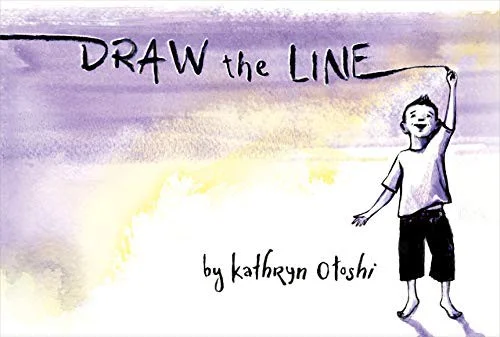
Draw the line
- Publication Date:
- September 21st, 2021
- Publisher:
- Square Fish
- ISBN-13:
- 9781250822710
- ISBN-10:
- 1250822718
- Pages:
- 48
Why Draw the line Has Been Challenged
Objections to picture books built around ambiguous, symbolic imagery often center on how that ambiguity gets interpreted rather than on any explicit content, and concerns raised about this title have followed that pattern, with some readers questioning the intent behind the boys' interaction once their lines cross. See more ↓
Challenged or banned in 1 state across 1 school district.
Overview
Draw the Line tells its entire story without a single word. Kathryn Otoshi builds the book around a simple visual premise: two boys, each drawing a line of his own, discover that their marks can meet and become something shared. The pictures alone carry the momentum, letting line, gesture, and color stand in for dialogue.
What begins as an act of individual creativity turns into a collaboration, and the drawn lines take on a playful, almost animate energy as the two figures build on each other's marks. The book leans on readers to interpret motion and emotion purely through the shifting shapes on the page.
That harmony doesn't last. A small mistake causes the lines to tangle, and the story pivots from connection to conflict, tracking how the same simple medium that brought the boys together can just as easily come between them.
Reading a Story Without Words
Wordless picture books ask something different of readers than conventional narratives: meaning has to be inferred from sequence, gesture, and visual metaphor rather than stated outright. Otoshi's use of drawn lines as both subject and storytelling device is well suited to this approach, letting abstract shapes function as stand-ins for friendship, cooperation, and rupture. The book sits within a body of picture-book work, including Otoshi's other titles, that uses minimal, symbolic visual elements to explore social and emotional dynamics for young readers.
Because it has no fixed text, the book also invites open-ended discussion; a caregiver or teacher reading it aloud must supply their own narration, which makes it a common tool in classrooms and counseling settings for talking through disagreement, misunderstanding, and repair between peers.
Why Draw the Line Has Been Challenged
Objections to picture books built around ambiguous, symbolic imagery often center on how that ambiguity gets interpreted rather than on any explicit content, and concerns raised about this title have followed that pattern, with some readers questioning the intent behind the boys' interaction once their lines cross. The book's brevity and wordlessness leave the resolution of the conflict largely to visual suggestion, which has made it a target for differing interpretations of what the story is depicting. In the catalog tracked here, the title has been challenged in 1 state and 1 district, reflecting how even a spare, dialogue-free format can draw scrutiny when its imagery is read as carrying meaning beyond simple conflict and reconciliation between friends.
Where to Buy


Affiliate links may generate a small commission at no extra cost to you, which helps support this site.
Banned in Schools
Banned or challenged in 1 state across 1 school district.
Iowa 1 district
- Alta-Aurelia Community Schools Banned pending investigation