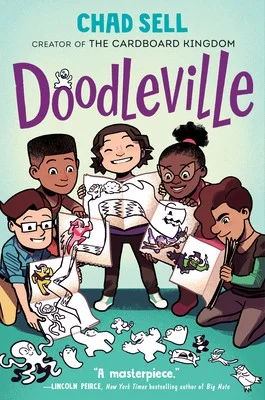
Doodleville
by Chad Sell
- Publication Date:
- January 1st, 2020
- Publisher:
- Random House Children's Books
- ISBN-13:
- 9781984894717
- ISBN-10:
- 1984894714
- Pages:
- 288
Why Doodleville Has Been Challenged
Much of the pushback against this title has less to do with its plot than with discomfort over graphic novels as a format being taken seriously in elementary and middle school collections. See more ↓
Challenged or banned in 2 states across 2 school districts.
Overview
Doodleville is a graphic novel by Chad Sell built around a simple, playful premise: a young artist's sketches don't stay on the page. What begins as an ordinary act of drawing turns into something stranger and more consequential once the doodles take on a life of their own.
The book leans heavily on its visual format, using sequential art to let imagination spill off the panel in ways prose alone couldn't easily capture. Sell, who works primarily as a cartoonist and illustrator, frames the story around a classroom-age cast navigating a problem they created themselves and now have to manage.
It reads as an all-ages adventure rather than a message-driven text, pairing lighthearted art with a plot that asks what happens when creative work escapes the control of the person who made it.
Imagination, Authorship, and the Limits of Control
At its core, Doodleville is preoccupied with the relationship between a maker and what they make. The central conceit — drawings that act independently of the artist's intentions — gives the book room to explore ideas about accountability, collaboration, and the gap between imagining something and being able to manage its consequences, all through the accessible lens of a children's graphic novel.
That framing places the book within a broader wave of contemporary middle-grade graphic novels that use visual storytelling to address emotional and social growth without relying on dense text. Its appeal to young, often reluctant readers is tied directly to this format: the art carries narrative weight that a prose-only version of the same story would need many more words to convey.
Why Doodleville Has Been Challenged
In at least one case, a parent complaint centered on whether the book's content and imagery were appropriate for the age group shelving it, arguing that graphic novels aimed at younger readers deserve the same scrutiny given to prose titles even when the material in question is largely visual rather than textual. Reviewers raising concerns have pointed to specific panels or character moments as needing a second look before the book stays on an elementary or middle school shelf.
Much of the broader debate around Doodleville reflects a pattern seen with other illustrated and graphic-format books for young readers: because the medium conveys meaning through images as much as words, a single frame can become the focus of a challenge in a way a comparable line of prose might not. Critics have also questioned whether a book with a lighthearted premise is being read carefully enough by adults making shelving decisions, versus being flagged based on a cursory skim of its artwork. The book has been the subject of challenges in 2 states and 2 school districts tracked in this catalog, consistent with the wider trend of graphic novels facing disproportionate scrutiny in school and library collections.
Where to Buy




Affiliate links may generate a small commission at no extra cost to you, which helps support this site.
Banned in Schools
Banned or challenged in 2 states across 2 school districts.
Florida 1 district
- Clay County School District Banned pending investigation
Kentucky 1 district
- Boyle County Schools Banned