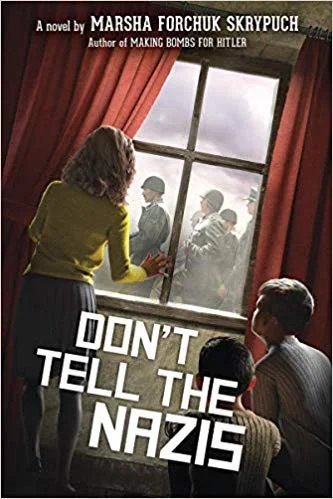
Don't Tell the Nazis
- Publication Date:
- January 1st, 2019
- Publisher:
- Scholastic, Incorporated
- ISBN-13:
- 9781338310542
- ISBN-10:
- 1338310542
- Pages:
- 240
Why Don't Tell the Nazis Has Been Challenged
Some parents and administrators have questioned whether a book this frank about ghettoization, betrayal, and wartime killing belongs in the hands of the middle-grade readers it's aimed at. See more ↓
Challenged or banned in 1 state across 1 school district.
Overview
Marsha Forchuk Skrypuch's novel opens in a Ukrainian village in 1941, a place already worn down by years of harsh Soviet control. When German forces arrive and push the Soviets out, many villagers greet them as liberators, allowing themselves to imagine that daily life might finally ease.
That hope curdles quickly. Krystia's classmate Dolik, who is Jewish, senses before almost anyone else that the new occupation will be no kinder than the last — and in fact far more dangerous. The narrative follows Krystia as she watches her town's Jewish residents singled out, blamed for crimes they had no part in, and ultimately confined to a ghetto.
As the danger closes in on Dolik's family, Krystia is pulled from the role of bystander into one of active risk-taking, searching for a way to keep her friends hidden and alive. The book frames her choices as a child's-eye reckoning with complicity, fear, and the limits of what one person can do.
A Child's View of Occupation and Moral Choice
Skrypuch's book belongs to a body of World War II fiction written for younger readers that resists a simple liberator-versus-oppressor storyline. By starting under Soviet occupation and then tracking the arrival of the Nazis, the novel complicates the idea that any single invading power could be a straightforward rescuer, and it uses that complication to show how quickly a population's relief can turn into fear once persecution begins in earnest.
The story also sits within Skrypuch's broader body of work, which frequently centers Ukrainian history and the experiences of children caught inside it — subject matter that has historically received less attention in English-language children's literature than other World War II narratives. By pairing Krystia's Ukrainian village life with Dolik's Jewish family's persecution, the book asks young readers to consider bystander behavior, neighborly loyalty, and the costs of both action and inaction, rather than presenting the war as a distant backdrop to a single hero's arc.
Why Don't Tell the Nazis Has Been Challenged
The passages depicting the Nazis' scapegoating of Jewish residents, the forced confinement into a ghetto, and the violence that follows are central to the book's objections. Because the novel does not soften these events for its intended middle-grade audience, some adults reviewing the book have argued that its descriptions of persecution and killing are too intense or disturbing for the age group most likely to pick it up.
Other concerns raised center on the broader appropriateness of introducing Holocaust-era atrocity and ethnic scapegoating to younger readers at all, separate from any specific scene, reflecting discomfort with exposing children to historical cruelty rather than a single incident in the text. Still others have questioned whether the book's unflinching treatment of betrayal and fear, even when handled through a child narrator, is suited to classroom or library shelves for this age range. In the catalog tracked here, the book has drawn a challenge in 1 state and 1 district.
Where to Buy




Affiliate links may generate a small commission at no extra cost to you, which helps support this site.
Banned in Schools
Banned or challenged in 1 state across 1 school district.
Florida 1 district
- St. John's County School District Banned by restriction