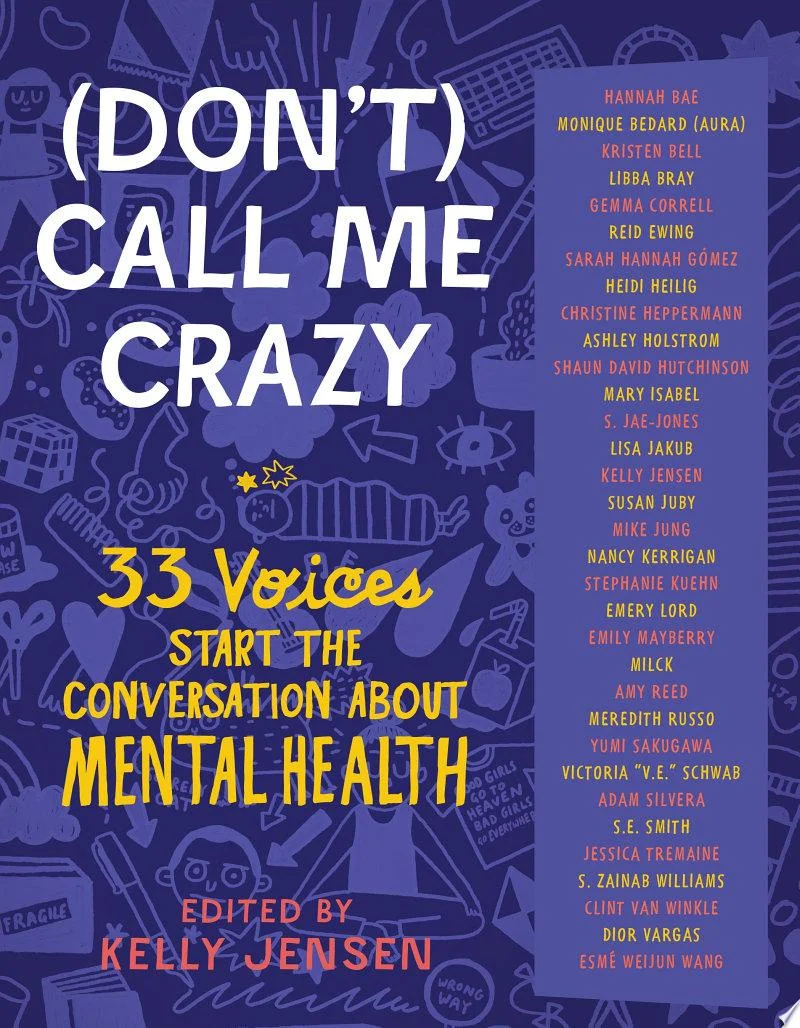
(Don't) Call Me Crazy
by Kelly Jensen
- Publication Date:
- October 2nd, 2018
- Publisher:
- Little, Brown Books for Young Readers
- ISBN-13:
- 9781616208745
- ISBN-10:
- 1616208740
- Pages:
- 344
Why (Don't) Call Me Crazy Has Been Challenged
Objections to this title center on its direct, first-person treatment of mental illness, self-harm, and related psychological distress, subject matter that some challengers argue is too candid or too clinically unfiltered for younger readers to encounter without adult mediation. See more ↓
Challenged or banned in 1 state across 1 school district.
Overview
(Don't) Call Me Crazy gathers thirty-three contributors — actors, athletes, writers, and visual artists — into a single anthology built around one deceptively simple question: what does it mean to be called crazy? Editor Kelly Jensen assembles essays, comics, illustrated lists, and short reflections rather than a single sustained narrative, giving the book a mosaic quality where each voice stands on its own.
The contributors write from a range of vantage points, describing their own encounters with mental illness alongside broader reflections on how mental health is discussed, misunderstood, or avoided altogether in everyday life. The mixed-media format — prose sitting alongside illustration and comic panels — keeps the book from settling into a single register, moving between the personal and the more clinical or explanatory.
Rather than offering a diagnosis-by-diagnosis survey, the collection circles back repeatedly to language: how a word like "crazy" can be worn as an insult, reclaimed as a badge, or simply used loosely to describe anything from passion to distress. That ambiguity is treated as the book's organizing tension rather than a problem to be resolved.
Language, Identity, and the Anthology Form
What the book is ultimately interested in is less a set of facts about psychiatric conditions than the vocabulary surrounding them, and who gets to control it. By putting well-known figures alongside lesser-known writers, the anthology suggests that mental health experience cuts across fame, achievement, and public image, complicating any assumption that struggle is rare or hidden among people who otherwise appear successful.
The anthology form itself does real work here: because no single contributor is asked to speak for "mental illness" as a whole, the book resists offering one tidy takeaway. Instead it models the kind of open, multi-voiced conversation its introduction calls for, treating disagreement and variation among contributors as evidence for its central claim that there is no single template for what it means to be "crazy." This positions the book within a broader wave of anthology-format young adult nonfiction from the same editor, which favors plurality of voice over a single authoritative narrator.
Why (Don't) Call Me Crazy Has Been Challenged
Objections to this title center on its direct, first-person treatment of mental illness, self-harm, and related psychological distress, subject matter that some challengers argue is too candid or too clinically unfiltered for younger readers to encounter without adult mediation. Because several essays describe personal crises in unguarded detail, critics have also raised concerns about whether the book normalizes or, alternatively, sensationalizes the experiences it depicts. Others have objected to the book's casual, reclaiming use of stigmatizing language around mental illness, arguing that even a critical or ironic use of such terms risks reinforcing them. In the catalog tracked here, the title has drawn a single challenge each at the state and district level, reflecting a narrower but still notable pattern of concern focused specifically on its handling of mental health as a subject for teen readers.
Where to Buy


Affiliate links may generate a small commission at no extra cost to you, which helps support this site.
Banned in Schools
Banned or challenged in 1 state across 1 school district.
Florida 1 district
- Clay County School District Banned pending investigation