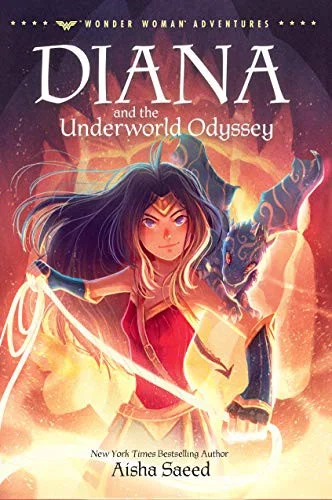
Diana and the Underworld Odyssey
by Aisha Saeed
- Publication Date:
- May 25th, 2021
- Publisher:
- Random House Books for Young Readers
- ISBN-13:
- 9780593178379
- ISBN-10:
- 0593178378
- Pages:
- 352
Why Diana and the Underworld Odyssey Has Been Challenged
Some parents and reviewers have argued that a child-aimed story built around the land of the dead, however mythic its framing, exposes young readers to themes of mortality and an alternate afterlife before they're ready for them. See more ↓
Challenged or banned in 1 state across 1 school district.
Overview
Diana and the Underworld Odyssey sends its young heroine on a descent into the land of the dead, a structure as old as storytelling itself and one that Aisha Saeed reshapes for a contemporary middle-grade audience. Rather than treating the underworld as mere spectacle, the novel uses it as the stage for Diana's growth, forcing her to rely on wit, loyalty, and resolve rather than any single heroic gift.
The novel sits comfortably within the wave of mythology-driven adventure fiction aimed at younger readers, where ancient figures and settings are refitted with contemporary pacing and emotional stakes. Diana's journey unfolds as a series of trials and encounters that test what she values and whom she is willing to risk everything for.
Saeed, known for grounding fantastical or high-concept premises in recognizable emotional truths, brings that same instinct here, keeping the underworld setting vivid without losing sight of a young protagonist's interior life.
Framing a Journey to the Underworld for Young Readers
Stories of descent into the underworld occupy a distinct place in the literary tradition, from Persephone's abduction to Orpheus's failed rescue to Aeneas's visit to the shades of the dead. Each version uses the underworld differently, but nearly all treat it as a crucible: a place where the living confront loss, mortality, and what they are prepared to sacrifice. By casting a girl named Diana as its traveler, the book joins a broader trend of middle-grade fiction that reclaims mythic journeys for protagonists who have traditionally been sidelined in the old epics, letting a young heroine take the lead role usually reserved for warriors and kings.
That reclamation is part of why mythology retellings have found such a durable audience among younger readers in recent years. They offer a familiar architecture, heroes, trials, a return home, while making room for different voices and different kinds of courage. In Diana's case, the underworld setting also allows the book to approach difficult subjects like death and grief at a remove, through metaphor and adventure rather than direct realism, which is often how middle-grade fiction chooses to introduce young readers to weighty themes.
Why Diana and the Underworld Odyssey Has Been Challenged
Mythology retellings for young readers are usually praised for making ancient material feel urgent and emotionally honest, giving children a safe, story-shaped way to think about death, courage, and loss. Yet that same subject matter is precisely what draws objections when the setting is the land of the dead itself. The book has been formally challenged in 1 state and 1 district tracked in this catalog, and the objections that drive such challenges tend to center on the underworld as a setting, with complaints that depicting death, spirits, or an afterlife realm for a child audience is too dark or frightening regardless of the mythic framing.
A second recurring thread in objections to this kind of material concerns its classical, pre-Christian cosmology. Some challengers argue that presenting gods, an underworld, and rules governing the dead as a coherent narrative world, even one clearly framed as myth and adventure, risks normalizing belief systems or imagery that conflict with a family's own religious teaching about death and the afterlife. Taken together, these objections say less about any particular scene in the book than about discomfort with introducing mortality and myth-based cosmology to children at all, a tension that has followed underworld narratives since long before this particular retelling.
Where to Buy



Affiliate links may generate a small commission at no extra cost to you, which helps support this site.
Banned in Schools
Banned or challenged in 1 state across 1 school district.
Florida 1 district
- Clay County School District Banned pending investigation